Home Buying · Due Diligence
A 40-page report full of “deficiencies” can panic any buyer. The skill is telling the cosmetic nitpicks from the few findings that should actually change your decision.
The home inspection report arrives, and it’s terrifying. Forty, fifty, sometimes seventy pages, packed with red-highlighted items, photos of corrosion and cracks, and ominous words like “deficiency,” “deteriorated,” and “recommend evaluation by a licensed professional.” First-time buyers read it and want to run. Experienced buyers read the exact same report and calmly sort it into two piles: the small stuff that comes with owning any house, and the handful of findings that genuinely matter. That sorting ability is the whole game, because almost every house, even a brand-new one, generates a long list of issues, and panicking at the length is how buyers either walk away from good homes or fixate on a leaky faucet while missing the cracked foundation.
This guide explains what the report actually is, how to read it without losing your nerve, and which findings are the true deal-killers worth negotiating hard over, requesting specialist evaluation for, or walking away from entirely.
What the report is, and isn’t
Understanding the scope keeps you from over- or under-reacting. A home inspection is, in the words of InterNACHI’s Standards of Practice, a non-invasive, visual examination of the accessible areas of a home, designed to identify material defects observed on the day of the inspection. Read that carefully, because every clause matters. “Non-invasive and visual” means the inspector doesn’t open walls, dig up the yard, or take things apart; they report what they can see. “Accessible areas” means a blocked crawlspace or a buried tank may simply not be evaluated. And “on the day of the inspection” means it’s a snapshot, not a prediction; the report explicitly does not forecast future conditions or guarantee anything won’t break next week.
Just as important is what it’s not. It’s not a pass/fail test; there’s no “passing score.” It’s not a code-compliance inspection, an appraisal, or a warranty. It won’t catch everything, since hidden defects behind walls or under floors can escape a visual exam. The report is a tool to inform your decision, not a verdict, and treating it as a list of demands to “make the seller fix everything” misunderstands its purpose. You’re looking for the serious, expensive, or dangerous, not perfection.
How to read it without panicking
Start by accepting that the length is normal and largely irrelevant. A thorough inspector documents everything, including trivia, because that’s their job and their liability protection. A long report often just means a diligent inspector, not a doomed house. So don’t count the items; weigh them. For each finding, ask three questions: Is it a safety hazard? Is it structurally or system-critical? And what would it actually cost to fix? A missing outlet cover and a failing foundation both appear as “deficiencies,” but one is a five-dollar afternoon fix and the other is a five-figure deal-killer.
Most reports flag a mix of cosmetic issues, ordinary deferred maintenance (worn caulk, a dirty filter, minor settling cracks), minor safety items that are cheap to correct, and, occasionally, the big-ticket problems. Your attention belongs almost entirely on that last category. A good inspector or your agent can help you triage, but the framework, safety, structure, system, cost, lets you do most of it yourself.
The red flags that actually kill deals
These are the findings that warrant real concern, specialist follow-up, hard negotiation, or walking away. They share a common trait: they’re expensive, dangerous, or both, and they involve the bones and major systems of the house rather than its surfaces.
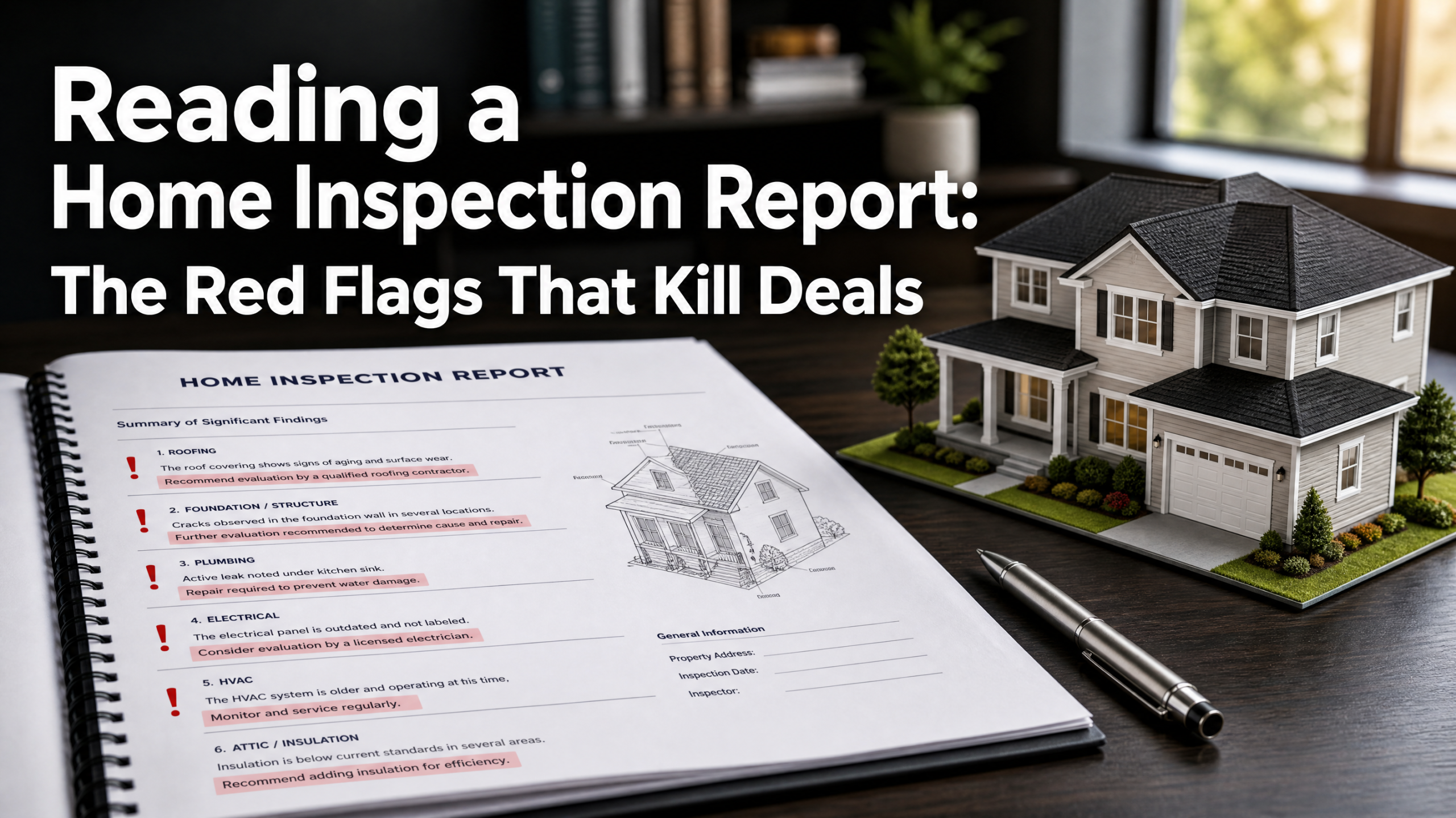
Foundation and structural issues. Large or growing cracks, bowing walls, uneven or sloping floors, and doors that won’t close can signal structural movement. Repairs run from significant to enormous, and serious cases should be evaluated by a structural engineer, not just the inspector.
A roof at the end of its life. Roofs are expensive. A report noting widespread deterioration, multiple layers, active leaks, or a roof near the end of its service life means a major near-term cost you must price in.
Major electrical problems. Outdated or hazardous wiring, certain problem-prone panels, overloaded or improperly modified systems, and widespread safety issues can be costly and dangerous. Electrical fire risk is not something to wave off.
Serious plumbing issues. Aging or failure-prone pipe materials, major leaks, sewer-line problems, or a failing water heater can mean large bills and water damage. A compromised main sewer line in particular can be a brutal surprise.
HVAC at end of life or unsafe. An old furnace or air conditioner near replacement, or a furnace with a suspected cracked heat exchanger (a carbon-monoxide concern), is both a safety and a cost issue.
Water intrusion, moisture, and mold. Evidence of basement seepage, chronic moisture, or mold points to drainage or envelope problems that can be expensive and persistent, and mold can be a health concern.
Two more deserve mention because they’re often handled separately. Pests and wood-destroying organisms (termites, carpenter ants) are frequently a distinct inspection, and active infestation or structural damage is a serious finding. And environmental hazards, radon, asbestos, and lead-based paint, are common in older homes and may require their own testing; these aren’t always in a general report but matter to your decision and your health.
The scary-looking stuff that usually isn’t
Counterbalancing the red flags is a long list of findings that read alarmingly but are minor in reality. Missing GFCI outlets in kitchens and bathrooms sound like a safety failure (and technically are) but are an inexpensive fix. Worn caulk, a running toilet, a few cracked tiles, a missing smoke detector, a loose railing, peeling exterior paint, hairline settling cracks, dirty HVAC filters, and “improper” but harmless prior repairs all generate official-sounding language and red highlighting while costing little to remedy. A house full of these and nothing major is, in fact, a house in decent shape. Don’t let the volume of small items distract you from the fact that the big systems are sound, and don’t blow up a good deal over a punch list of cheap repairs you could knock out in a weekend.
What to do when you find a real red flag
A serious finding isn’t automatically a reason to run; it’s a reason to dig deeper and respond strategically. First, get a specialist evaluation. The general inspector flags the symptom (“recommend evaluation by a structural engineer / licensed electrician / roofer”), and that specialist tells you the real scope and cost. A scary-sounding foundation note sometimes turns out to be minor, and sometimes turns out to be worse than feared; you need the specialist’s number before you decide.
Armed with real costs, you have options. You can negotiate, asking the seller to repair the issue, credit you the cost, or reduce the price. You can proceed with eyes open if you’re comfortable handling it. Or, if the problem is severe enough or the seller won’t budge, you can walk away, which is exactly what the inspection contingency in most purchase contracts protects your right to do. That contingency, the window during which you can review the inspection and back out or renegotiate without losing your earnest money, is one of the most important protections you have as a buyer. The whole point of the inspection is to let you make an informed choice while you still can.
Choose your own inspector, and go to the inspection
Two practical points that improve everything that follows. First, hire your own inspector rather than simply taking whoever the seller’s agent suggests. You want someone working for you, with no incentive to soft-pedal problems that could threaten the sale. Look for a qualified, experienced inspector who follows recognized standards, and check reviews and credentials.
Second, attend the inspection if you possibly can. Walking the house with the inspector for a few hours is worth more than the written report alone, because you can ask questions in real time, see the issues with your own eyes, and learn the difference between “this is normal wear” and “this concerns me” directly from the person evaluating it. An inspector pointing at a panel and explaining why it worries them teaches you more than a paragraph ever will, and it helps you calibrate the written report’s alarming language against reality. You’ll also pick up a working knowledge of the home’s systems, where the shutoffs are, what needs maintenance, that pays off long after closing.
When to order a specialized inspection
The general home inspection is a broad, visual overview, and by design it doesn’t go deep on everything. When it flags something serious, or when the property has particular features, a specialized inspection is the right next step, and it’s money well spent relative to the risk. Common ones include a sewer line camera scope (a small camera run through the main sewer line to find cracks, root intrusion, or collapse, problems that are invisible from inside the house but extremely expensive to fix), a structural engineer’s evaluation for foundation concerns, a licensed electrician or roofer for issues in their domain, a dedicated termite or wood-destroying-organism inspection, and tests for radon, mold, asbestos, or lead in older homes.
The pattern to internalize: the general inspector is a generalist who tells you where to look harder. When they recommend evaluation by a specialist, take it seriously rather than treating it as boilerplate, because that recommendation often points exactly at the kind of finding that becomes a five-figure problem if ignored. A few hundred dollars on a sewer scope or an engineer’s letter can reveal whether a “maybe” finding is a minor note or a deal-breaker, and that knowledge is precisely what lets you negotiate or walk with confidence.
Bottom line
Don’t read a home inspection report as a verdict or a list of demands; read it as a triage exercise. Every house has issues, so weigh each finding by safety, structural or system impact, and real cost. The true deal-killers are foundation, roof, major electrical and plumbing, end-of-life or unsafe HVAC, and water intrusion, plus pests and environmental hazards. For those, get a specialist’s evaluation and use your inspection contingency to negotiate or walk. Let the cheap, cosmetic items be what they are: the normal price of owning a home.
Frequently asked questions
Does a long inspection report mean the house is bad?
Not necessarily. Thorough inspectors document everything, including trivial items, so a long report often just reflects diligence. Judge the house by the severity and cost of the findings, not by the page count. A house with many cheap, cosmetic items and no major problems is in decent shape.
What are the most serious things to look for?
Foundation and structural issues, a roof near the end of its life, major electrical or plumbing problems, end-of-life or unsafe HVAC (including cracked heat exchangers), and water intrusion or mold. Pests and environmental hazards like radon, asbestos, and lead also matter and are often inspected separately.
Can I ask the seller to fix everything in the report?
You can ask, but it’s usually unrealistic and can sour negotiations. Focus your requests on significant safety, structural, and system issues rather than every minor item. Sellers are far more likely to address a real foundation or roof concern than a list of cosmetic nitpicks.
Should I always walk away from a home with red flags?
No. A red flag is a reason to investigate further with a specialist and to negotiate, not an automatic dealbreaker. Once you know the true scope and cost, you can ask for repairs or credits, adjust your offer, or use your inspection contingency to walk if the problem or the seller’s response warrants it.
For what a home inspection covers and its limits, see InterNACHI’s Home Inspection Standards of Practice. Always use a qualified inspector and obtain specialist evaluations for serious findings before making a decision.