Appliances · Backup Power
A standby generator can keep your whole home running through an outage, but only if you size it right, pick the right fuel, and budget for an installation that often costs as much as the unit.
When the power goes out for the third time in a season, a backup generator starts to look less like a luxury and more like a necessity, especially if you have a sump pump that floods without it, food spoiling in the fridge, medical equipment that needs electricity, or a home office you can’t afford to lose for days. The appeal is obvious. What’s less obvious, until you start shopping, is that “get a generator” splits into very different products at very different prices, that sizing and fuel are decisions you have to get right, and that the installation of a true whole-house unit is a serious project whose cost can rival the generator itself. And before any of that, there’s a safety issue so important it has to come first, because generators kill people every year, and almost all of those deaths are preventable.
⚠ READ THIS FIRST: CARBON MONOXIDE KILLS
Portable generators produce carbon monoxide (CO), an invisible, odorless, deadly gas. According to the U.S. Consumer Product Safety Commission, one portable generator can produce as much CO as hundreds of cars. Never run a portable generator inside a home, garage, basement, crawlspace, shed, or any enclosed space, even with doors and windows open. Run portable generators outside only, at least 20 feet from the house, with the exhaust pointed away from windows, doors, and vents.
Install battery-backed CO alarms on every level and outside sleeping areas. Get to fresh air immediately if you feel sick, dizzy, or weak. See the CPSC’s Carbon Monoxide Information Center and the EPA’s guidance on carbon monoxide and indoor air quality.
With that essential warning in place, let’s get into how to actually choose and budget for backup power.
Portable vs. standby: two different products
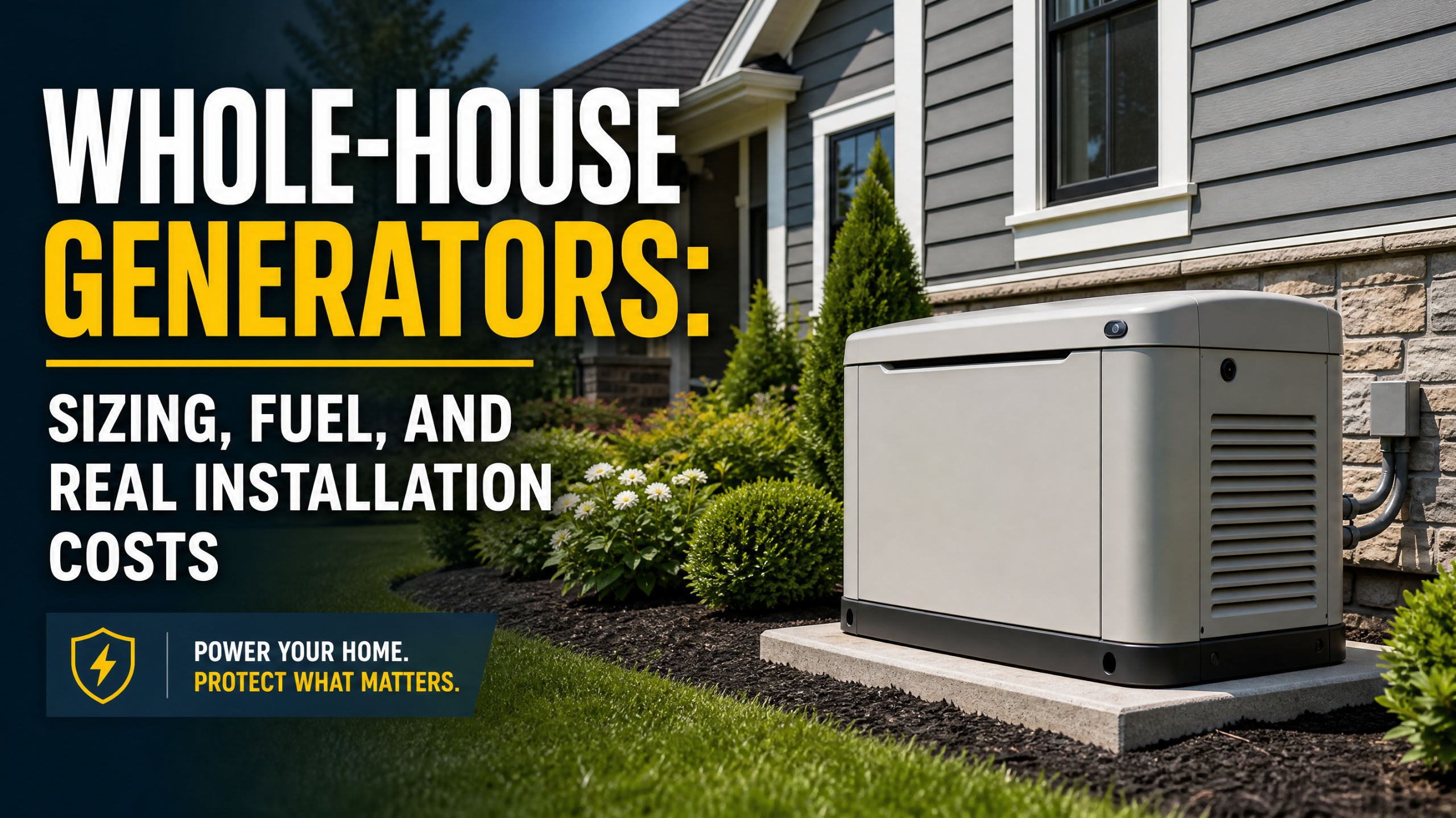
“Generator” covers two very different machines. A portable generator is the wheeled unit you roll out during an outage, fuel with gasoline, and connect to a few appliances or (safely, through a transfer switch or interlock) to some house circuits. It’s far cheaper, but it’s manual, limited in capacity, requires fuel storage, and carries the CO risk above. A standby (whole-house) generator is permanently installed outside the home, wired into your electrical system through an automatic transfer switch, and connected to a fuel supply. When the power fails, it starts automatically within seconds and powers your home, then shuts off when utility power returns, often without you doing anything. The standby unit is the “whole-house” experience people picture, and the rest of this guide focuses there, with portable as the budget alternative.
Sizing: whole-house or just the essentials?
This is the most important spec decision, and it drives the cost. Generators are rated in watts (or kilowatts), and you size them by what you intend to power. There are broadly two philosophies.
Whole-house sizing aims to run essentially everything at once, central air conditioning, electric range, the works, which requires a large, more expensive unit. Essential-circuits sizing covers only what you truly need during an outage: the furnace blower or heat, the refrigerator and freezer, a well or sump pump, some lights and outlets, internet, and any medical equipment. This requires a smaller, cheaper generator and is what many homeowners actually choose, because powering the critical loads keeps you safe and comfortable without paying for the capacity to run the whole house simultaneously.
Getting the size right matters in both directions. Undersize it and the generator overloads or can’t run what you need; oversize it and you’ve overpaid and you burn more fuel. Some modern systems use load management (smart load shedding) to run a larger home on a smaller generator by prioritizing circuits, an option worth asking about. The right approach is to make an honest list of what must stay on during an outage, then have a professional calculate the wattage, including the surge loads when motors like pumps and AC compressors start, which spike well above their running draw.
Don’t forget surge (starting) watts
Motors, well pumps, sump pumps, refrigerator compressors, AC, draw a large momentary spike when they start, far above their steady running watts. A correct sizing accounts for these surge loads, which is a common reason DIY sizing comes up short.
Fuel: natural gas, propane, or gasoline
Standby generators typically run on natural gas or propane; portables usually run on gasoline. Each has trade-offs.
| Fuel | Upside | Downside |
|---|---|---|
| Natural gas | Continuous utility supply; no refueling or storage | Needs a gas line; useless if gas service is disrupted |
| Propane | Stores well; independent of gas utility; clean-burning | Finite tank; must monitor/refill; tank cost |
| Gasoline (portable) | Cheap unit; widely available fuel | Short shelf life; manual refueling; supply scarce in long outages |
For a standby unit, natural gas is the convenience champion if your home has a gas line, since the generator draws from an effectively unlimited supply and never needs refueling. Propane is the choice where there’s no natural gas, and it stores indefinitely, but you’re limited by tank size and have to manage refills. Gasoline, the portable’s fuel, is the catch with portables in a long outage: it has a limited shelf life, and in a regional emergency gas stations may be closed or out of fuel, exactly when you need it most.
The real installation cost (the part that surprises people)
Here’s the budget reality. With a standby generator, the unit price is only part of the story; the installation is a substantial project that can cost as much as, or more than, the generator. A proper install typically includes an automatic transfer switch wired into your electrical panel, electrical work by a licensed electrician, a fuel hookup (running a gas line or setting a propane tank), a concrete or composite pad for the unit, and permits and inspection. Depending on your panel, the distance to the gas line, and local labor and permit costs, all of that adds up to a major expense on top of the equipment.
The practical lesson: never budget for a whole-house generator by looking only at the price of the unit. Get itemized quotes that include the transfer switch, electrical and gas/propane work, the pad, and permits, because the all-in installed cost is what you’re actually committing to, and it’s frequently the bigger half of the bill. A portable generator with a transfer switch or interlock kit is dramatically cheaper to set up, which is a big part of its appeal for budget-conscious buyers, with the trade-offs of manual operation and the CO precautions above.
Maintenance you can’t skip
A standby generator is a small engine that sits idle most of the time and must work flawlessly the moment you need it, which means it needs upkeep. Most units run a periodic self-test (an “exercise” cycle) to keep the engine ready, and they need regular maintenance like oil and filter changes and occasional professional service. Neglect it and you risk the worst-case scenario: the power fails, and the generator you spent thousands on won’t start. Many owners buy a maintenance plan for exactly this reason. Factor ongoing maintenance into the true cost of ownership, alongside the fuel it will consume when running.
Is a whole-house generator worth it for you?
It comes down to how often your power fails and what an outage costs you, in money, safety, or peace of mind. A standby generator makes the most sense if you experience frequent or long outages, depend on electricity for medical equipment, have a sump pump that must run to prevent flooding, work from home, live somewhere with severe weather, or simply value never thinking about outages again. If your outages are rare and brief, the large investment may be hard to justify, and a portable for occasional use (with strict CO safety) may be plenty. There’s no universal answer; it’s a function of your risk and your priorities. What’s universal is the homework: size it for your real needs, choose the fuel that fits your home, budget for the full installed cost, and respect the carbon-monoxide rules without exception.
Never backfeed: the transfer switch matters
One more safety point that’s about other people’s lives as well as your own. You must never connect a generator to your home by plugging it into a wall outlet to “backfeed” the panel. Doing so can send power back onto the utility lines, electrocuting line workers trying to restore power and damaging equipment when utility power returns. The safe, legal way to connect a generator to your house circuits is through a proper transfer switch or an approved interlock kit installed by a licensed electrician, which isolates your home from the grid while the generator runs. Standby generators include an automatic transfer switch by design; for a portable feeding house circuits, the transfer switch or interlock is the non-negotiable piece that makes it safe. This isn’t an area to improvise, the makeshift “suicide cord” approach is dangerous and prohibited for good reason.
Inverter generators and quieter options
If you’re leaning toward a portable, it’s worth knowing about inverter generators, a newer style that’s become popular for good reasons. Inverter models produce cleaner, more stable power (safer for sensitive electronics like computers and TVs), run noticeably quieter, and are more fuel-efficient because the engine throttles up and down with demand rather than running flat-out constantly. They typically cost more than a conventional portable of similar capacity, but the lower noise and cleaner power make them attractive for home backup, especially if you’ll run electronics or have close neighbors. Many are also lighter and more compact. The same carbon-monoxide rules apply to inverter generators, they’re still combustion engines producing CO, so the “outside only, far from the house” rule is just as absolute. For occasional home backup with modern electronics, an inverter portable is often the sweet spot between a basic gasoline generator and a full standby system.
Bottom line
A standby whole-house generator delivers automatic, hands-off backup power, but the decision rests on sizing (whole-house vs. essential circuits, accounting for surge loads), fuel (natural gas for convenience, propane for independence), and the full installed cost, which includes a transfer switch, electrical and fuel work, a pad, and permits and often rivals the unit price. Whether it’s worth it depends on your outage frequency and what you’re protecting. And whatever you buy, never run a portable generator in any enclosed space, carbon monoxide is the one risk you can’t compromise on.
Frequently asked questions
What size generator do I need for my house?
It depends on what you want to power. A whole-house approach runs nearly everything and needs a large unit; an essential-circuits approach covers critical loads (heat, fridge, pumps, some lights, medical gear) with a smaller, cheaper one. Have a professional calculate the wattage, including the surge loads that motors draw when starting.
Natural gas or propane for a standby generator?
Natural gas is the most convenient if you have a gas line, drawing from a continuous supply with no refueling. Propane is the choice without natural gas; it stores indefinitely but is limited by tank size and needs refilling. Both are cleaner and more practical for standby use than gasoline.
Why is installation so expensive?
A standby install includes an automatic transfer switch, licensed electrical work, a fuel hookup (gas line or propane tank), a pad, and permits and inspection. Together these can cost as much as the generator itself, which is why you should always get the full installed cost, not just the unit price.
Can I run a portable generator in my garage if the door is open?
No. The CPSC is explicit that you must never run a portable generator inside a home, garage, or enclosed space, even with doors and windows open, because deadly carbon monoxide builds up quickly. Run it outside only, at least 20 feet from the house with exhaust pointed away, and use CO alarms.
For life-saving generator safety, see the U.S. Consumer Product Safety Commission’s Carbon Monoxide Information Center and the EPA on carbon monoxide and indoor air quality. Always use a licensed professional for standby generator installation and follow all manufacturer and local code requirements.