Heat Pump
Furnace
Appliances · Buyer’s Guide
One burns fuel to make heat; the other moves heat with electricity and cools your home too. Which wins comes down to your climate and your local energy prices, not a universal answer.
Heating equipment is having a moment. Heat pumps, long seen as a niche product for mild climates, have surged into the mainstream, pushed by better cold-weather technology and generous incentives. Meanwhile the trusty gas furnace remains the default in much of the country for good reasons of its own. If you’re replacing a heating system, you’re standing at exactly this fork, and the marketing on both sides is loud. The honest truth is that neither is universally “better.” A heat pump can be the obvious smart choice for one household and a questionable one for their neighbor across the state line, because the answer hinges on two variables the brochures gloss over: your climate and the relative price of electricity versus gas where you live.
Let’s compare them properly, how each works, the efficiency reality, the upfront and operating costs, and the climate question that decides everything, so you can figure out which side of the fork is yours.
Two fundamentally different approaches to heat
A furnace makes heat. It burns a fuel, usually natural gas, sometimes propane or oil, in a combustion process and blows the resulting hot air through your ducts. Its efficiency is measured by AFUE (annual fuel utilization efficiency), the share of fuel energy that becomes usable heat, as the Department of Energy explains. A 95% furnace converts 95% of its fuel into heat. By the laws of combustion, a furnace can approach but never exceed 100% efficiency; it’s limited to the energy in the fuel it burns.
A heat pump doesn’t make heat; it moves it. Using electricity to run a refrigeration cycle, it transfers heat from one place to another, exactly like your refrigerator does in reverse. In winter it pulls heat out of the outdoor air (yes, even cold air contains heat energy) and moves it inside; in summer it runs the other way, pulling heat out of your house to cool it. The Department of Energy’s overview of heat pumps describes this transfer process, and it’s the key to both the heat pump’s biggest advantage and its climate sensitivity.
The efficiency gap is enormous, on paper
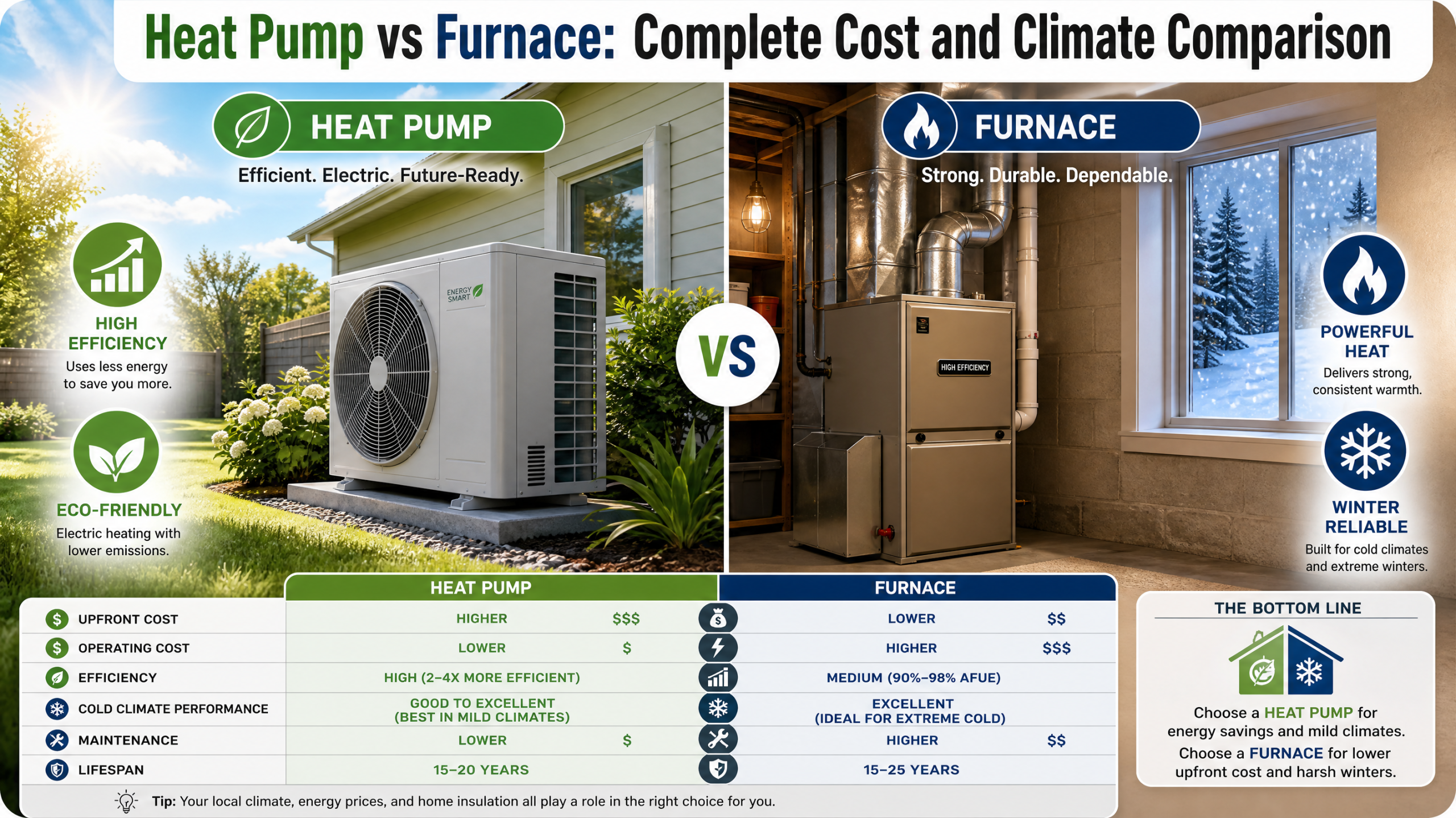
Because a heat pump moves heat rather than generating it, it can deliver far more heat energy than the electrical energy it consumes. The Department of Energy notes that a properly installed air-source heat pump can deliver up to two to four times more heat energy than the electricity it uses, and that a modern heat pump can cut electricity use for heating by up to 75% compared with electric resistance heating like electric furnaces and baseboards. That’s a staggering efficiency advantage that no combustion furnace can match in raw energy terms, because the furnace is fundamentally capped at the energy content of its fuel while the heat pump multiplies its electrical input.
But, and this is crucial, “more efficient” in energy terms doesn’t automatically mean “cheaper to run.” A heat pump runs on electricity; a furnace runs on gas. Whether the heat pump’s efficiency translates into lower bills depends entirely on what electricity and gas cost in your area, which is the operating-cost question we’ll get to.
The feature furnaces can’t match
A heat pump heats and cools. One unit replaces both your furnace and your air conditioner, running in reverse for summer cooling. A furnace only heats; you still need a separate AC. That two-in-one nature is central to the cost comparison.
The climate question that decides everything
Here’s the historical knock on heat pumps: as it gets colder outside, there’s less heat in the outdoor air to extract, so a heat pump works harder and less efficiently, and old models struggled badly in deep cold. That reputation is now partly outdated. The Department of Energy notes that advances in cold-climate heat pump technology have made them a viable heating option even in regions with extended subfreezing temperatures, and Energy Star highlights air-source heat pumps as efficient heating and cooling for a wide range of climates. Cold-climate models can now keep a home warm through real winters.
Still, climate sets the economics. In mild and moderate climates, a heat pump is often a clear winner, efficient heating, plus cooling, in one unit. In very cold climates, a heat pump still works (with a proper cold-climate model) but its efficiency drops in the coldest stretches, and you may want a backup heat source for the worst days, which leads many cold-climate homes to a dual-fuel setup. And if your region has cheap natural gas and brutal winters, a gas furnace may simply be cheaper to run during peak heating. Your climate isn’t a footnote; it’s the first thing to weigh.
Cost, part one: upfront
On equipment alone, a gas furnace is often less expensive to buy and install than a comparable heat pump, especially a premium cold-climate model. But that’s an unfair comparison if you also need cooling, because the furnace only heats. The fairer comparison for most homes is heat pump vs. furnace-plus-air-conditioner, since the heat pump does both jobs. Viewed that way, the heat pump’s higher price is offset by the fact that you’re not also buying a separate AC. If you already have a working AC and just need heat, a furnace can be the cheaper upfront path; if you’re replacing both heating and cooling, the heat pump’s all-in-one nature closes much of the gap.
Cost, part two: operating (the decider)
This is where the rubber meets the road, and where there’s no national answer because energy prices are local. The heat pump’s efficiency advantage is real, but it spends electricity while a furnace spends gas. In areas with cheap electricity and/or expensive gas, the efficient heat pump often wins on monthly bills. In areas with cheap natural gas and pricey electricity, a high-efficiency gas furnace can be cheaper to run, particularly through a cold winter when the heat pump is working hardest. To actually know, you’d compare your local electricity rate and gas rate against each system’s efficiency. The single most important homework before choosing is to look up what you pay per unit of electricity and gas, because that ratio, more than any spec sheet, determines which system costs less to operate in your home.
Don’t forget rebates and tax credits
Incentives can meaningfully shift the math. Energy-efficient heat pumps frequently qualify for federal tax credits, utility rebates, and other incentives that reduce the effective upfront cost, sometimes substantially, which can tip a close decision toward the heat pump. These programs change over time and by location, so check current federal credits and your local utility’s offerings as part of pricing the options. Energy Star’s resources on air-source heat pumps are a useful starting point for what qualifies. A heat pump that looked pricey at sticker can become very competitive after incentives, so don’t judge upfront cost before accounting for them.
The hybrid answer: dual-fuel systems
You don’t always have to choose. A dual-fuel (hybrid) system pairs a heat pump with a gas furnace as backup. The efficient heat pump handles heating most of the time, and when temperatures drop low enough that the furnace becomes cheaper or the heat pump needs help, the system automatically switches to gas. This gives cold-climate homes the heat pump’s efficiency and summer cooling for most of the year, plus the furnace’s reliable, powerful heat for the deepest cold. It costs more upfront (you’re buying both), but for the right climate and energy-price situation it can be the best-of-both answer that sidesteps the heat pump’s one real weakness.
Quick decision guide
Lean heat pump if you’re in a mild-to-moderate climate, want cooling too, are replacing both furnace and AC, or have favorable electricity prices and available rebates.
Lean furnace if you’re in a very cold climate with cheap natural gas, already have working AC, and want lower upfront cost.
Consider dual-fuel if you’re in a cold climate but want the heat pump’s efficiency and cooling for most of the year with gas backup for the coldest days.
A third option: ductless mini-splits
The heat-pump-vs-furnace framing assumes you have ductwork, but many homes don’t, or have rooms ducts can’t reach well. That’s where a ductless mini-split heat pump comes in. Instead of pushing air through ducts, it mounts indoor units (heads) directly on walls or ceilings, each connected to an outdoor unit, and heats and cools the spaces they serve. Mini-splits are a popular way to add efficient heating and cooling to additions, garages, older homes without ducts, or rooms that are always too hot or too cold. They also allow zoning, conditioning only the rooms in use rather than the whole house, which saves energy. If your home lacks ductwork, a mini-split heat pump can be far more practical and efficient than installing ducts for a furnace, and it’s worth pricing alongside the ducted options rather than assuming you’re limited to what your existing system uses.
The practical differences beyond cost
A few day-to-day differences are worth weighing alongside the numbers. Heat from a furnace tends to feel hotter and arrive in strong bursts, while a heat pump delivers gentler, steadier warmth at a lower air temperature; some people love the even comfort, others initially miss the blast of furnace heat and need to adjust their expectations. Heat pumps also dehumidify well in cooling mode, a comfort plus in humid summers. On the other hand, a furnace doesn’t depend on outdoor temperature for its output, so it provides reliably powerful heat on the coldest night, which is reassuring in a harsh climate. There’s also the resilience question: a gas furnace can heat during an electrical outage with minimal power for the controls and blower, whereas an all-electric heat pump won’t run without electricity. None of these decides the matter alone, but they’re real differences in how the two systems feel to live with, and they’re worth factoring into a decision you’ll live with for a decade or more.
Bottom line
A heat pump is dramatically efficient and does both heating and cooling in one unit; a furnace is a powerful, often cheaper-upfront heater that needs a separate AC. The winner depends on your climate and, above all, your local electricity-vs-gas prices, plus available rebates. In mild-to-moderate climates and when replacing both systems, the heat pump is increasingly the smart pick; in very cold, cheap-gas regions, a furnace or a dual-fuel hybrid often makes more sense. Price your local energy rates and incentives before deciding, that homework, not the brochure, gives you the real answer.
Frequently asked questions
Do heat pumps work in cold climates?
Modern cold-climate heat pumps do work in regions with extended subfreezing temperatures, a big change from older models. Their efficiency drops in the coldest stretches, so very cold areas often pair them with backup heat in a dual-fuel system, but the old “heat pumps can’t handle winter” rule no longer holds for current technology.
Is a heat pump cheaper to run than a furnace?
It depends on local energy prices. Heat pumps are far more energy-efficient, but they use electricity while furnaces use gas. Where electricity is reasonably priced or gas is expensive, the heat pump usually wins on operating cost; where gas is cheap and winters are harsh, a furnace can be cheaper to run. Compare your local rates.
Does a heat pump replace my air conditioner?
Yes. A heat pump provides both heating and cooling in one system, running in reverse to cool in summer. That’s a major advantage over a furnace, which only heats and requires a separate AC, and it’s why the fairest cost comparison is heat pump versus furnace-plus-air-conditioner.
What is a dual-fuel system?
A dual-fuel (hybrid) system combines a heat pump with a gas furnace backup. The heat pump handles efficient heating and cooling most of the year, automatically switching to the furnace when it’s cold enough that gas heat is cheaper or needed. It offers a strong compromise for cold climates at a higher upfront cost.
For independent guidance, see the U.S. Department of Energy on heat pump systems and furnaces and boilers, and Energy Star’s air-source heat pumps page. Compare local energy prices and current incentives, and get professional sizing for your specific home.