Property · Deeds & Rights
“Subject to easements of record” is easy to skim past at closing. It can also mean a stranger has a permanent legal right to use part of the land you just bought.
Somewhere in the paperwork for almost every property is a phrase like “subject to easements, covenants, and restrictions of record.” Most buyers’ eyes slide right over it. But that line can carry real weight: it may mean the utility company can dig across your backyard, your neighbor has the legal right to drive over your driveway forever, or there’s a strip of your land you can never build on. Easements are one of the most misunderstood corners of property ownership, partly because they’re invisible, you can’t see a legal right the way you can see a fence, and partly because they sound like dry legalese until one affects what you can actually do with your own land.
Understanding easements before you buy, or before you build that shed, can save you from expensive surprises and neighbor disputes. Here’s what an easement really is, the crucial distinctions, how they get created, and what every buyer should check.
What an easement actually is
An easement is a limited legal right to use someone else’s land for a specific purpose, without owning it. The classic example: your neighbor has the right to drive across a strip of your property to reach a road they couldn’t otherwise access. They don’t own that strip, you do, but they have a legally enforceable right to use it for that purpose. Crucially, an easement is what lawyers call a nonpossessory interest: the easement holder gets to use the land in a defined way, but they don’t possess or own it. You keep ownership; they keep a right to use.
This matters because an easement constrains the owner without transferring the land. You still pay the taxes on it and it’s still yours, but you can’t block the use the easement protects, and you typically can’t build over it in a way that interferes. That tension, you own it but someone else can use it, is the heart of why easements cause confusion and conflict.
TWO KEY TERMS
The servient estate is the property that’s burdened, the land the easement is over. The dominant estate is the property that benefits from the easement. If your neighbor crosses your land to reach theirs, your land is the servient estate and theirs is the dominant estate.
The distinction that matters most: appurtenant vs. in gross
This is the single most important easement concept for a buyer, because it determines whether the easement sticks around when property changes hands. There are two fundamental types.
An easement appurtenant benefits a parcel of land, not a particular person. As Cornell’s Legal Information Institute explains, appurtenant rights run with the land, meaning they’re tied to the property itself and pass automatically to whoever owns it next. So if your neighbor’s right to cross your driveway is appurtenant, it survives when either of you sells; the new owners inherit the same arrangement. The benefit attaches to the dominant estate and, as Cornell notes, can’t exist separate from it. This is the most common residential type, the shared driveway, the right-of-way to a landlocked parcel, and it’s permanent in the sense that it travels with the deed.
An easement in gross benefits a person or an entity rather than a piece of land. The textbook example, per resources like Justia’s overview of easements, is the utility company that has the right to run power lines or a gas pipeline across your property. There’s no neighboring “dominant estate” benefiting; the right belongs to the utility itself. Easements in gross are common for utilities and infrastructure and generally stay in place regardless of who owns the burdened land.
Common types you’ll actually encounter
In day-to-day property ownership, a handful of easement types come up again and again:
| Utility easement | Lets utilities run and access power, water, gas, sewer, or cable lines across the property. Extremely common. |
| Right-of-way / access | Allows passage across the land, e.g. a driveway to reach a landlocked parcel or a shared lane. |
| Drainage easement | Permits water to flow or be managed across the property; often you can’t obstruct it. |
| Shared driveway | Two owners share a drive; rights and maintenance duties are defined by the easement. |
| Conservation easement | Voluntarily limits development to preserve land, often for a tax benefit; runs with the land. |
How easements get created
Easements arise in several ways, and the method affects how clearly they’re documented. The cleanest is an express grant, a written agreement, usually recorded in the deed or a separate document, that spells out the easement. These are easy to find in a title search. Others are murkier. An easement by necessity can be implied when a parcel would otherwise be landlocked, since the law won’t strand a property with no access. An implied easement can arise from how the land was historically used when it was divided. Government and utility easements are often established by statute or dedication.
The one that surprises owners most is the prescriptive easement, which can be created not by agreement but by long-term, open, continuous use without the owner’s permission, somewhat like adverse possession but for a use rather than ownership. If a neighbor (or the public) has openly used a path across your land for the legally required period, they may gain a legal right to keep doing so, even though you never agreed. This is why owners are sometimes advised not to let informal, long-running uses of their land go completely unaddressed: tolerated for long enough, a casual courtesy can harden into an enforceable right.
Why this matters to you as a buyer
An easement can affect three things you care about: what you can do with the land, the property’s value, and your relationship with neighbors. Practically, you generally can’t build a permanent structure, a pool, an addition, a garage, over an easement, because doing so could interfere with the protected use, and you may be forced to remove it. A utility easement across the part of the yard where you dreamed of putting an addition can quietly kill that plan. Drainage easements may bar you from regrading or obstructing water flow. Access easements mean others have the right to cross your land, which affects privacy and use.
Easements can also affect value, sometimes lowering it (a heavily burdened lot is less flexible) and sometimes being neutral or even necessary (the access easement that makes a parcel usable at all). And shared easements, like a shared driveway, come with maintenance questions, who pays to repair it, that are best understood before closing, not after a pothole opens up and you and your neighbor disagree about the bill.
How to find the easements on a property
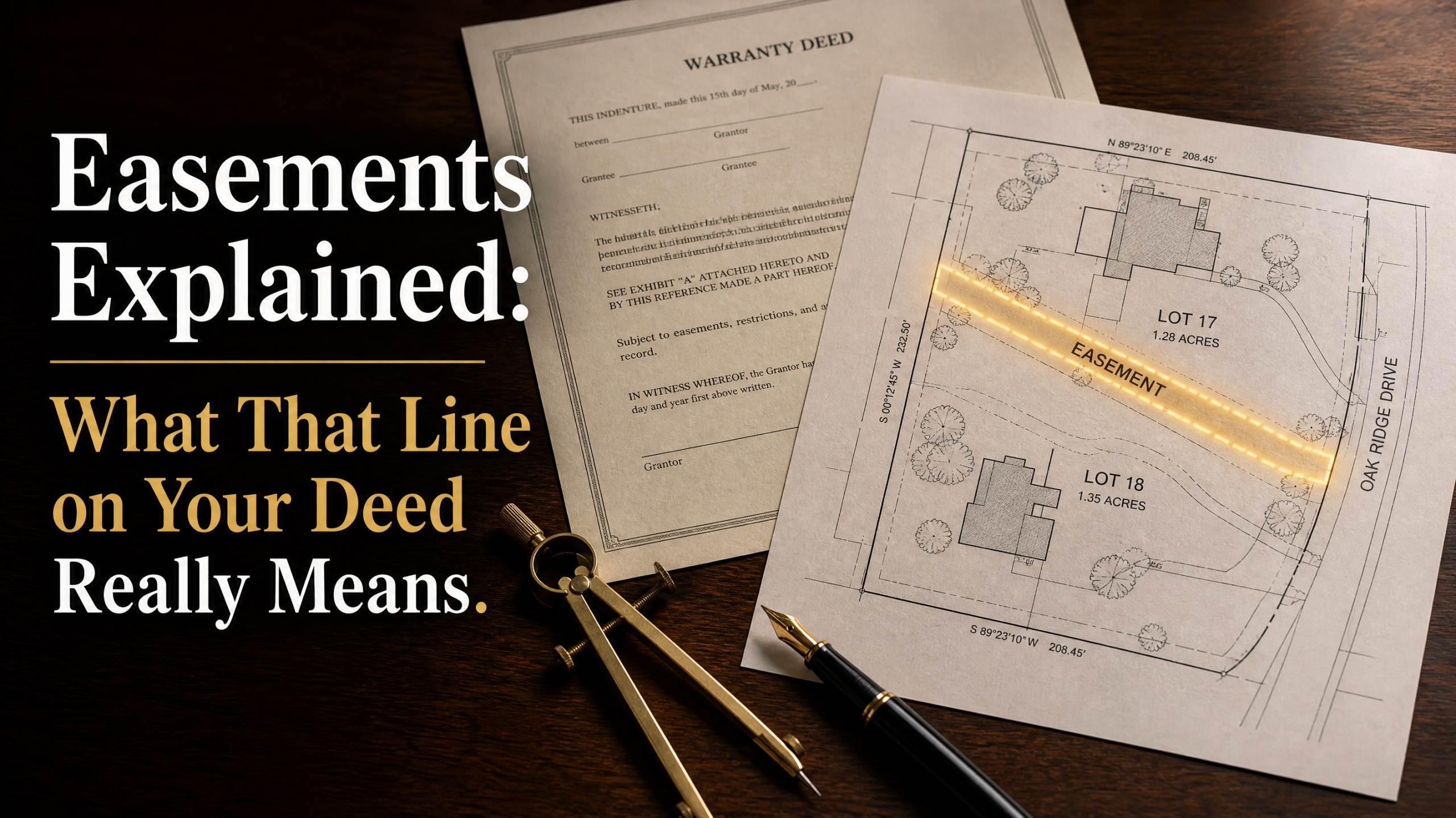
Don’t rely on the seller’s memory or on walking the lot. Recorded easements show up in the title search, and they’ll typically be listed as exceptions in the title commitment your title company produces before closing, read that document carefully, because those exceptions are exactly the rights that burden your land. A survey, especially a detailed boundary or ALTA survey, can map where easements physically run on the property, which turns an abstract “utility easement” into “the strip ten feet along the back fence.” If a property’s intended use depends on building in a particular spot, confirming there’s no easement there before you buy is essential due diligence. When the stakes or the ambiguity are high, a real estate attorney can interpret what the recorded easements actually allow and restrict.
Can an easement be removed?
Sometimes, but not easily, especially for appurtenant easements that run with the land. They can end by mutual written agreement of the affected owners, by the purpose becoming impossible or no longer needed, by the dominant and servient parcels coming under common ownership (you can’t have an easement over your own land), or by abandonment in some circumstances. But you generally can’t unilaterally cancel an easement just because you find it inconvenient, and a utility easement in gross is particularly durable. The practical lesson: assume a recorded easement is permanent unless you have specific reason and legal grounds to believe otherwise, and plan your use of the property around it rather than counting on getting rid of it.
Easements vs. encroachments: a useful distinction
Buyers often confuse easements with encroachments, and the difference is worth knowing because they’re handled differently. An easement is a recognized legal right to use someone’s land. An encroachment is something physically intruding onto a property where it has no right to be, a neighbor’s fence built three feet over the line, a shed that crosses the boundary, eaves or a driveway that spill onto the adjacent lot. An encroachment isn’t a legal right; it’s a problem, and it can cloud title, complicate a sale, and, if left unchallenged long enough, potentially even ripen into a prescriptive easement or an adverse-possession claim. A survey is what reveals encroachments, which is one more reason to get one before buying. When you spot an encroachment, it’s better to resolve it, through agreement, removal, or a formal easement, than to let it sit ambiguously, because ambiguity is what creates future disputes and claims.
Avoiding easement disputes
Most easement conflicts between neighbors come down to two things: scope and maintenance. Scope disputes happen when one party uses an easement more aggressively than intended, an access easement meant for occasional foot traffic suddenly used for heavy vehicles, or a shared driveway treated as a parking lot. The defense against this is a clearly written easement that spells out the permitted use, which is why vague or undocumented easements cause the most trouble. Maintenance disputes happen when a shared feature, a common driveway, a drainage channel, needs repair and nobody agreed in advance who pays. A well-drafted easement, or a separate maintenance agreement, allocates those costs before the pothole appears.
The takeaway for a buyer is to treat any shared or access easement as something to understand fully before closing: read the recorded language, learn what it permits and who maintains what, and if it’s unclear, get it clarified or get legal advice. An easement you understand is rarely a problem; an easement you discover and misunderstand after moving in is how neighbor relationships and budgets get strained.
Bottom line
An easement is a legal right for someone else to use part of your land for a defined purpose without owning it. The key question is whether it’s appurtenant (runs with the land and survives sales) or in gross (belongs to a person or utility). Before buying, find every recorded easement through the title commitment and a survey, understand what each lets others do and forbids you from doing, and remember that prescriptive easements can arise from tolerated long-term use. That skimmed-over line on the deed can shape what you’re allowed to build and how you can use your own property.
Frequently asked questions
Does an easement mean I don’t own that part of my land?
No. You still own the land and pay taxes on it. An easement is a nonpossessory right, the holder can use it for a specific purpose, but ownership stays with you. You simply can’t block the use the easement protects or build over it in a way that interferes.
Can I build over an easement on my property?
Generally no, at least not with permanent structures that could interfere with the protected use. Building over a utility or access easement can mean being forced to remove the structure later. Confirm where easements run before planning any addition, pool, or outbuilding.
What’s the difference between appurtenant and in gross?
An easement appurtenant benefits a neighboring parcel of land and runs with the land, passing to new owners when either property is sold. An easement in gross benefits a person or entity, like a utility company, rather than a parcel. The appurtenant type is most common in residential settings.
How do I find out what easements affect a property?
Recorded easements appear in the title search and are listed as exceptions in the title commitment before closing. A boundary or ALTA survey shows where they physically run. Review both carefully, and consult a real estate attorney if the easements could affect your plans for the property.
For legal definitions, see Cornell Law School’s Legal Information Institute entry on appurtenant rights and Justia’s overview of easements. Easement law varies by state; consult a qualified real estate attorney for specific situations.