Home Electrical · Protection
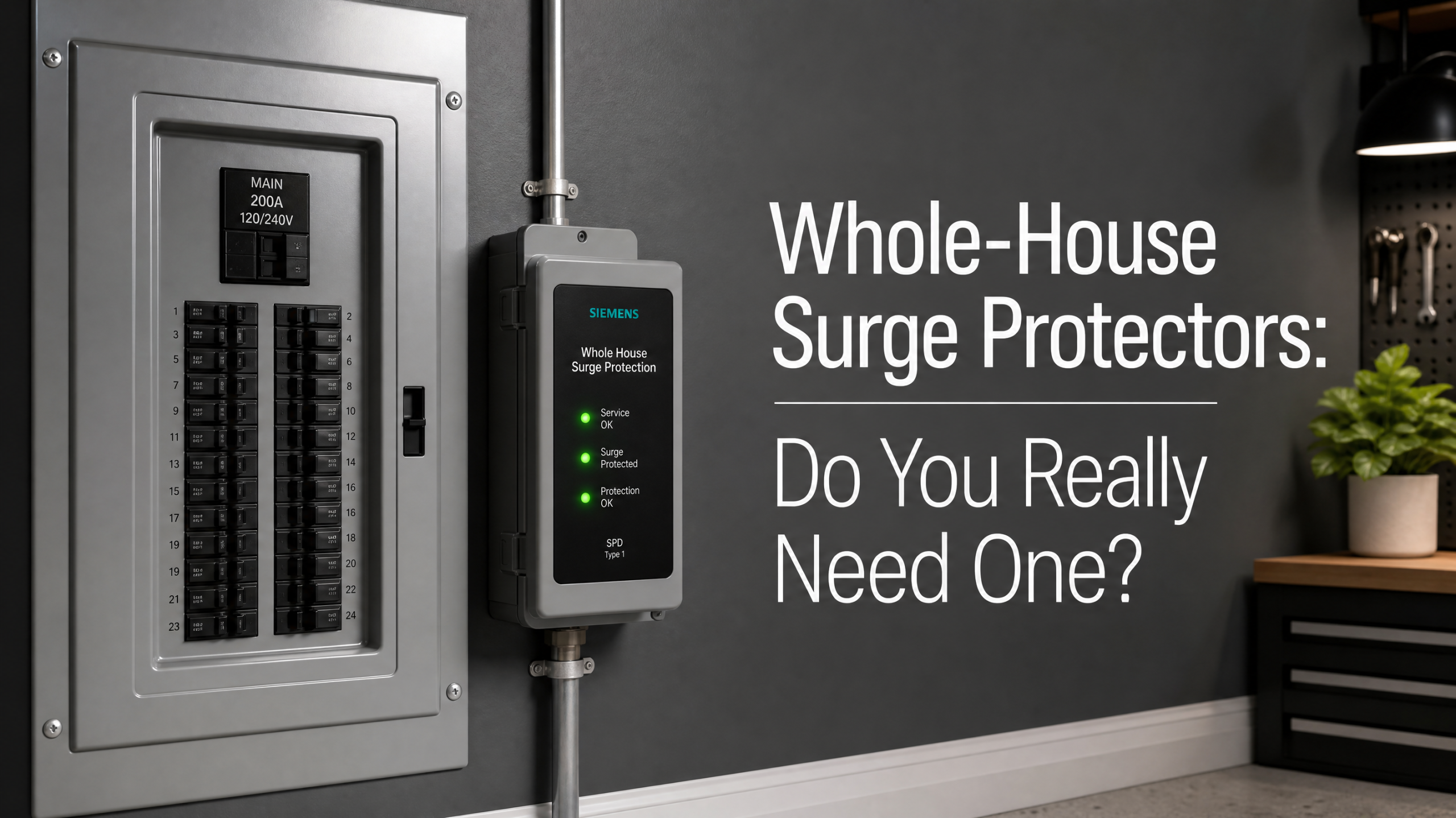
A power strip protects your TV. A whole-house unit protects the wiring, the appliances, and everything you forgot was electronic. Here’s whether the upgrade is worth it for you.
Walk through your home and count the things with a circuit board in them. The obvious ones: TV, computer, game console. Then the quieter ones: the furnace control board, the smart thermostat, the refrigerator’s inverter, the dishwasher, the garage door opener, the LED dimmers, the doorbell, the router. Modern houses are stuffed with electronics that older homes never had, and almost none of them are plugged into a surge protector. That’s the gap a whole-house surge protective device is designed to fill, and it’s why the question “do I need one?” gets a different answer today than it would have twenty years ago.
Let’s be clear-eyed about it, though. Whole-house surge protection isn’t magic, it isn’t a substitute for unplugging during a storm, and the marketing oversells it. Here’s what it actually does, what it doesn’t, and how to decide.
First, what’s a power surge?
A surge is a sudden, brief spike in voltage. The dramatic cause everyone pictures is a lightning strike, but according to the Electrical Safety Foundation International, the National Electrical Manufacturers Association estimates that 60 to 80 percent of surges actually originate inside the home. Every time a large appliance like an air conditioner, refrigerator compressor, or well pump cycles on and off, it sends a small voltage spike back through your wiring. These internal surges are tiny compared to lightning, but they happen constantly, day after day, and the cumulative wear degrades sensitive electronics over time. The TV doesn’t die in a dramatic flash; it just fails years earlier than it should.
Power strip vs. whole-house: not the same thing
This is the confusion that sinks a lot of households. First, not every power strip is a surge protector; many are just multi-outlet extensions with no protection at all. Second, even a real surge-protecting power strip is what’s called a point-of-use device, meaning it only guards whatever is plugged directly into it. ESFI describes a layered system: a service-entrance device at the panel handles the big incoming surges, and point-of-use protectors at the outlet catch what gets through and the surges generated downstream.
The layered approach
A whole-house unit at the panel is your first line of defense for large surges and for the hardwired things you can’t plug into a strip, like the furnace, the dishwasher, and the LED lighting. Power strips remain the second layer for your most sensitive electronics. They work together, not instead of each other.
The three types, briefly
Surge protective devices come in categories, and you’ll see them labeled by type:
| Type | Where it lives | What it handles |
|---|---|---|
| Type 1 | At the meter / service entrance | Large external surges |
| Type 2 | At the main electrical panel | Whole-home protection (most common) |
| Type 3 | At the outlet (power strips) | Whatever is plugged into it |
For most homeowners, the “whole-house surge protector” they’re asking about is a Type 2 device installed in the main panel. ESFI notes a service-entrance device mounted in or at the panel protects your entire electrical system, including the outlets and switches that can’t be connected to a point-of-use protector.
It’s not just a good idea, it’s in the code
Here’s a fact that surprises people: whole-home surge protection isn’t a luxury add-on in the eyes of the people who write electrical safety standards. ESFI points out that surge protection has been required by the National Electrical Code since the 2020 edition for dwellings. The code gets revised every three years and reflects the consensus on what’s now considered baseline safety, not gold-plating. When a new house is wired or a panel is replaced under current code, a surge protective device is expected. That tells you something about how the experts weigh the cost against the benefit.
What it costs, and what it protects
A Type 2 whole-house surge protector itself typically runs somewhere around $70 to $300 for the device, with professional installation by a licensed electrician usually adding a few hundred dollars depending on your panel and local rates. Call it roughly $250 to $700 installed in many cases. That’s not nothing, but weigh it against what’s on the line: a modern furnace control board can cost several hundred dollars to replace, a high-end refrigerator’s electronics far more, and that’s before you count the TV, computers, and the dozens of small smart devices scattered around the house.
The economic case isn’t really about surviving one catastrophic lightning hit; it’s about the slow protection against the constant internal surges that quietly shorten the life of everything electronic in the house. Spread across the value of all those devices and their replacement cost, a few hundred dollars looks like cheap insurance.
The honest limitations
Now the part the sales pitch leaves out. No surge protective device can handle a direct lightning strike. ESFI is blunt about it: the best protection against a surge you know is coming is to unplug devices entirely. A whole-house unit dramatically reduces risk; it does not make your home lightning-proof.
Surge protectors also wear out. The components inside absorb energy over time and degrade, and after a major surge event a device may need replacement. Better units have an indicator light showing they’re still functioning; check it occasionally. And a surge protector does nothing for other power problems like brownouts or sustained over-voltage, which call for different equipment. Knowing the boundaries keeps you from a false sense of security.
The slow death vs. the dramatic one
When people picture surge damage, they picture the dramatic version: a lightning strike, a pop, a fried television, a burning smell. That happens, but it’s the rare case. The far more common damage is invisible and cumulative. Every one of those daily internal surges from appliances cycling on and off delivers a small jolt that electronics shrug off individually but accumulate over months and years. Capacitors degrade, solder joints weaken, components drift out of spec.
The result isn’t a device that dies on a specific Tuesday; it’s a device that simply doesn’t last as long as it should. The router that needed replacing after two years instead of five. The dishwasher control board that failed just outside warranty. You never attribute these to power quality because there’s no smoking gun, but a typical home experiences a surprising number of small surges every month. A whole-house protector’s biggest contribution is shaving down this steady erosion, which is exactly the benefit that’s hardest to see and easiest to underrate.
What the spec numbers actually mean
If you’re comparing units, three numbers do most of the work, and knowing them keeps a salesperson from baffling you:
Surge current rating (kA). How big a surge the device can divert, measured in kiloamps. For a whole-house Type 2 unit, a higher rating (often in the range of 40 kA per phase or more) means more headroom for large events. Bigger is generally better here.
Voltage protection rating (VPR / let-through voltage). How much voltage still gets past the device to your equipment. Lower is better, because it means less makes it through to your electronics.
Response time. How fast it reacts. Faster clamping means the spike is cut off sooner. Quality units respond in nanoseconds.
Also look for a status indicator and ideally a connected-equipment warranty from the manufacturer. The indicator tells you the unit is still alive (they wear out), and a manufacturer warranty on connected equipment is a sign the maker stands behind the protection, though you should always read what it actually covers and requires.
How to choose and install one
For most homes, the target is a Type 2 device installed at the main panel by a licensed electrician. There are two physical styles: units that mount inside the panel and take up breaker slots, and units that mount externally next to the panel. Your electrician will pick based on your panel’s available space and layout. If your panel is already full, the external style or a panel evaluation may be needed. This is genuinely not a DIY project, because it wires into a live panel where a mistake is dangerous and can also void the protection or violate code. The device might be a couple hundred dollars; the safe, code-compliant installation is what the rest of the cost buys, and it’s money well spent.
If you’re already having electrical work done, replacing a panel, adding a circuit, installing an EV charger, that’s the cheapest possible moment to add surge protection, because the electrician is already in the panel. Bundling it in can cut the marginal cost dramatically compared to a standalone visit.
So, do you actually need one?
Lean yes if your home is full of modern electronics and smart devices, if you live somewhere with frequent storms or an unstable grid, if you have expensive hardwired appliances, or if your panel is being worked on anyway, since adding the device then is cheap. The current code requirement is a strong hint that the experts consider it worthwhile for nearly everyone.
It’s lower priority if you’ve got an older, sparsely-wired home with few electronics and a rock-solid local grid, though even then the falling cost makes it an easy call when an electrician is already on site. What you shouldn’t do is treat a power strip as equivalent protection, or assume a whole-house unit means you can ignore storms entirely.
To make it concrete: a smart home owner with a connected thermostat, video doorbell, mesh router, and a couple of TVs has dozens of small circuit boards exposed to those daily internal surges, and a clear case for the upgrade. Someone in a rural area at the end of a long utility line, where the grid is prone to fluctuations, has an even stronger case. A renter, by contrast, can’t modify the panel and is better served by quality point-of-use protectors on their most valuable electronics. And a homeowner mid-renovation with the panel already open should simply add it then and be done.
The verdict
For most modern homes, yes, and the code now agrees. A whole-house surge protector is inexpensive relative to the electronics it guards and protects the hardwired things a power strip can’t reach. Treat it as the first layer, keep surge strips on your most sensitive gear as the second, and still unplug what you can before a serious storm.
Frequently asked questions
Doesn’t my power strip already protect everything?
No. A surge-protecting power strip only guards what’s plugged directly into it, and many strips offer no protection at all. It can’t protect hardwired equipment like your furnace, dishwasher, or lighting. A whole-house unit covers those and serves as the first layer of a system.
Will it stop lightning damage?
It greatly reduces the risk, but no device can fully absorb a direct lightning strike. For a storm you can see coming, unplugging sensitive electronics is still the safest move.
Can I install one myself?
A whole-house unit wires into your main electrical panel, which is work for a licensed electrician. Opening a live panel is dangerous, and improper installation can void protection and violate code. The device is cheap; the safe installation is what you’re paying for.
How long do they last?
They degrade as they absorb surges and can be used up by a single large event. Many have a status indicator light; if it changes or goes out, the unit needs replacement. Check it periodically rather than assuming it lasts forever.
Does a whole-house unit cover everything, or do I still need power strips?
Use both. The whole-house device handles large surges and protects hardwired equipment, while point-of-use strips add a second layer for sensitive electronics like computers and home theater gear. The two layers complement each other rather than being redundant, and the combination is what professionals recommend.
For independent guidance on home electrical safety and surge protection, see the Electrical Safety Foundation International’s pages on home surge protective devices and surge protection basics. Always use a licensed electrician for panel work.