Home Exterior · Buyer’s Guide
Three technologies, wildly different prices, and one marketing promise nobody fully delivers on. Here’s how they actually perform and which one fits your roof.
Every gutter guard ad makes the same pitch: install ours and you’ll never climb a ladder to scoop wet leaves again. It’s a great fantasy, and it’s worth saying up front that no gutter guard makes your gutters truly maintenance-free. What a good one does is dramatically cut how often, and how miserably, you have to clean them. That’s a real benefit, especially if you’ve got tall gutters, a lot of trees, or any reason to stay off ladders. But the three main types work on completely different principles, cost anywhere from a few dollars a foot to more than the gutters themselves, and each fails in its own particular way. Pick the wrong one for your situation and you’ll have paid good money to make your gutters harder to clean, not easier.
Let’s go through mesh, foam, and reverse-curve guards honestly, including where each one lets you down, so you can match the technology to your trees, your roof, and your budget instead of to a salesperson’s script.
First, why bother at all?
Clogged gutters aren’t just an eyesore. When a gutter overflows, water sheets down the side of the house and dumps straight at the foundation, which is the one place you never want it. University extension guidance on stormwater management stresses directing roof runoff well away from the foundation, because water pooling against the base of a house is a leading cause of basement seepage, cracked foundations, and erosion. The University of Nebraska’s extension materials on managing roof and downspout runoff explain how disconnected, properly directed downspouts protect both the structure and the surrounding soil. A gutter that’s clogged can’t do any of that. So the real value of a guard isn’t convenience for its own sake; it’s keeping the whole drainage system working through leaf season without constant intervention.
The three approaches at a glance
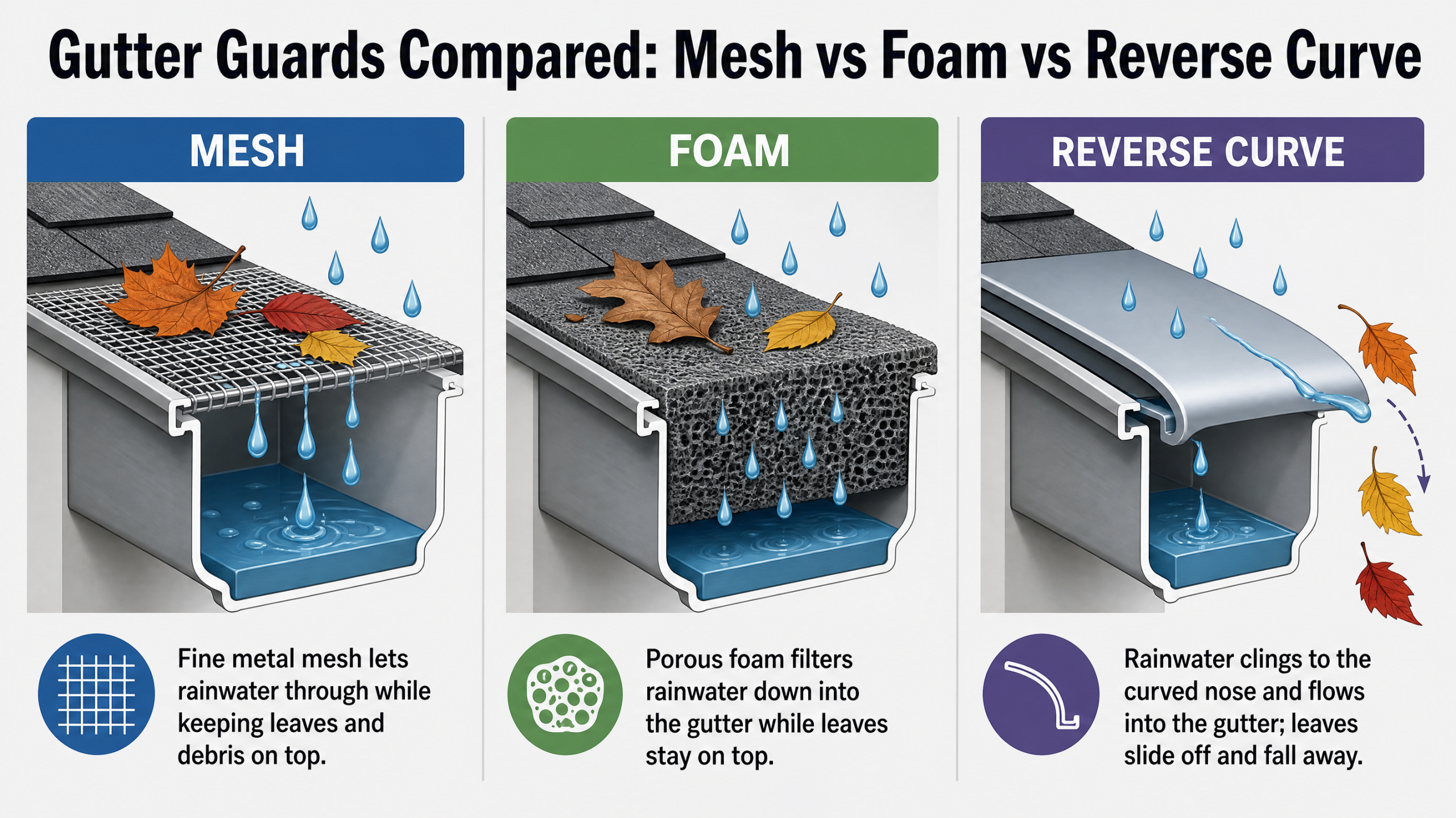
All gutter guards are trying to solve the same puzzle: let water in, keep debris out. Where they differ is how. Mesh and screen guards cover the gutter opening with a barrier full of holes. Foam inserts fill the gutter channel itself with a porous block. Reverse-curve guards use the physics of surface tension to pull water around a curved nose while leaves fall past. Each strategy has a logic, and each has a blind spot.
The honest summary
Micro-mesh keeps out the most debris but needs occasional brushing and a quality install. Foam is the cheapest and easiest to DIY but tends to clog from the inside over a few years. Reverse-curve sheds leaves well and handles volume but is pricey, professionally installed, and can struggle with fine debris and heavy downpours.
Mesh and screen guards
This is the broadest and most popular category, and it splits into two very different tiers. At the cheap end are coarse plastic or aluminum screens with relatively large openings. They snap or lay over the gutter and block big leaves, but small debris like pine needles, seed pods, shingle grit, and roof sand slips right through and still accumulates below. They’re inexpensive and better than nothing, but in a yard with conifers or maples they don’t solve much.
At the premium end is micro-mesh: a fine stainless-steel screen, often on an aluminum frame, with openings small enough to block even pine needles and shingle grit while letting water through. This is the most effective barrier type for keeping debris out, and a well-made micro-mesh guard on a solid install can go a long time between cleanings. The catches are real, though. Fine mesh can develop a film of pollen, dust, and shingle residue that sheds water if it’s never brushed off, so “maintenance-free” becomes “occasional gentle brushing.” And in very heavy rain, a clogged or dirty fine mesh can shed water right over the front rather than through it. Quality and proper pitch matter enormously here; a cheap micro-mesh poorly installed underperforms a mid-grade product done right.
Foam inserts
Foam guards are wedge-shaped blocks of porous material you push down into the gutter channel. Water soaks through the foam while leaves rest on top and (in theory) blow away when they dry. The appeal is obvious: foam is the cheapest option, you can cut it with a knife, and any homeowner can install it in an afternoon with zero special tools. For a quick, low-stakes fix on a small house, that accessibility is genuinely attractive.
The problem shows up over time. Debris and grit work into the foam’s pores, and organic matter trapped inside stays damp, which becomes a perfect bed for seeds to sprout and for the foam to gradually clog from the inside out. Many homeowners find that within a few years the foam is holding moisture and growing weeds rather than shedding water, and because the clogging is internal, you can’t just brush it off; you pull the foam out and replace it. Foam can also degrade and discolor with UV exposure. It’s the budget choice, and it behaves like one: fine for a few seasons, rarely a decade-long solution.
Reverse-curve (surface-tension) guards
Reverse-curve guards are the slickest engineering of the bunch. A solid cover curves over the gutter and ends in a rounded “nose” with a narrow slot. Water clings to the curved surface (surface tension) and wraps around the nose into the slot, while leaves, lacking that adhesion, tumble off the edge to the ground. When they work, they shed leaves beautifully and can handle large volumes of water, which is why this style anchors many of the heavily advertised professional systems.
The downsides are cost and a few stubborn failure modes. These are usually the most expensive guards and are typically professionally installed, sometimes requiring the system to be set at a pitch that follows the roofline rather than the gutter. Fine debris and shingle grit can still ride the water around the curve and into the gutter, building up over time. In torrential rain, water can overshoot the nose and skip past the slot entirely, spilling over. And in cold climates the solid cover can contribute to ice damming. They’re a strong choice for big-leaf shedding in a yard of oaks and maples, less so where the enemy is fine needles or where you get extreme downpours.
Side by side
| Micro-Mesh | Foam | Reverse-Curve | |
|---|---|---|---|
| Relative cost | Mid–high | Lowest | Highest |
| Install | DIY or pro | Easy DIY | Usually pro |
| Blocks fine debris | Best | Poor over time | Fair |
| Handles heavy rain | Good if clean | Fair | Can overshoot |
| Typical lifespan | Long | Short (few yrs) | Long |
What it actually costs
Foam runs maybe a couple dollars per linear foot and is pure DIY, so a small home might be done for a few hundred dollars in materials. DIY micro-mesh and screen products land in a wide middle range per foot. Professionally installed micro-mesh or reverse-curve systems, especially the nationally advertised brands, can run many dollars per foot installed, and a whole-house job from a premium company can reach several thousand dollars. The right way to judge value isn’t the sticker; it’s cost against the years of cleaning avoided and the foundation damage prevented. A $3,000 system that lasts twenty years and keeps water off your foundation can pencil out better than replacing $400 of foam every few years and still climbing ladders.
The roof-warranty trap and install quality
Here’s a detail the showroom rarely raises: some guard systems attach by lifting the bottom row of roof shingles and sliding a flange underneath. That can be a problem, because disturbing shingles may affect your roofing warranty, and improper installation can let water under the shingles. If a system requires going under your shingles, ask in writing how it affects your roof warranty and how it’s flashed. Surface-mounted guards that attach to the gutter or fascia avoid this entirely. Whatever type you choose, installation quality is the variable that most determines whether you’re happy in five years, so don’t fixate on the product name and ignore who’s putting it on.
Match the guard to your trees and climate
Your specific debris is the deciding factor. If your yard is full of pine, spruce, or anything that drops needles, plus the fine “helicopter” seeds and oak tassels of spring, you need micro-mesh; coarse screens and many reverse-curve designs let that small stuff through. If your problem is mostly big deciduous leaves and you want maximum shedding with high water volume, reverse-curve shines. If you’re on a tight budget, have a small single-story home, and just want a few easier seasons, foam gets you there cheaply with the understanding you’ll replace it.
Climate matters too. In snow country, any solid-cover guard can interact with ice dams, so good attic insulation and ventilation matter more than the guard, and micro-mesh’s open design is often less prone to trapping ice mass. In regions of intense downpours, test how a candidate system handles a firehose before committing your whole roof to it.
Install details that quietly decide everything
Two homes can buy the same micro-mesh product and have wildly different experiences, and the difference is almost always the install, not the box. A few details matter more than the brand name. The guard has to follow the correct pitch so water actually reaches the opening rather than pooling or sheeting past; on a reverse-curve system that pitch sometimes follows the roof rather than the gutter, which is why setup is fussy. The gutters themselves need to be clean and sound before anything goes on top, because installing a guard over a gutter that’s already sagging, pitched wrong, or full of old debris just seals the problem inside where you can’t see it. And the fasteners and edges need to be secure enough to handle wind, snow load, and the weight of a brushing tool later.
It’s also worth being honest about where guards genuinely don’t help much. On a low-slope roof with little tree cover, the payback is modest. On a complex roof with lots of valleys that dump concentrated water and debris into specific gutter runs, even good guards can be overwhelmed at those choke points, and the fix is as much about gutter sizing and downspout capacity as it is about the guard. Walking the roofline mentally, where does the water concentrate, where do the leaves pile, can tell you more about whether guards will satisfy you than any product brochure.
The verdict
For most homeowners who want the best long-term performance, quality micro-mesh on a careful install is the strongest all-around choice, particularly against fine debris. Reverse-curve is excellent for big-leaf yards with money to spend. Foam is the honest budget pick for small homes and short horizons. None is truly maintenance-free, so buy the one whose limited upkeep you’ll actually do.
Frequently asked questions
Do gutter guards mean I never clean my gutters again?
No. They greatly reduce how often and how unpleasantly you clean, but every type still needs periodic attention. Micro-mesh may need brushing, foam needs replacing, and reverse-curve can accumulate fine debris. Treat “maintenance-free” claims as “much less maintenance.”
Which gutter guard is best for pine needles?
Micro-mesh. Its fine stainless screen blocks needles and shingle grit that pass through coarse screens and can ride the water around reverse-curve designs. If conifers are your main problem, micro-mesh is the clear answer.
Are expensive professional systems worth it over DIY?
Sometimes. The value is in long life, warranty, and avoided ladder time and foundation damage, not the brand. A quality DIY micro-mesh done carefully can rival a pricey system; a premium system done well can be worth it on a tall or complex roof. Compare total cost over the years, not the sticker.
Can gutter guards cause ice dams?
Solid-cover styles can contribute in cold climates, but ice dams are mainly caused by heat escaping into the attic and melting snow unevenly. Good attic insulation and ventilation address the root cause; choose guards with that in mind in snowy regions.
For guidance on managing roof runoff and protecting your foundation, see the University of Nebraska–Lincoln Extension’s stormwater and downspout management resource. Always confirm how any guard system affects your roofing warranty before installation.