Investing · Boring Cash Flow
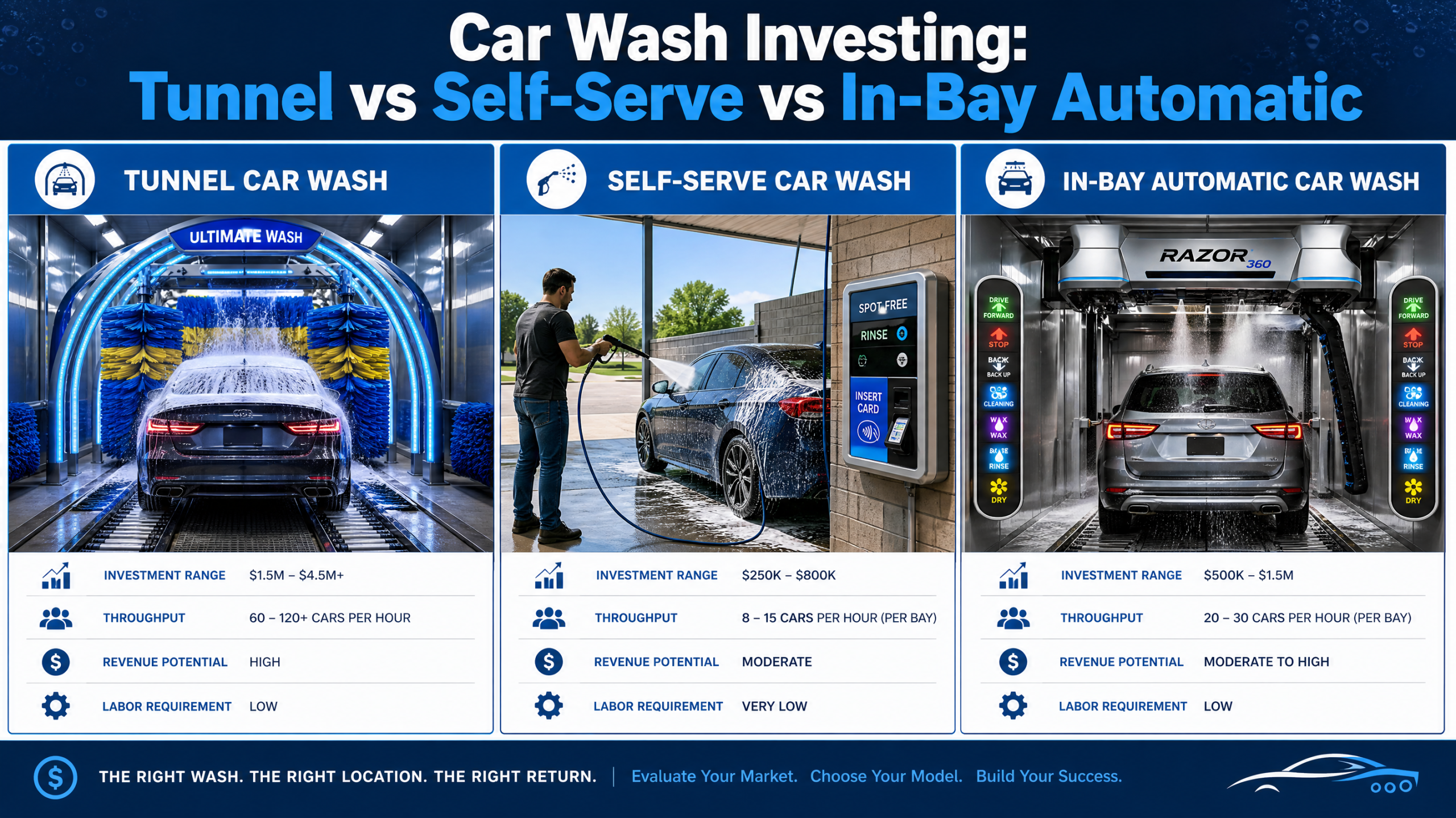
Three very different businesses share the name “car wash.” They differ in cost by an order of magnitude, in labor, and in how they make money. Picking the right model is the whole decision.
Car washes have quietly become one of the most talked-about “boring business” investments, and the interest isn’t hype for its own sake. A car wash combines a cash-generating business with a piece of commercial real estate, the demand is relatively steady (cars get dirty in any economy), and the rise of unlimited monthly wash memberships has transformed the revenue model from unpredictable one-off sales into something closer to a subscription business. That’s a genuinely attractive combination for an investor who wants tangible, durable cash flow rather than a screen full of stock tickers, and it explains why the sector has drawn everyone from individual owner-operators to large private-equity-backed chains.
But “car wash” covers three fundamentally different businesses, and confusing them is how people lose money. A self-serve wand bay, an in-bay automatic, and a high-volume tunnel are as different from each other as a vending machine is from a restaurant. They require wildly different capital, labor, traffic, and operating skill. Here’s how each model actually works, what it costs, how it earns, and which kind of investor each one suits.
Model 1: Self-serve (the wand bays)
This is the open-bay setup where customers do the work themselves: drive in, feed money or tap a card, and use the wand, foaming brush, and vacuum. The operator provides the equipment, water, and a place; the labor is the customer’s.
Capital: lowest of the three · Labor: minimal · Revenue ceiling: lower · Best for: hands-off owners, smaller budgets, secondary markets.
The appeal is simplicity and low overhead. With little to no staff and modest equipment, a self-serve can run lean, and a number of small-market operators like them precisely because they’re close to passive. The trade-off is the revenue ceiling: you’re charging relatively little per use, throughput per bay is limited by how fast customers work, and there’s no membership engine driving recurring revenue the way a tunnel has. It’s the entry-level model, lower risk and lower reward, and it depends heavily on enough local traffic to keep the bays busy.
Model 2: In-bay automatic (IBA)
The customer pulls into a single bay, the car stays put, and the equipment, either rollover gantry or rotating brushes, moves around the vehicle to wash it. You see these bolted onto gas stations and convenience stores constantly, because they pair perfectly with fuel traffic.
Capital: moderate · Labor: low · Revenue ceiling: moderate · Best for: add-on to fuel/c-store, mid-budget single-site owners.
The IBA automates the wash with little staff, splitting the difference between self-serve and tunnel. It’s a favorite as a profit center attached to a convenience store or gas station, where it captures existing traffic and adds high-margin revenue without much added labor. The limitation is throughput: a single bay can only wash one car at a time, and each wash takes several minutes, so there’s a hard cap on how many cars per hour you can process. That ceiling is why the IBA is great as a complement to another business but less commonly the basis of a high-volume standalone empire.
Model 3: Tunnel (express exterior)
The big one. Cars load onto a conveyor and ride through a long tunnel of equipment, getting washed continuously while the line keeps moving. The modern “express exterior” tunnel can process a high volume of cars per hour and is built around unlimited monthly memberships.
Capital: highest by far · Labor: moderate · Revenue ceiling: highest · Best for: serious investors, high-traffic sites, membership-driven scale.
The tunnel is where the real money and the real risk live. Because the conveyor keeps cars moving, throughput is far higher than any single-bay model, and the express format (exterior-only, free vacuums, drive-through speed) is designed for volume. Layer on the membership model and the economics get powerful: a base of members paying every month whether they wash or not creates predictable recurring revenue that smooths out weather and seasonality. That recurring-revenue story is exactly why private equity and large chains have poured into the tunnel space. The flip side is cost, a tunnel requires substantial land, a large building, expensive equipment, and real operational competence to run well.
The three models, side by side
| Self-Serve | In-Bay Auto | Tunnel | |
|---|---|---|---|
| Upfront cost | Lowest | Moderate | Highest |
| Throughput | Low | Low–moderate | High |
| Labor | Minimal | Low | Moderate |
| Membership engine | Weak | Possible | Strong |
| Risk / reward | Low / low | Mid / mid | High / high |
The membership model changed everything
It’s hard to overstate how much unlimited monthly plans reshaped car wash economics. Instead of hoping enough cars show up on a sunny Saturday, a wash with thousands of members collects a predictable sum on the first of every month regardless of weather. Members tend to wash more often (they’re paying anyway), which builds habit and loyalty, and the recurring revenue makes the business far more stable and far more valuable to a buyer. This is the single biggest reason tunnels attract big capital, and it’s why “how many members can this site support?” is a more important question than “how many cars wash here today?” The membership flywheel is strongest in the tunnel model and weakest in self-serve.
Costs, land, and water
Across all models, a car wash is as much a real estate play as a business; the land and visibility you secure are a huge part of the investment and the eventual value. Costs scale dramatically with the model, from a relatively modest self-serve build to a multi-million-dollar tunnel development including land, building, and equipment. Financing a build of that size is its own project, and the SBA’s resources on planning and funding a business are a reasonable starting point for structuring it.
Water is both a cost and a compliance issue. High-volume washes use a lot of water, so reclaim and recycling systems that capture and reuse water are now standard for both economics and regulation. Wash runoff is wastewater, and discharging it improperly into storm drains can violate the Clean Water Act and the EPA’s stormwater program; commercial washes route wash water to the sanitary sewer or reclaim it rather than letting it run to storm drains. Factor water reclamation and proper discharge into both the build budget and the operating plan.
Location is the make-or-break
As with most retail, location decides outcomes. The factors that matter are traffic counts (how many cars pass daily), visibility and ease of entry/exit, local demographics and density (enough nearby vehicles and disposable income to build a membership base), and competition (how many washes already serve the area). A tunnel needs a high-traffic, high-density site to fill the membership base that justifies its cost; a self-serve can survive on more modest traffic. Weather matters too, very rainy or very cold climates change wash frequency and the math. Serious operators run real site analysis before committing, because the wrong location can sink even a well-run wash, and unlike many businesses you can’t simply relocate a multi-million-dollar tunnel once it’s built.
Matching the model to the investor
Self-serve suits an investor with a smaller budget who wants a low-labor, lower-risk, semi-passive asset and isn’t chasing maximum returns. In-bay automatic fits someone adding a profit center to an existing gas station or convenience store, or a single-site owner with a moderate budget. Tunnel is for the investor with serious capital, appetite for a real operating business, and a high-traffic site, who wants the upside of the membership model and is prepared for the complexity and competition that come with it. There’s no single “best” model, only the best fit for your capital, your tolerance for hands-on operation, and your location. Be honest with yourself about all three before you commit.
Express exterior vs. full-service tunnels
Within the tunnel category there’s an important split worth understanding, because it changes the labor and the economics. A full-service tunnel washes the exterior and also has staff who clean the interior, vacuum, wipe down, detail, which means a bigger crew, higher labor cost, and a slower, more service-heavy operation. The express exterior model, which has driven most of the recent growth, strips that back: the machine washes the outside, customers vacuum their own interiors for free at on-site stations, and the whole experience is fast and low-labor. Fewer employees and higher throughput make express tunnels efficient and scalable, which is a big reason the membership-driven express format attracted so much investment.
Neither is automatically better; they serve different markets. Full-service can command higher prices and suit areas that value the pampering, while express wins on volume, simplicity, and the recurring-membership flywheel. Knowing which you’re building, and which fits your market and your appetite for managing labor, is part of doing the model selection properly rather than just “building a tunnel.”
The risks specific to car wash investing
For all its appeal, a car wash carries real risks that the “recurring revenue” pitch can gloss over. Competition and saturation are the big ones: the same investor enthusiasm that made the sector attractive has flooded some markets with new tunnels, and a site that pencils out on paper can struggle when two competitors open nearby and a membership price war erupts. Site selection therefore has to account not just for today’s traffic but for who else might build close by.
Equipment is another. A wash is a machine that runs cars through it all day, and equipment breaks down; downtime means lost revenue and unhappy members, so maintenance and capital reserves for repairs and eventual replacement are part of the real cost. Weather and seasonality affect volume, though memberships cushion this. And the upfront capital, especially for a tunnel, means significant debt for most buyers, so the business has to perform to service the loan. None of these are reasons to avoid the sector, but they’re reasons to underwrite a deal conservatively, with honest traffic and competition analysis, rather than assuming memberships make it bulletproof.
Bottom line
“Car wash” is three different investments. Self-serve is the cheap, low-labor entry point; in-bay automatic is the efficient add-on, especially beside fuel; the tunnel is the high-cost, high-reward machine powered by unlimited memberships and recurring revenue. All three are real estate plays as much as businesses, all depend on location and traffic, and all must handle water reclamation and discharge properly. Match the model to your budget, your operating appetite, and above all your site.
Frequently asked questions
Which car wash model makes the most money?
Tunnels have the highest revenue ceiling because of their throughput and the unlimited membership model, but they also cost the most and carry the most risk. Self-serve earns less but is cheaper and lower-risk. The best return depends on your capital, location, and how hands-on you want to be.
Why are memberships such a big deal?
Unlimited monthly plans turn unpredictable one-off sales into recurring, weather-proof revenue, much like a subscription. They make the business more stable and more valuable, which is why tunnels built around memberships attract so much investor interest.
Is a car wash a passive investment?
Self-serve and in-bay automatic models can be relatively low-labor and closer to passive. Tunnels are operating businesses requiring real management of staff, equipment, and marketing. None are entirely hands-off, though absentee ownership with a hired manager is possible at the larger scale, many tunnel investors run multiple sites through managers rather than working the wash themselves.
What about water use and regulations?
Car washes use significant water and generate wastewater that can’t simply run into storm drains. Reclaim and recycling systems are standard, and wash water must be discharged properly under the Clean Water Act and local rules. Build these into your budget and operating plan.
For business planning and funding, see the U.S. Small Business Administration’s plan your business guide; for wash-water and stormwater rules, see the EPA’s NPDES stormwater program. Always conduct site-specific market and regulatory analysis before investing.