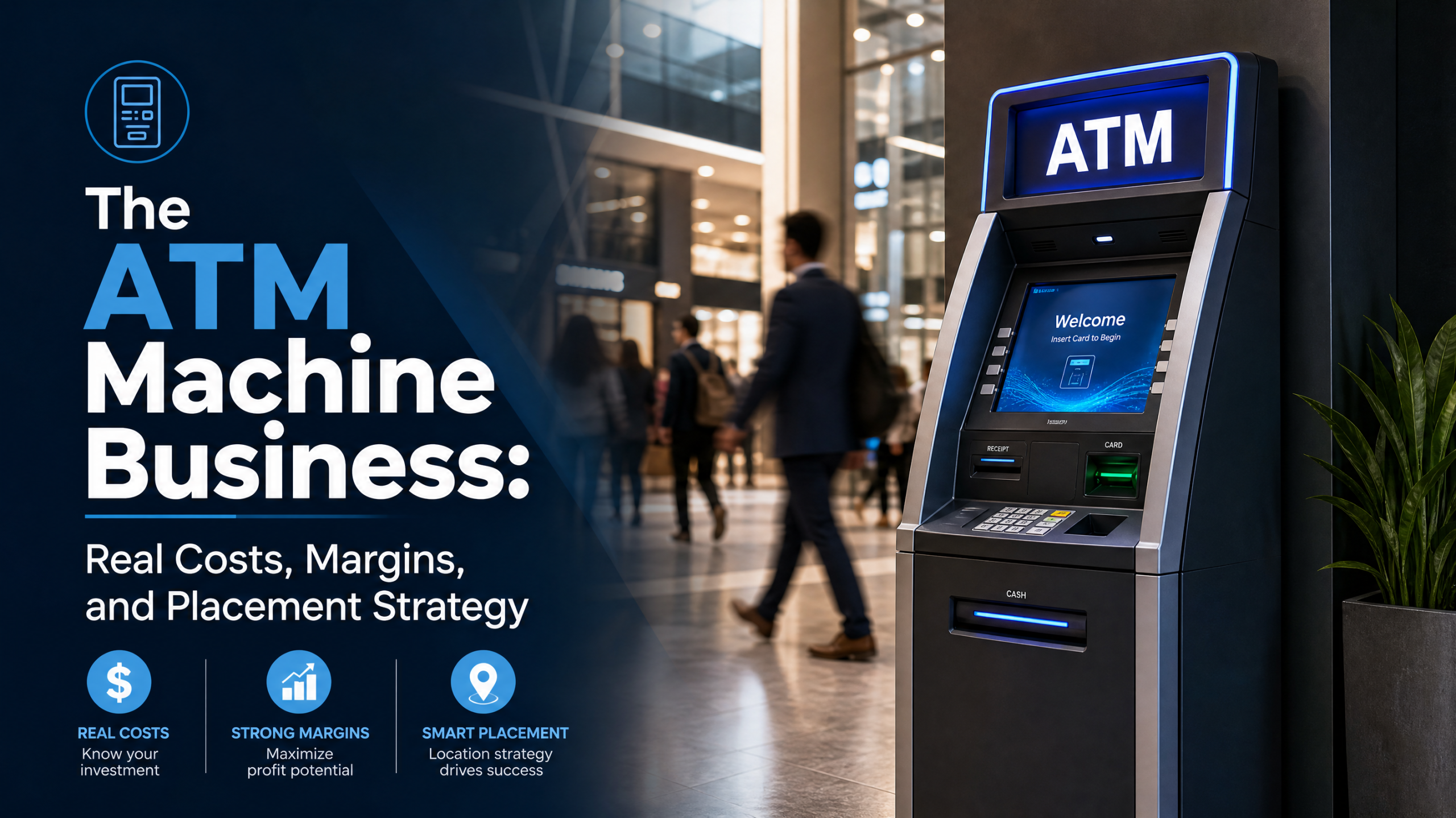
Passive Income · The Numbers
It’s sold as effortless passive income from a box on a wall. The truth is more interesting: a simple, real business where one decision, location, determines almost everything.
The ATM business has a seductive pitch: buy a machine, stick it in a busy store, and collect a few dollars every time someone withdraws cash, forever, while you sleep. Like most passive-income stories, that’s part true and part fantasy. The true part is that ATM ownership can be a genuinely profitable, relatively simple business with predictable economics. The fantasy part is “passive,” because someone has to keep the machine stocked with cash, fix the occasional jam, and, most importantly, get it placed somewhere people actually need cash. Get the location right and the machine prints modest, steady money month after month with little effort. Get it wrong and you own an expensive paperweight bolted to a wall in a store nobody visits, with your cash sitting idle inside it.
Let’s strip the hype and look at how the money really works, what it actually costs, and why placement is the entire game.
How an ATM actually makes you money
The core revenue is the surcharge, that “this ATM charges a fee of $X” message you click past when you withdraw cash. As the machine owner, you set and keep that surcharge (minus processing costs). That’s the bulk of your income, and it’s why the business is so simple to understand: revenue equals the number of withdrawals times your surcharge. There can be a small additional revenue stream called interchange, a tiny amount the card networks pay per transaction, but for most independent operators the surcharge is the engine.
Notice what this means. Your income is driven entirely by transaction volume, which is driven entirely by location. A machine doing 50 withdrawals a week at a few dollars each is a nice little earner. The same machine doing 5 withdrawals a week barely covers its costs. The machine is identical; the location makes or breaks it.
The whole business in one line
Monthly profit ≈ (withdrawals per month × your surcharge) − processing fees − your share of any location split − cash/operating costs. Everything else is detail. Volume is king.
The real costs nobody mentions up front
The “just buy a machine” pitch glosses over several costs:
The machine itself. A new retail ATM is a few thousand dollars; used machines are cheaper. This is the obvious cost and usually the smallest surprise.
The cash inside it, which is yours. This is the cost people forget. An ATM dispenses your money. You load it with your own cash, and when a customer withdraws $100, that $100 leaves your float and is later settled back to your bank account through the processor. So you must keep thousands of dollars of working capital tied up in each machine at all times. That cash isn’t earning anything sitting in a slot, an opportunity cost, and it’s a real amount of money to have circulating.
Processing fees. You connect the machine to an ATM processor that handles the transactions and settlement, and they take a cut per transaction. This trims your surcharge margin.
Location split. The store owner usually expects a piece of the action, either a share of each surcharge or a flat rental, in exchange for the floor space and the foot traffic. A great location commands a bigger split.
Insurance, maintenance, and the unglamorous rest. Connectivity, occasional repairs, receipt paper, and insuring the cash and machine against theft all chip at the margin.
The unit economics, illustrated
Numbers vary, but a simple illustration shows the shape. Imagine a machine in a decent location doing 8 withdrawals a day, roughly 240 a month, at a $3 surcharge. That’s about $720 in surcharge revenue. Subtract processing fees, the location owner’s split, and operating costs, and you might net a few hundred dollars a month from that one machine. Multiply that by a route of well-placed machines and you have a meaningful income. Now imagine a weak location doing 2 withdrawals a day, about 60 a month: $180 of revenue that barely survives the same deductions. Same machine, completely different outcome.
| Line item | Strong location | Weak location |
|---|---|---|
| Withdrawals / month | ~240 | ~60 |
| Surcharge revenue | Healthy | Thin |
| After costs & split | Profitable | Marginal / loss |
| Verdict | Worth it | Avoid |
Placement: the entire game
If you take one thing away, take this: ATM success is a real-estate decision disguised as an equipment purchase. The ideal location has high foot traffic, a reason people need cash on the spot, and no convenient free alternative nearby. Think bars and nightclubs (cash tips, cabs, no card minimums), convenience stores, festivals and events, laundromats, cash-preferred ethnic markets and restaurants, smoke shops, and venues where card acceptance is limited. The common thread is people who need cash, right now, with no bank ATM next door.
The killers of a location are the mirror image: low traffic, a clientele that pays for everything by card or phone, and a bank branch or competing surcharge-free ATM within easy reach. A beautiful machine in a quiet card-friendly cafe will starve. This is why experienced operators spend their energy scouting and negotiating placements, not shopping for machines. You’re not really in the ATM business; you’re in the business of finding spots where cash demand is high and supply is low, and parking a machine there.
How “passive” is it, honestly?
Semi-passive is the fair description. The machine runs itself between visits, but someone has to keep it loaded with cash, and that’s the recurring chore. A busy machine needs restocking regularly, which means you (or an armored cash service you pay) physically bringing money to it, with the security risk that implies. You’ll also handle the occasional bill jam, receipt-paper change, connectivity hiccup, or repair. It’s far less hands-on than running a store, but it isn’t “set it and forget it.” As you scale to multiple machines, the cash-handling logistics become the core operational challenge, and some operators eventually pay a cash-replenishment service to handle it, trading margin for true hands-off operation.
Compliance you can’t skip
A few non-negotiables: ATMs must meet accessibility (ADA) standards and current card-security standards like EMV chip support, so very old machines may be non-compliant. There are also financial regulations around operating ATMs and handling cash that vary by state, and the cash-intensive nature of the business means anti-money-laundering considerations exist in the background. Setting the business up properly, choosing a structure that fits and registering correctly, matters here; the SBA’s guides on choosing a business structure and planning your business are the right starting points, and it’s wise to confirm state-specific ATM operator requirements before you launch, since rules around registration, fee disclosure, and cash handling differ from one state to the next and getting them wrong early is far costlier than checking first.
Buy, lease, or place
There are a few ways in. You can buy machines outright (highest upfront cost, you keep the most revenue). You can sometimes find existing ATM routes for sale, buying a portfolio of placed, earning machines, which costs more but skips the hardest part (placement) by acquiring proven locations. Be careful to verify the reported transaction volumes before buying a route, since a seller’s numbers are easy to inflate. Starting with one or two machines in locations you’ve personally vetted, then reinvesting profits into more, is the lower-risk path for most newcomers.
Common mistakes new operators make
A handful of errors sink first-time ATM owners, and almost all of them trace back to underestimating something:
Falling for a weak location to get started. Eager to place their first machine, beginners accept a low-traffic spot because it was available, then wonder why the income is dismal. A bad location doesn’t improve with patience. It’s better to wait for a genuinely good placement than to lock a machine into a quiet store.
Underestimating the cash float. People budget for the machine and forget they must keep thousands of dollars of their own cash circulating in it. Running short on float means an empty machine, which means no revenue and an annoyed store owner.
Overpaying for a route on inflated numbers. When buying an existing route, taking the seller’s transaction claims at face value is dangerous. Always verify actual processor statements showing real volume before you pay for “proven” locations.
Ignoring security and compliance. Cash attracts theft, and machines must meet accessibility and card-security standards. Cutting corners on either invites loss or liability. Treat both as costs of doing business, not optional extras.
Building a route, the real scaling play
One well-placed machine is a nice supplement; a route of them is a business. The scaling logic is straightforward: each additional machine in a strong location adds another stream of surcharge income, and the fixed parts of your operation, your processor relationship, your knowledge, your systems, spread across more machines. The constraint that grows with you is cash and logistics: more machines mean more float tied up and more stops to restock, which is why operators at scale often graduate to a cash-replenishment or armored service that handles loading for a fee. That trade, giving up some margin to make the business truly hands-off and to remove the personal security risk of carrying cash, is often worth it as the route grows.
The skill that compounds is placement. Once you can reliably identify and negotiate good locations, signing convenience stores, bars, and high-traffic venues onto fair splits, you can keep adding machines as fast as you can fund and service them. The operators who build sizable, genuinely passive income from ATMs are the ones who treated location-hunting as their core competency and slowly assembled a portfolio of spots where cash demand is high and alternatives are scarce.
Bottom line
The ATM business is a legitimate, simple, semi-passive income source whose entire profitability hinges on placement and transaction volume. Budget not just for the machine but for the working cash it ties up, processing fees, and the location owner’s cut. Chase high-traffic, cash-demanding spots with no nearby free alternative, keep the machine compliant and stocked, and treat it like the real-estate-and-logistics business it actually is rather than the effortless money the ads promise.
Frequently asked questions
Is the ATM business truly passive income?
It’s semi-passive. The machine earns on its own between visits, but you must keep it stocked with your own cash, handle occasional jams and maintenance, and manage the cash logistics. It’s far less hands-on than a storefront but not “set it and forget it” until you pay a service to replenish cash.
Where does the cash in the ATM come from?
From you. The machine dispenses your own money, which is later settled back to your bank account through the processor. This means you keep significant working capital tied up in each machine, an often-overlooked cost of the business.
What makes a good ATM location?
High foot traffic, a genuine need for cash on the spot (bars, convenience stores, events, laundromats, cash-preferred venues), and no convenient bank or surcharge-free ATM nearby. Low-traffic, card-friendly spots with competition close by are the locations to avoid.
How do I make money from an ATM?
Primarily through the surcharge fee customers pay per withdrawal, which you set and keep minus processing costs and any split with the location owner. Revenue scales directly with the number of withdrawals, so transaction volume, driven by location, determines your income.
How much money do I need to start?
Beyond the machine itself, budget for the working cash that lives inside it, which can be several thousand dollars per machine, plus processing setup, insurance, and any location deposit. The cash float is the cost most newcomers overlook, so plan for it before committing to your first placement.
For business setup, see the U.S. Small Business Administration’s guides to choosing a business structure and planning your business. ATM operation involves financial and accessibility regulations that vary by state; confirm local requirements before launching.