Home Exterior · Maintenance Money
Sealing the right driveway at the right time genuinely extends its life. Sealing the wrong one, too often, or with the wrong product is money poured onto pavement.
Driveway sealing sits in a strange spot in home maintenance. Done thoughtfully, it’s a legitimately smart, low-cost way to stretch the life of an asphalt driveway and put off a four- or five-figure replacement. Done reflexively, on a schedule pushed by a guy who knocked on your door with a leftover bucket of sealer, it’s one of the easier ways to waste a few hundred dollars on something your driveway didn’t need. The difference comes down to a handful of factors most homeowners never get told: what your driveway is made of, what shape it’s in, how often you reseal, and crucially, which product you use.
Let’s separate the cases where sealing pays for itself from the ones where you’re better off keeping your money, and cover one health-and-environment issue that should change which product you buy.
First: is your driveway even asphalt?
This sounds basic, but it’s the first money-waster. Sealing is for asphalt (the black, petroleum-based stuff). Concrete driveways (the gray kind) can be sealed too, but with entirely different products and for different reasons, mostly stain resistance and protection from freeze-thaw and de-icing salts, not the same “preserve the binder” logic. If someone is offering to spray a black sealer on your gray concrete driveway, something is off. Know which surface you have before anyone quotes you, because the entire calculation differs.
The rest of this focuses on asphalt, where the sealing question is most common and most often mishandled.
What sealing actually does
Asphalt is aggregate (stone) held together by a petroleum binder. Over time, sunlight (UV), oxygen, water, and especially oil and gasoline drips break that binder down. The asphalt fades from black to gray, gets brittle, and starts to ravel, crack, and develop potholes. A sealcoat is a thin protective layer applied on top that shields the binder from UV and water and resists oil penetration, slowing the aging process. It also makes the driveway look fresh and black again, which is most of why people do it.
When sealing pays off
Sealing is worth the money when the driveway is fundamentally sound and you’re preserving it:
It’s a relatively new asphalt driveway. The first sealcoat is usually best applied not immediately but after the new asphalt has cured for several months to a year, then periodically after. Protecting good asphalt early keeps the binder healthy and genuinely extends life.
The surface is sound but graying. If the driveway is solid with only minor surface wear and small cracks you can fill, sealing now protects it before the damage compounds. This is the classic good-value scenario.
You live with harsh sun or lots of oil drips. In intense-UV climates or where vehicles leak oil, the binder degrades faster, so the protection earns its keep more quickly.
When it’s a waste of money
Sealing is throwing money away in these cases:
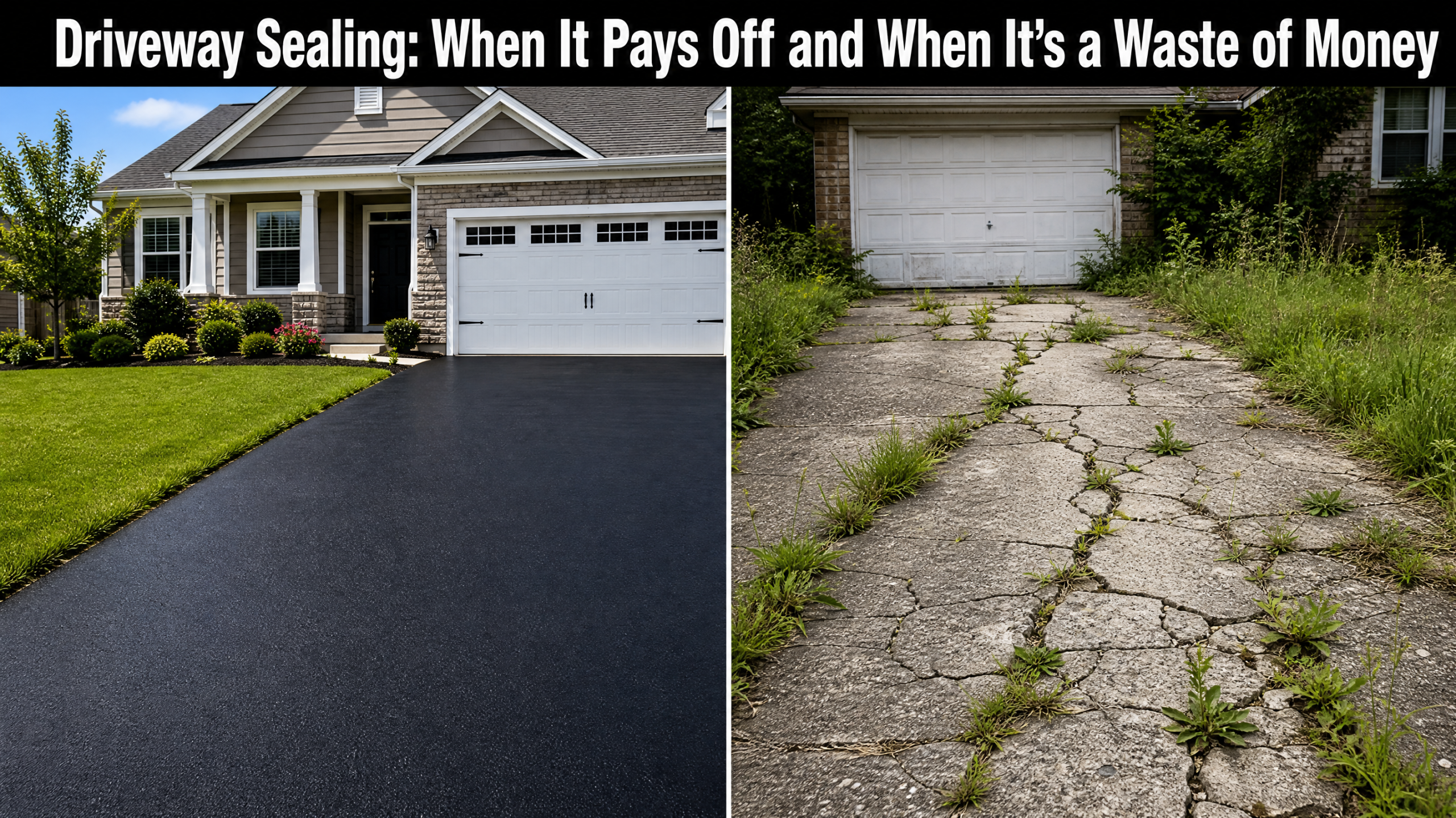
The driveway is already failing. Sealcoat is cosmetic and protective, not structural. If you have alligator cracking (a scaly, interconnected crack pattern), large potholes, or sections crumbling and shifting, that’s a sign the base or the asphalt itself has failed. Sealing over it hides the problem for a few months and changes nothing underneath. That money belongs toward repair or replacement.
You’re sealing too often. More is not better. Resealing every single year builds up thick layers that can themselves crack and peel, and you’re paying repeatedly for protection the driveway didn’t need yet. A common sensible interval is every few years, judged by how the surface looks and feels, not by a salesperson’s annual reminder.
The driveway-sealing “deal” found you. The classic scam is the unsolicited crew with “extra material from a nearby job.” These often use watered-down product, skip surface prep, and disappear. A rushed, low-quality seal looks fine for a month and then peels. If you didn’t go looking for it, be very skeptical.
The product choice that matters for your health
Here’s the part almost nobody mentions, and it should influence which sealer you buy. Asphalt sealcoats come in two main chemistries: coal-tar-based and asphalt-based. They look similar in the bucket, but they are not the same. The U.S. Geological Survey has documented that coal-tar-based pavement sealcoat contains very high concentrations of polycyclic aromatic hydrocarbons (PAHs), with the USGS noting coal-tar-based products typically contain on the order of 100 times more PAHs than used motor oil and around 1,000 times more than asphalt-based sealcoat.
Why care? Because that sealcoat doesn’t stay put. The USGS research describes how the coating is worn into a fine dust by tires that gets tracked into homes and washed into streams and stormwater, where several PAHs are toxic to aquatic life and some are classified as probable human carcinogens. A number of cities and some states have restricted or banned coal-tar sealcoat for these reasons. The practical takeaway for a homeowner: if you do seal, asphalt-based (or other low-PAH) sealers carry far less of this concern, and they’re widely available. Ask specifically what’s in the product, because “driveway sealer” on a label tells you nothing about which chemistry is in the bucket.
Before you sign anything, ask the contractor:
Is this coal-tar-based or asphalt-based sealer? Is my driveway sound enough to benefit from sealing, or does it need repair first? When was it last sealed, and is it actually due? How will cracks be prepped before sealing? Honest answers to these four questions separate a worthwhile job from a waste.
DIY vs. hiring out
Sealing a driveway is one of the more DIY-able maintenance jobs. Buckets or squeegee-and-roller kits are inexpensive, and a careful homeowner can do a small driveway in a day. The work that actually determines results is the prep: cleaning the surface thoroughly, removing oil stains, filling cracks with the proper crack filler first, and sealing only when the weather is dry and warm enough for the product to cure. Skipping prep is why both bad DIY jobs and bad contractor jobs peel. If you hire out, you’re mostly paying for labor, equipment, and (ideally) better prep and product; confirm you’re getting those rather than just a fast spray-and-go.
The honest cost-benefit
A driveway replacement is expensive, often several thousand dollars for asphalt. Against that, periodic sealing of a sound driveway is cheap insurance that can add years to its service life, which is why, done correctly and not too often, it pays off. But the math collapses the moment you’re sealing a failing driveway (you’re delaying an inevitable replacement while spending money) or sealing far too frequently (you’re paying for unneeded coats that can make things worse). The value isn’t in the act of sealing; it’s in sealing the right driveway, at the right time, with the right product.
How to tell if your driveway is even worth sealing
Before you spend a dollar, walk your driveway and look at it like an inspector rather than an owner who wants it to look nice. The goal is to decide which of three buckets it’s in: sound and worth protecting, repairable and worth fixing first, or failed and headed for replacement.
Hairline and narrow cracks are normal aging and a sign that protection is sensible. Fill them with crack filler, then sealing makes sense. Graying and a dry, rough texture mean the binder is oxidizing, which is exactly what a sealcoat slows; good candidate. These are the “seal it” signs.
Alligator cracking, that interconnected scaly pattern, is the big red flag. It usually means the base beneath the asphalt has failed, and no amount of surface sealer fixes a base problem. Potholes, sunken areas, or sections that move underfoot point the same direction. Wide cracks you can put a finger into are past simple crack-filling. These are the “don’t waste money sealing” signs; the money belongs toward patching, resurfacing, or replacement depending on severity.
If most of the driveway is sound with only localized damage, you can repair the bad spots and seal the rest. If the failure is widespread, sealing is lipstick on a problem and you’re better off saving toward the real fix.
Concrete driveways are a different conversation
Because the question comes up constantly, it’s worth being clear that concrete (the gray driveway) plays by different rules. You don’t sealcoat concrete with the black asphalt emulsion; you’d use a clear or tinted concrete sealer, typically a penetrating or film-forming product designed to resist stains, water absorption, and the damage from freeze-thaw cycles and de-icing salts. The motivation differs too: concrete doesn’t have a petroleum binder oxidizing in the sun, so it’s less about preserving flexibility and more about keeping water and salt out of the surface so it doesn’t spall (flake) or stain. Newly poured concrete in particular benefits from a sealer once it’s cured. If you have a concrete driveway, ignore the asphalt-sealing schedule entirely and ask about a concrete-specific product and interval, which is usually less frequent.
Timing and weather matter more than you’d think
Even the right product on the right driveway fails if it’s applied at the wrong time. Sealer needs warm, dry conditions to cure properly, so it’s a job for a stretch of mild weather with no rain in the forecast for the curing window, and not in the heat of a blistering afternoon or the chill of late fall. Brand-new asphalt is another timing question: fresh asphalt needs to cure and off-gas before its first seal, so resist the urge to seal a just-laid driveway immediately; giving it some months first is the usual advice. And after sealing, the driveway needs time to cure before you drive or park on it. Rushing any of these steps is a common reason a job that should have lasted years peels within weeks, which converts a worthwhile maintenance task into wasted money through nothing more than bad timing.
The verdict
Seal a structurally sound asphalt driveway every few years and you’ll meaningfully extend its life for little money, that’s the pay-off case. Don’t seal a driveway that’s already cracking apart, don’t reseal on a too-frequent schedule, don’t buy from door-to-door crews, and favor asphalt-based over coal-tar sealer for health and environmental reasons. Sealing is maintenance, not a miracle, and timing is everything.
Frequently asked questions
How often should I seal my asphalt driveway?
Judge by condition rather than a fixed annual schedule. Many sound driveways do well resealed every few years. Sealing every single year tends to build up layers that can crack and peel, so more frequent is not better.
Will sealing fix cracks and potholes?
No. Sealcoat is a thin protective layer, not a structural repair. Cracks should be filled with crack filler first, and serious damage like potholes or alligator cracking signals a deeper problem that sealing won’t fix.
Is coal-tar driveway sealer safe?
Coal-tar-based sealcoat contains very high levels of PAHs, which research from the USGS links to environmental and potential human-health concerns as the coating wears into dust. Many jurisdictions have restricted it. Asphalt-based or other low-PAH sealers are a lower-concern alternative.
Should I trust a door-to-door sealing offer?
Be very cautious. Unsolicited crews offering cheap sealing with “leftover material” often use diluted product and skip prep, leaving a coat that peels quickly. If you didn’t seek the service out, get your own quotes from established local contractors instead.
Does sealing make a driveway last longer, or just look better?
Both, when done correctly on a sound driveway. Cosmetically it restores the fresh black look, and functionally it shields the asphalt binder from UV, water, and oil that would otherwise break it down, slowing the aging that leads to cracking and raveling. The life-extending benefit only applies to a structurally sound driveway, though; on failing asphalt the appearance improves briefly while the underlying decay continues.
For research on the environmental and health concerns of coal-tar-based sealcoat, see the U.S. Geological Survey’s pages on PAHs and pavement sealcoat. Local regulations on sealer products vary; check your area’s rules before purchasing.