Home Systems · Water Heating
The sales pitch says tankless pays for itself. The math says it depends. Here’s how to figure out which side of that line your house falls on.
If you’ve shopped for a water heater lately, you’ve probably run into the same argument from two directions. The plumber points at the tankless unit on the wall and calls it the obvious upgrade. The neighbor who just replaced a tank shrugs and says the old kind worked fine for fifteen years. They’re both right, which is exactly why the decision is harder than it looks. The honest answer to “which one saves money?” isn’t a brand or a technology. It’s a calculation that runs differently in a two-person condo than it does in a five-person house with three teenagers who all shower at 7 a.m.
Let’s walk through the parts that actually move the number: how each type works, what they cost up front, what they cost to run, how long they last, and the installation surprises that wreck a lot of budgets. By the end you should be able to do your own math instead of trusting whoever’s holding the wrench.
Two completely different machines
A storage tank heater does what the name says. It holds 40, 50, or 75 gallons of water and keeps the whole batch hot around the clock so it’s ready the moment you open a tap. The downside is baked into the design: the tank loses heat to the room even when nobody’s using hot water, and the burner or element kicks on to top it back up. The Department of Energy calls this standby heat loss, and it’s the quiet tax you pay on a tank twenty-four hours a day.
A tankless unit, sometimes called a demand or instantaneous heater, holds almost no water. When you turn on a hot tap, cold water rushes through a heat exchanger and a gas burner or electric element heats it on the way through. According to the Department of Energy’s guidance on tankless heaters, that means no standby loss and, in theory, a constant supply of hot water that never runs out mid-shower. In theory. The catch is flow rate, which we’ll get to.
The one-sentence version
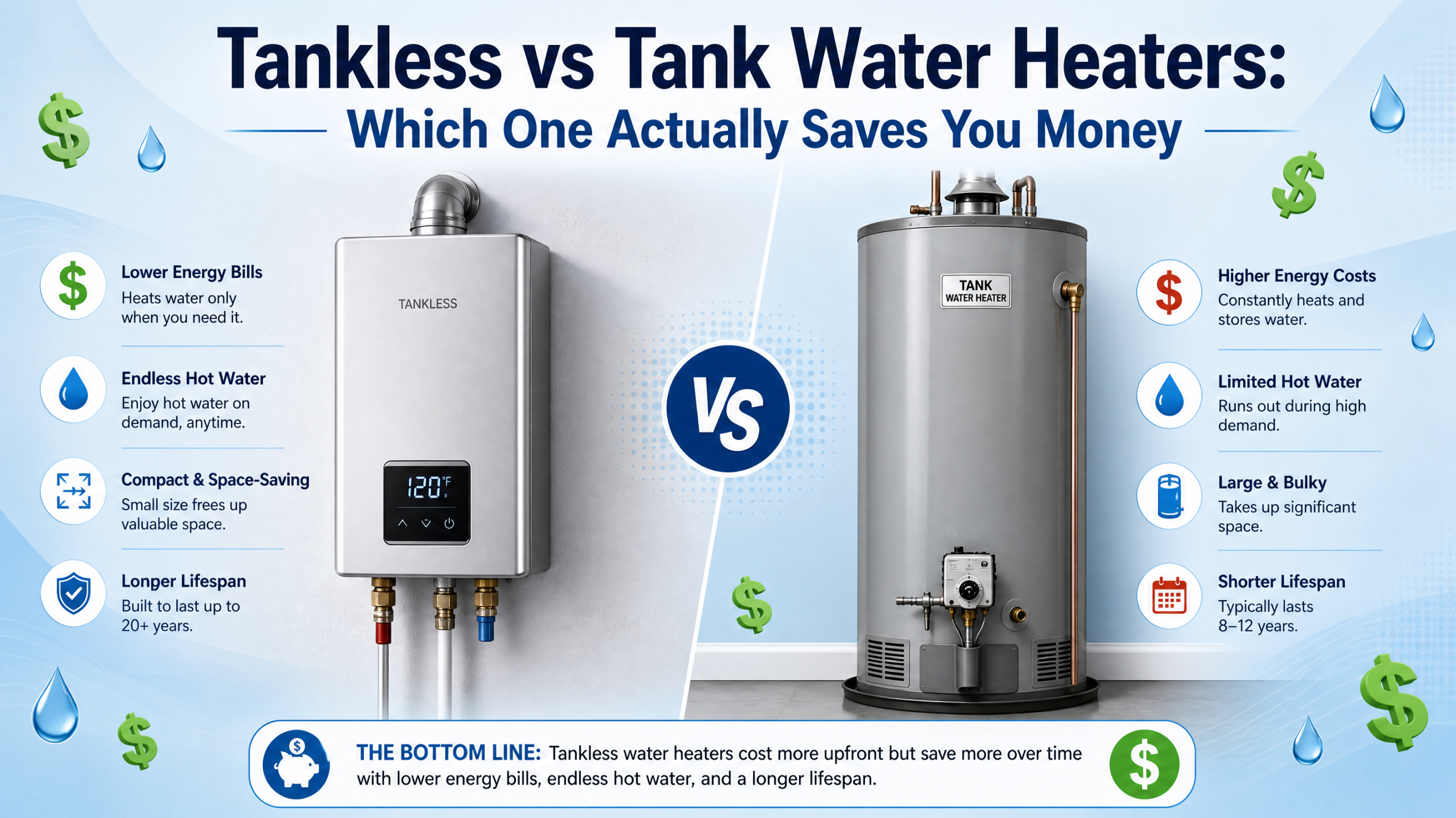
A tank wastes energy keeping water hot you aren’t using; a tankless wastes nothing on standby but costs far more to buy and install. Whether that trade pays off comes down to how much hot water you actually burn through.
The upfront cost gap is real
This is where a lot of people stop reading the marketing and start doing arithmetic. A conventional gas tank heater, installed, commonly runs somewhere in the neighborhood of $1,000 to $1,800 depending on size and your local labor rates. A gas tankless unit installed often lands closer to $2,500 to $4,500, and sometimes higher once you account for the work nobody mentions in the showroom.
Why the spread? A tankless unit isn’t a drop-in swap. Gas models usually need a larger gas line because they fire at a much higher rate when running. They need their own dedicated venting, often stainless steel, because the exhaust is different from a tank’s. Electric whole-house tankless units are even more demanding on the panel side. The Department of Energy notes that large electric tankless heaters can draw a great deal of current, and older homes frequently need an electrical service upgrade to handle one. That panel work alone can add four figures before the heater is even bolted to the wall.
So before you compare energy savings, accept the starting position: you’re usually paying $1,500 to $3,000 more on day one for tankless. Every dollar of monthly savings is chipping away at that gap, and the gap has to close before you’ve “saved” anything at all.
Where the savings actually come from
Here’s the figure that drives every tankless sales pitch, and it’s worth understanding precisely. The Department of Energy reports that for homes using around 41 gallons of hot water a day or less, demand water heaters can be 24 to 34 percent more energy efficient than conventional storage tanks. For heavy users at roughly 86 gallons a day, the edge shrinks to about 8 to 14 percent.
Read that twice, because it’s counterintuitive. The biggest percentage savings go to low hot-water users, not high ones. That’s because the savings come almost entirely from killing standby loss. A small household that barely touches its tank still pays to keep it hot all day, so eliminating that waste is a big relative win. A household that’s constantly drawing hot water keeps the tank “earning its keep,” so there’s less idle waste to eliminate in the first place.
Translate that into dollars and the picture gets sobering. A 25 to 30 percent cut on a water-heating bill that might be $300 to $450 a year for a modest household saves you on the order of $80 to $130 annually. The Energy Star program estimates a certified gas tankless can save a family of four roughly $95 a year versus a standard gas tank, or about $1,800 over the unit’s life. Helpful, real, but not life-changing, and you can see how a $2,000 price premium takes a long time to earn back at that pace.
| Factor | Storage Tank | Tankless |
|---|---|---|
| Typical installed cost | Lower ($1,000–$1,800) | Higher ($2,500–$4,500+) |
| Standby energy loss | Yes, around the clock | Essentially none |
| Hot water supply | Limited to tank volume | Continuous, but flow-limited |
| Typical lifespan | 10–15 years | Up to 20 years |
| Best fit | Big simultaneous demand | Lower-use homes, space-limited |
The flow-rate trap nobody warns you about
“Endless hot water” is the tankless tagline, and it’s technically true but practically misleading. A tankless unit can run hot water forever, but only up to its flow rate. That’s measured in gallons per minute, and it depends heavily on how cold your incoming water is. The Department of Energy notes that a gas demand heater typically manages about a 70-degree temperature rise at 5 gallons per minute, while an electric one might only handle 2 gallons per minute at that same rise.
Picture a January morning in a cold climate. The groundwater coming in is frigid, so the unit has to work harder for every gallon, which drops its effective flow. Now someone starts a shower (around 2 to 2.5 gpm), the dishwasher kicks on, and a second shower starts upstairs. A single mid-size unit can’t keep up, and everyone gets lukewarm water. The fix is sizing up, installing two units, or adding point-of-use heaters, all of which push the cost higher. A tank, by contrast, doesn’t care how many taps open at once until it simply runs out of its stored gallons.
Lifespan and the long game
Here’s where tankless quietly claws back some ground. A conventional tank typically lasts 10 to 15 years before the lining gives out and it starts to leak. A well-maintained tankless unit can run closer to 20 years. So in a long enough timeline, you might buy two tanks for every one tankless, and that second tank purchase belongs in the comparison.
The asterisk is maintenance. Tankless units, especially in hard-water areas, need periodic descaling to clear mineral scale out of the heat exchanger, usually every year or two. Skip it and you lose efficiency and shorten the lifespan you paid a premium for. Tanks need attention too, but the tankless maintenance is less optional if you want it to reach that 20-year promise.
Don’t forget the third option
The tank-versus-tankless framing skips a contender that often beats both on operating cost: the heat pump (or hybrid) water heater. It uses a tank but heats the water by moving heat from the surrounding air rather than generating it directly, which can cut water-heating energy use dramatically. It’s worth pricing alongside the other two, particularly with the rebates frequently available. The Department of Energy’s overview of estimating costs and efficiency across storage, demand, and heat pump heaters is the cleanest place to compare all three on the same terms.
A worked example, with real numbers
Abstract percentages are easy to wave around, so let’s put two believable households side by side and watch the payback math play out. Numbers vary by region and energy prices, but the shape of the result holds almost everywhere.
Household A is a retired couple in a small home. They use maybe 35 gallons of hot water a day. Their annual water-heating bill on a gas tank runs around $280. A tankless unit at the high end of the efficiency range (call it 30 percent savings for a low-use home) saves them roughly $84 a year. The tankless install costs $2,000 more than a replacement tank. Pure payback: about 24 years on energy alone. But the tankless lasts around 20 years versus maybe 12 for the tank, so they’d buy a second tank in that window. Fold in that avoided second purchase and the longer life, and the deal looks far better than the raw 24-year figure suggests, possibly net-positive within the unit’s lifespan. For a couple planning to stay put, tankless is defensible, and the recovered space and endless supply are real bonuses.
Household B is a family of five with two working parents and three kids, burning through 90-plus gallons a day with overlapping morning showers. Their tank water-heating bill is around $480 a year. At the high-use efficiency edge (closer to 10 percent savings), tankless saves them about $48 a year, the smaller percentage applied even to their bigger bill. Worse, their simultaneous demand means a single mid-size unit can’t keep up, so they’d need a larger or second unit, pushing the premium past $3,500. Payback on energy alone stretches toward 70-plus years, which is to say it never really happens. For this family, a quality high-recovery tank or a heat pump model is the smarter money. They might still choose tankless for the endless supply, but they should do it with eyes open, knowing it’s a comfort purchase, not a savings one.
The water-quality factor most people miss
Your water’s mineral content quietly tips the scales, and it’s almost never mentioned at the point of sale. Hard water deposits scale inside a tankless heat exchanger, which is a tight, intricate path with lots of surface area. Scale there chokes flow and efficiency faster than it would in a roomy tank, which is why tankless units in hard-water homes need regular descaling, typically every year or so, to protect both performance and that 20-year lifespan you paid for. Some owners add a water softener or a dedicated scale filter ahead of the unit, which is another cost line to factor in.
A tank in hard water builds sediment too, but the consequences are slower and the maintenance (an annual flush) is simpler and more forgiving if you skip a year. So in a hard-water region, the maintenance burden tilts a little more toward the tankless side of the ledger. It doesn’t disqualify tankless, but if you’re the type who will never descale a unit, be honest about that before you buy one whose value depends on maintenance you won’t do.
So who actually comes out ahead?
Tankless tends to win when you’re a low-to-moderate hot-water household, you plan to stay in the home long enough to recoup the premium (think a decade or more), you’re tight on space and want the wall back, or your tank is in a spot where a leak would be catastrophic. The efficiency edge is largest for you, and the longer lifespan compounds the value.
A tank tends to win when you have heavy, simultaneous demand, a tight budget today, or you’re not sure how long you’ll stay in the house. The lower upfront cost is hard to overcome when your usage already keeps the efficiency gap small, and you avoid the gas-line, venting, and panel surprises entirely.
The verdict
Tankless doesn’t automatically save money, and it isn’t automatically a gimmick. It saves the most for small households planning to stay put, and saves the least for big families with constant demand, who are often better served by a quality tank or a heat pump model. Run the numbers on your own usage and your own install quote before you let anyone tell you the answer is obvious.
Frequently asked questions
Does a tankless water heater really never run out of hot water?
It won’t run out the way a tank does, but it’s limited by flow rate. If you demand more gallons per minute than the unit can heat, especially with cold incoming water in winter, the temperature drops. Sized correctly for your home, it delivers continuous hot water; sized too small, it disappoints.
How long until a tankless pays for itself?
With typical savings around $80 to $130 a year against a premium of $1,500 to $3,000, payback often lands somewhere between roughly 12 and 25 years. That’s why the longer lifespan and your length of stay matter so much to whether it’s truly economical.
Is tankless worth it for a large family?
The energy savings shrink the more hot water you use, so a big family sees the smallest efficiency gain. You may still want tankless for endless supply or space reasons, but you’ll likely need a larger or second unit, and the pure dollar case is weaker than it is for a small household.
What about a heat pump water heater instead?
For many homes it offers the best operating cost of the three, using a tank but heating far more efficiently. It needs a reasonably warm, ventilated space to draw heat from. Price it alongside tank and tankless rather than ignoring it.
For independent efficiency data and sizing guidance, see the U.S. Department of Energy’s water heater sizing and tankless heater pages, and Energy Star’s whole-home tankless resource. Always get itemized installation quotes for your specific home before deciding.