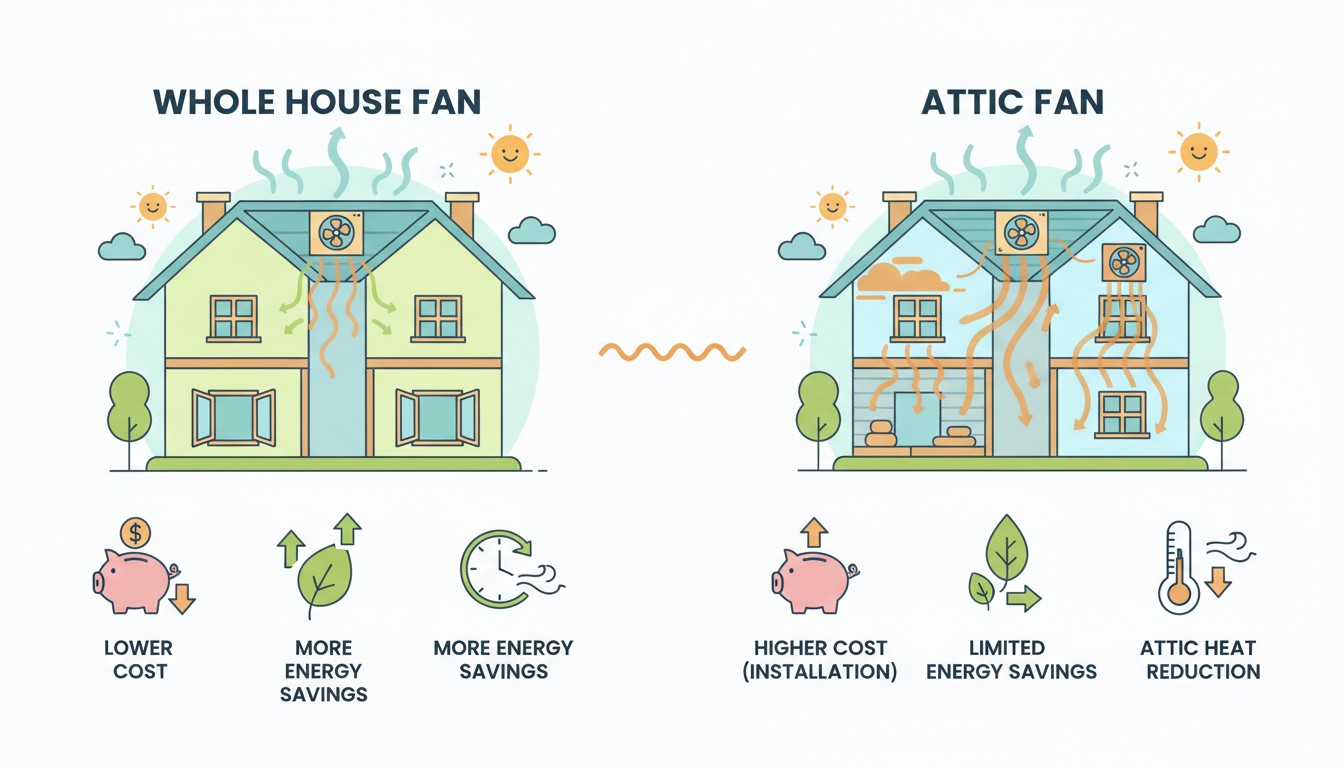
The decisions that most intimately shape your home’s thermal performance aren’t made by your HVAC installer or architect—they’re made in that forgotten space between your ceiling and roof where airflow either works for you or against you. Research from the U.S. Department of Energy shows that whole-house fans can use just 33% of the energy of central air conditioning, potentially saving 50-90% on cooling costs . Yet most homeowners install attic fans thinking they’re solving the same problem, only to discover they’ve accelerated conditioned air loss while barely cooling the living space .
This ventilation confusion creates a pervasive problem: while we obsess over smart thermostats and insulation R-values, the fundamental mechanism of heat removal—the actual movement of air—remains misunderstood. An attic fan that simply pushes hot attic air outside does nothing to cool your bedrooms directly. A whole-house fan that pulls cool evening air through your windows and flushes your entire home’s thermal mass can eliminate AC usage for months—but only if your climate cooperates. Understanding how these systems actually function transforms you from a frustrated homeowner into a strategic climate manager.
The Invisible Architecture: How Air Movement Shapes Your Home’s Fate
Every aspect of your home’s thermal experience rests on a foundation of airflow physics. The cubic feet per minute (CFM) of fan capacity, the square footage of attic vents, the timing of operation—these aren’t technical details but the invisible architecture that determines whether your upstairs stays habitable or becomes an oven by 10 AM.
Consider something as fundamental as operation timing. An attic fan controlled by a thermostat runs automatically when attic temperatures hit 100-110°F, typically mid-afternoon . This is when your AC is already working hardest, and the fan helps—slightly—by reducing ceiling radiance. But a whole-house fan requires manual operation during evening hours when outdoor temperatures drop below indoor levels, typically 70-75°F . It changes your home’s air 15-23 times per hour, flushing out all the heat that built up in walls, floors, and furniture during the day . The difference? One reduces heat gain; the other eliminates it entirely for hours.
The cumulative effect of these operational differences creates divergent outcomes. A homeowner in Sacramento who runs a whole-house fan from 6-8 AM can keep their home below 78°F until 2 PM without AC, saving $150 monthly during summer . The same homeowner with only an attic fan still runs AC continuously from noon onward, saving maybe $20 monthly from slightly reduced heat load. The difference isn’t just energy—it’s whether you can live comfortably without mechanical cooling during temperate months .
The Ventilation Decision Tree: What Controls Your Cooling Destiny
Whole House Fan: Cools living space directly, 1500-7000 CFM, evening operation, requires open windows, needs 2-4x attic vent area, $900-$1530 installed
Attic Fan: Cools attic only, 1000-1600 CFM, automatic daytime operation, no window changes, uses existing vents, $250-$350 installed
Energy Impact: Whole-house fan uses 200-650 watts; attic fan uses 200-400 watts; central AC uses 3500+ watts
Climate Fit: Whole-house fans excel in dry climates with cool nights; attic fans work anywhere but provide less cooling benefit
Best Practice: Use both—whole-house fan for living spaces, attic fan for dedicated attic ventilation with uninsulated ceilings
The Psychology of Fan Confusion: Why We Install the Wrong Solution
If the differences are so clear, why do homeowners consistently install attic fans expecting whole-house cooling? The answer lies in a combination of marketing ambiguity, installation path dependency, and a cognitive bias that overvalues mechanical solutions over operational strategy.
The Name Game: “Attic” vs “Whole House” Creates False Equivalence
Both products have “fan” and both are installed in the attic, so they must do similar things, right? This false equivalence bypasses rational analysis. Homeowners hear “attic fan” and assume cooling the attic cools the house. What they don’t understand is that modern, well-insulated attics are designed to be thermal buffers—heat shouldn’t radiate significantly through an R-49 insulated ceiling . The attic fan becomes a solution in search of a problem, while the real issue (heat trapped inside living spaces) goes unaddressed.
The Installation Path Dependency: The Easy Choice Isn’t the Right Choice
Attic fans are simpler and cheaper to install ($250-$350 total) —they mount to existing gable vents or require a simple roof cut, connect to existing attic power, and operate automatically. Whole-house fans cost 2-3x more ($900-$1,530) , require cutting into ceiling drywall, potentially bracing joists, installing dedicated circuits, and enlarging attic vents to 2-4x normal size . This installation friction pushes homeowners toward the easier, less effective solution, even when whole-house fans would deliver 5x the energy savings .
The Automation Addiction: “Set It and Forget It” Backfires
Attic fans operate automatically via thermostat—no user intervention required. This feels modern and convenient. Whole-house fans require manual operation and strategic window opening, which feels like a chore. Yet this “convenience” comes at a steep price: automatic attic fans can inadvertently suck conditioned air from your living space through ceiling leaks, increasing your AC bill by 10-15% . The manual effort of whole-house fan operation is precisely what makes it effective—you only run it when conditions are optimal, maximizing savings while minimizing energy waste.
The Cost Cascade: How Fan Choice Multiplies Your Investment
The initial price difference between fans creates a cascade effect that determines your true cost of ownership. Understanding this temporal dimension separates strategic buyers from penny-wise, pound-foolish shoppers.
Installation Cost Reality Check
Attic Fan: $250-$350 total installed . Includes $75-$225 fan unit, basic electrical connection, and either gable mounting (simple) or roof cut (moderate). Most installations complete in 2-3 hours by a handyman .
Whole House Fan: $900-$1,530 total installed . Includes $200-$1,600 fan unit, dedicated circuit ($200-$400), ceiling cut and joist bracing, and critical attic vent enlargement. Requires professional installation, typically 4-6 hours .
The Hidden Ventilation Cost
Whole-house fans require 1 square foot of net free vent area per 750 CFM . A 4,000 CFM fan needs 5.3 sq ft of vents—typically 2-4x your existing vent area. Adding dormer vents, ridge vents, or soffit vents costs $200-$800, often exceeding the fan cost but being absolutely critical for performance . Skip this and the fan will pressurize your attic, forcing hot air back into living spaces and potentially causing roof damage.
Energy Savings: Where Whole-House Fans Dominate
Attic Fan: Uses 200-400 watts. Saves an estimated $20-$40 monthly on AC by reducing ceiling radiance in poorly insulated attics . ROI: 1-2 years.
Whole House Fan: Uses 200-650 watts (about 33% of central AC power) . Can reduce or eliminate AC usage in temperate climates, saving $50-$150 monthly . In hot climates, using it to pre-cool at night can cut AC runtime by 50% . ROI: 2-4 years, but cumulative savings over 10 years can reach $5,000-$15,000 depending on climate.
10-Year Total Cost of Ownership
Attic Fan: $300 install + $1,200 electricity (10 years) = $1,500 total
Whole House Fan: $1,200 install + $1,500 electricity + $400 vent upgrades = $3,100 total
Savings Comparison: Whole house fan saves $6,000-$12,000 more on AC costs over 10 years in suitable climates
Pre-Installation Intelligence: The Assessment That Prevents Waste
1. Climate Reality Check
Whole-house fans only work when outdoor temperatures drop below indoor temperatures—typically evenings and early mornings . In humid climates, opening windows introduces moisture that your AC must later remove, potentially negating savings . Check your local weather patterns: if nights stay above 75°F or humidity exceeds 70%, a whole-house fan will provide limited benefit. Attic fans work regardless of outdoor temperature since they only target attic heat .
2. Attic and Insulation Assessment
Climb into your attic and assess:
- Insulation level: If you have R-49 or higher, attic fans provide minimal benefit because heat shouldn’t radiate through the ceiling
- Air sealing: Check for gaps around light fixtures, plumbing stacks, and chimneys. Poorly sealed attics lose conditioned air to attic fans
- Ventilation: Measure existing vent area. Whole-house fans need 2-4x more venting than code requires
3. Usage Pattern Honesty
Be realistic: Will you actually open windows every evening and run the fan manually? If you prefer “set it and forget it” automation, an attic fan is your better choice despite lower savings. If you enjoy the engagement of natural cooling and can build a routine, whole-house fans deliver superior results .
The Assessment Checklist (Do This First)
Climate: Night temperatures below 75°F? Humidity below 70%? If yes, whole-house fan viable
Insulation: Is attic floor insulated to R-49+? If yes, attic fan provides minimal benefit
Ventilation: Measure existing vent area. Can you enlarge it 2-4x for whole-house fan?
Lifestyle: Will you manually operate a fan daily? If not, choose automatic attic fan
Home Layout: Multi-story? Whole-house fan works best. Single-story with good cross-ventilation? Either works
Real-World Installations: What Worked, What Failed, and Why
The Sacramento Whole-House Fan That Eliminated AC
A homeowner installed a 4,000 CFM whole-house fan with enlarged dormer vents for $1,400. From May through September, they run the fan from 6-8 AM daily, cooling the house to 72°F. The AC doesn’t turn on until 3 PM, and only runs for 3 hours instead of 12. Their summer electricity bill dropped from $280 to $95 monthly—a $185/month savings that paid for the fan in 8 months . The key? Consistent operation during optimal temperature windows.
The Florida Attic Fan That Wasted Money
A homeowner in Miami installed a $300 attic fan hoping to reduce AC costs. Their attic was already insulated to R-38 and well-sealed. The fan ran automatically every afternoon but made zero perceptible difference in indoor comfort because heat wasn’t radiating through the ceiling. Worse, it created negative pressure that pulled humid outdoor air through tiny ceiling leaks, increasing indoor humidity. Their AC actually worked harder. After one year, they abandoned the fan. Their mistake? Not understanding that attic fans only help with poorly insulated ceilings .
The Dual-System Colorado Home That Optimized Everything
A Colorado homeowner installed both systems strategically. The attic fan (automatic) keeps the attic below 100°F during July afternoons, reducing stress on the well-insulated ceiling. The whole-house fan (manual) runs during cool mountain evenings from May-September, eliminating AC usage entirely. Their AC runs only 30 days per year instead of 120. The attic fan cost $250, the whole-house fan $1,200, and combined they save $1,400 annually on cooling. The synergy works because each addresses a different thermal load at different times .
The Final Decision: Which Fan Is Actually Right for You
The choice isn’t about which fan is “better”—it’s about which solves your actual problem:
Your Ventilation Strategy Is Hiding in Plain Sight
The fan choice you’re debating isn’t a trivial appliance selection—it’s the invisible architecture that determines whether your home stays comfortable for pennies or costs hundreds in wasted cooling. An attic fan quietly ventilates a space you rarely enter. A whole-house fan transforms your entire living environment in 30 minutes. One is a background tool; the other is a lifestyle change.
Your power to get this right doesn’t depend on HVAC certifications or construction experience. It depends on one thing: your honest assessment of your climate, your attic insulation, and your willingness to engage with manual operation. The fan will be installed whether you understand its function or not. The hot air will accumulate whether you manage it or not. You can be the homeowner who saves thousands annually by mastering natural ventilation, or you can be the one who wonders why their “ventilation solution” never seems to help.
The choice is yours. Start simple. Check your night temperatures. Inspect your insulation. Time how long your AC runs daily. Your cooling destiny begins with a single decision to stop guessing—and to let airflow physics, not product names, guide your investment.
Key Takeaways
Whole-house fans cool living spaces directly by pulling cool outdoor air through windows and exhausting hot air through enlarged attic vents, while attic fans only ventilate the attic space itself .
Installation costs differ dramatically: attic fans cost $250-$350 total, while whole-house fans cost $900-$1,530 due to ceiling cuts, electrical work, and required vent enlargement (2-4x normal vent area) .
Energy savings are substantial for whole-house fans in suitable climates—saving 50-90% on cooling costs by using 200-650 watts versus 3500+ watts for central AC, while attic fans save only $20-$40 monthly .
Cognitive biases like name confusion and automation addiction cause homeowners to install attic fans expecting whole-house cooling, leading to minimal comfort improvement and potential conditioned air loss .
Best practice: Use both systems strategically—whole-house fans in well-insulated homes with cool nights, attic fans for poorly insulated attics or as a supplement; proper sizing and vent area are critical for performance .