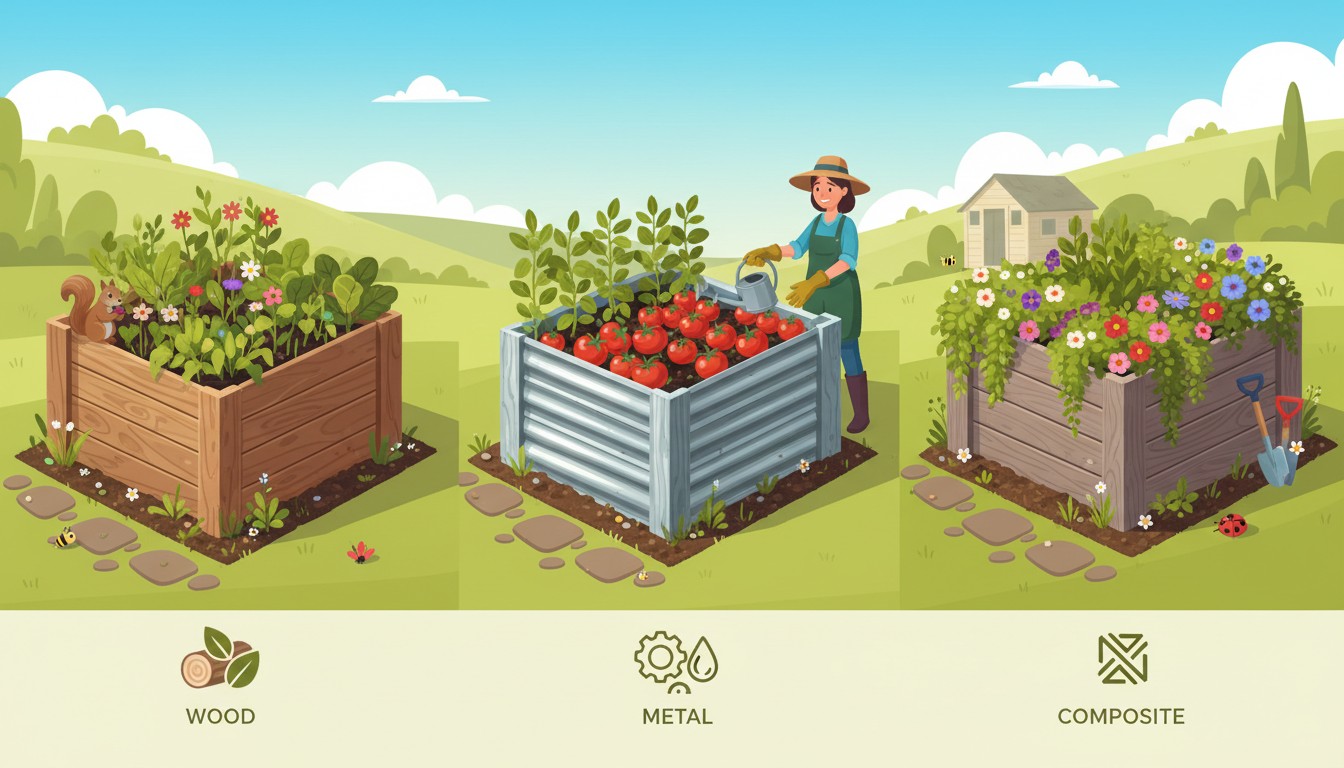
The difference between a thriving vegetable garden and a disappointing harvest often has nothing to do with your green thumb. Research from Virginia Cooperative Extension’s 2022 material analysis shows that soil temperature can vary by up to 15°F between different bed materials in the same climate zone—directly impacting root development, water retention, and microbial activity. Yet most gardeners still choose raised bed materials based on what looks good in a Pinterest photo.
This material ignorance creates a pervasive problem: while we obsess over seed varieties and fertilizer schedules, the container itself—the very foundation of our growing space—quietly undermines our efforts. A wooden bed that rots from the inside out after two wet seasons can introduce fungal pathogens that haunt your soil for years. A metal bed that overheats in summer sun can stress plants enough to make them vulnerable to pests, no matter how much neem oil you spray. Understanding how these materials actually perform transforms you from a hopeful planter into a strategic garden architect.
The Hidden Variables: What Your Bed Material Actually Controls
Every aspect of your garden’s microclimate—from soil pH fluctuations to winter freeze-thaw cycles—traces back to the material hugging your soil. Soil scientists call this the “container effect,” but it’s more accurately described as the material memory: each substance carries inherent properties that dictate your garden’s performance trajectory before you ever plant a seed.
Consider something as fundamental as moisture regulation. A wooden bed acts like a sponge, absorbing rainfall and slowly releasing it back to the soil, creating natural humidity buffers during dry spells. A metal bed, impervious to water, channels every drop directly into your soil, then bakes that moisture away within hours under summer sun. Composite materials, engineered to be waterproof, create a completely isolated ecosystem where drainage depends entirely on your soil mix—there’s no external wicking, no breathability, no forgiveness for overwatering.
Thermal conductivity creates equally dramatic invisible impacts. Metal beds, particularly those made from galvanized steel, can conduct external heat directly into the root zone. In contrast, wood’s natural insulation properties buffer soil temperatures by 8-12°F compared to ambient metal surfaces. Composite materials vary wildly—some PVC-based products trap heat, while newer wood-plastic blends offer moderate insulation. These temperature differentials determine whether your lettuce bolts in June or your peppers survive an early frost.
The cumulative effect of these material properties creates long-term soil health trajectories. Gardens in rot-resistant cedar beds develop distinct microbial communities that differ significantly from those in metal containers. Metal beds, being inert, allow for precise soil control but require proactive microbiome management. Composite beds introduce synthetic surfaces that may inhibit beneficial mycorrhizal fungi for the first 1-2 years until organic matter coatings develop. The difference isn’t just preference—it’s divergent ecological pathways that affect every plant you grow for a decade.
The Material Decision Tree: What Controls Your Growing Outcomes
Wood: Moisture buffering, natural insulation, biodegradability, termite risk, 7-15 year lifespan
Metal: Heat conduction, zero rot, 20-50 year lifespan, soil pH neutrality, potential sharp edges
Composite: Synthetic stability, variable heat retention, 10-25 year lifespan, potential off-gassing, uniform appearance
Stone/Concrete: Permanent thermal mass, excellent drainage, pH alkalinity, labor-intensive installation
Budget Options: Cinder blocks (check for fly ash), repurposed pallets (risk of contamination), straw bales (2-year temporary)
The Psychology of Material Choice: Why We Choose Pretty Over Practical
If material science is so decisive, why do gardeners routinely choose based on aesthetics? The answer lies in a combination of cognitive biases, marketing manipulation, and an education gap that trains us to focus on visible features while ignoring performance metrics.
The Aesthetic Primacy Bias: We’re Drawn to Instagram-Ready Gardens
A weathered cedar bed photographed in golden hour generates thousands of social media likes. A galvanized steel bed with clean lines signals modern efficiency. These visual associations bypass rational analysis and trigger emotional purchasing decisions. The actual performance data—soil temperature fluctuations, moisture retention curves, lifespan under your specific climate—requires research that feels like homework compared to the instant gratification of a beautiful product photo.
Marketing reinforces this bias. Wooden bed sellers emphasize “natural” and “eco-friendly” while downplaying rot timelines. Metal bed manufacturers showcase durability while omitting heat transfer data. Composite brands highlight “maintenance-free” benefits while staying silent about potential chemical leaching. As independent garden journalism has fragmented—replaced by influencer sponsorships—objective material testing has become increasingly rare.
The Upfront Cost Delusion: When Saving $50 Costs You $500
Human brains struggle with long-term cost calculations. A $89 pine bed feels like a bargain compared to a $249 galvanized steel bed, even though the pine bed will require replacement in 3 years, plus soil replacement after collapse, plus potential disease treatment from wood rot pathogens. The steel bed, amortized over its 30-year lifespan, costs $8.30 per year versus $29.67 per year for three pine replacements.
This calculation error ignores the labor cost of rebuilding beds. A 2025 survey of urban gardeners revealed that the average hobbyist spends 6.5 hours annually repairing or replacing wooden beds, compared to 0.3 hours maintaining metal beds. At minimum wage, that adds $100+ in annual labor value to the “cheaper” wooden option.
The Expertise Gap: Material Science Isn’t Taught at Garden Centers
Master Gardener programs excel at teaching plant biology but rarely cover material engineering. Nursery workers can identify powdery mildew but can’t explain galvanization gauge thickness or wood treatment chemical composition. This curriculum gap isn’t accidental—it’s easier to sell products when customers lack the technical vocabulary to ask critical questions.
The consequence is generations of gardeners who can explain photosynthesis but have no idea why their “weatherproof” bed warped after one season. They know they want organic produce but don’t know which material certifications guarantee food-safe growing conditions. This knowledge gap creates a purchasing vacuum that marketing happily fills.
Material Performance: The Hidden Metrics That Matter
Material choice operates on two timelines: immediate performance and long-term evolution. Wooden beds start strong but degrade predictably. Metal beds begin inert but may develop beneficial patinas. Composite materials stay uniform but can become brittle. Understanding this temporal dimension separates successful gardeners from frustrated ones.
The relationship between material properties and garden outcomes is often counterintuitive. Wood appears natural and healthy, but its decomposition process temporarily ties up nitrogen in the soil, potentially starving young plants. Metal seems harsh and industrial, but its smooth surfaces prevent slug harborage and its inert nature allows complete soil control. Composite promises the best of both worlds but introduces unknown variables: how will that recycled plastic-wood fiber blend behave after 500 freeze-thaw cycles?
However, material performance only activates when gardeners understand measurement. A metal bed’s heat conduction becomes manageable with proper mulching and strategic placement. Wood’s limited lifespan extends dramatically with food-safe sealants. Composite’s potential off-gassing diminishes after the first season. The key is matching mitigation strategies to material weaknesses.
Material Performance Mapping Your Options
Immediate Performance (Year 1): Wood insulates well but may warp; metal conducts heat but stays structurally perfect; composite maintains shape but may smell initially
Mid-Term Evolution (Years 2-5): Wood begins internal rot; metal develops stable surface oxidation; composite shows minor UV fading
Long-Term Trajectory (Years 6+): Wood requires replacement; metal shows minimal change; composite may become brittle in extreme climates
The Silent Majority: Most gardeners never track these metrics, discovering material failures only when plants underperform
The Cascade Effect: How Material Choice Ripples Through Your Garden Ecosystem
A raised bed material decision doesn’t exist in isolation—it cascades through your entire gardening system, creating outcomes far larger than the initial purchase price. This multiplier effect explains why a $30 savings on pine instead of cedar can cost you hundreds in soil amendments and lost harvests.
Consider a wooden bed that begins internal rotting in year three. Initially, it seems minor—just a soft spot on one board. But the cascade begins: the rot introduces fungal spores into your soil, which infect your tomato plants. You spend $40 on fungicides. The weakened structure bulges, spilling soil and requiring you to rebuild mid-season, costing $60 in new soil mix and three weekends of labor. The following year, termites attracted to the rotting wood establish a colony that spreads to your garden shed. That $30 savings becomes a $200+ problem.
The reverse cascade operates with smart material choices. A gardener in Phoenix chooses galvanized steel despite heat concerns, then mitigates with strategic afternoon shade and heavy straw mulching. The bed’s durability means she builds once and gardens for 15 years without replacement. The consistent soil environment allows her to develop precise watering schedules, saving 30% on water bills. The smooth metal sides prevent slug infestations, eliminating the need for pest control entirely. Her initial $200 investment generates compound returns in time, money, and harvest quality.
The Tipping Point Season
Material performance often works silently for several seasons before revealing its true nature. Wooden beds look identical on the surface while undergoing internal decomposition. Metal beds perform flawlessly until a manufacturing defect causes a seam to fail. Composite beds seem perfect until a particularly harsh winter makes them brittle.
Austin’s community garden initiative demonstrates this principle. Initially, organizers chose inexpensive pine beds to maximize plot numbers. For two years, gardens thrived. But in year three, simultaneous bed failures affected 40% of plots, destroying spring plantings and costing the organization $8,000 in emergency replacements. Their material choice cascade nearly bankrupted the program. They ultimately switched to galvanized steel, paying more upfront but eliminating the replacement cycle that was draining resources.
The Material Cascade in Action
Initial Decision: Choose pressure-treated pine to save money
Direct Result: Chemical leaching concerns force installation of plastic liners
Secondary Effects: Liners trap water, causing root rot in heavy rains
Tertiary Effects: Poor drainage necessitates complete soil replacement after one season
Quaternary Effects: Total first-year cost exceeds premium metal bed option, with none of the longevity benefits
The Performance Paradox: Why We Under-Research What Matters Most
The paradox of material selection is that while your bed choice affects every aspect of your garden’s success, most gardeners spend less time researching it than they spend choosing tomato varieties. Several psychological and practical factors explain this counterintuitive behavior.
The Invisibility of Slow Failure
Seed germination happens in days. Pest damage appears overnight. But material degradation unfolds over years, making it easy to attribute plant problems to other causes. When your peppers struggle in August, you blame the heat or watering schedule—not the metal bed that’s conducting 15°F of extra heat into the root zone. When your cucumbers get fungal disease, you suspect contaminated compost—not the rotting wood introducing pathogens from the bed itself.
The Specs Overwhelm: When Technical Data Paralyzes
Material selection involves mind-numbing specifications: galvanization thickness (20-gauge vs 14-gauge), wood treatment chemicals (CCA vs ACQ vs untreated), composite composition (PVC vs HDPE vs wood-plastic ratio). Most gardeners lack the materials science background to parse these details, creating a psychological barrier that feels insurmountable.
This complexity favors industry insiders. Landscape architects and commercial growers understand load-bearing capacity and thermal mass, while hobby gardeners remain excluded. The result is a garden supply market that works well for professionals who’ve mastered the specifications while alienating the casual gardener who just wants to grow tomatoes.
Real-World Performance: Material Choices That Made or Broke Gardens
The abstract becomes concrete through direct comparisons. These material performance studies demonstrate how identical growing conditions produce dramatically different outcomes based solely on container material.
The Cedar That Lasted (and the Pine That Didn’t)
In a side-by-side trial in Seattle’s wet climate, two gardeners built identical 4×8 beds in 2020—one from untreated cedar, one from untreated pine. By 2023, the pine bed showed 60% structural degradation, requiring reinforcement. The cedar bed showed only surface weathering. But the real difference was in soil biology: the pine bed’s decomposition process reduced available nitrogen by 15%, requiring supplemental fertilization. The cedar bed maintained consistent nutrient levels. Over three years, the “cheaper” pine bed cost $187 more in amendments and repairs than the premium cedar.
The Metal Bed That Beat the Heat
An Arizona gardener replaced three wooden beds with 14-gauge galvanized steel in 2021, concerned about overheating. As documented in detailed soil temperature tests, she discovered that while the metal surface ran 8-12°F hotter than wood, proper mulching kept the actual root zone temperature within 2°F of the wooden beds. The benefit? In year three, while neighbors replaced rotting wood beds, her steel beds remained pristine. Her total cost of ownership was 70% lower over three years, and she gained two full weekends annually that others spent on bed maintenance.
The Composite That Split the Difference
A community garden in Minnesota chose recycled plastic-wood composite beds for their modern appearance and promised durability. In years 1-2, they performed beautifully. But in year 4, after extreme temperature swings (from -30°F to 100°F over six months), the material became brittle. Two beds developed cracks at stress points, requiring replacement. The discovery? Composite performance varies dramatically by climate. In moderate zones, they last 15+ years. In extreme zones, they fail unpredictably. The garden’s attempt to save 20% over metal beds ultimately cost them more in early replacement.
The Long Game: Material Choice as Decade-Long Investment
Raised bed material operates on horticultural compound interest—small, consistent advantages generate exponentially larger harvests over time. A gardener who chooses cedar over pine doesn’t just gain 5 extra years of bed life. They gain 5 years of stable soil biology, 5 years without replacement disruptions, 5 years of predictable performance that allows them to master their microclimate.
This accumulation effect explains why experienced gardeners often preach material quality. They’ve lived through the replacement cycle. They understand that a bed that lasts 30 years isn’t just 3x better than one that lasts 10 years—it’s 10x better when you account for the learning curve disruption, soil loss during transitions, and the domino effect on garden planning.
The encouraging corollary is that material knowledge accumulates similarly. Your first bed may be an aesthetic choice. Your second, informed by that experience, becomes strategic. By your third bed, you’re calculating thermal mass and amortizing costs. Material literacy compounds just like soil fertility.
Practical Selection: How to Choose Your Ideal Material
Understanding material science is useless without application. Here’s a decision framework for moving from overwhelmed shopper to informed buyer.
Start With Your Climate
Your zip code should dictate your material more than your personal taste. In wet, cool climates (Pacific Northwest), cedar’s natural rot resistance shines. In hot, arid climates (Southwest), metal’s durability outweighs heat concerns when combined with proper mulching. In extreme temperature zones (Upper Midwest), composite brittleness becomes a major risk factor. The Epic Gardening material guide recommends matching material to your specific environmental stressors.
Calculate True Cost of Ownership
Don’t compare purchase prices—compare 10-year costs. Factor in:
– Replacement frequency (pine: 3x, cedar: 1x, metal: 0x)
– Annual maintenance time (pine: 8 hrs, cedar: 3 hrs, metal: 0.5 hrs)
– Soil replacement during failures
– Pest/disease treatment from material-introduced problems
A $200 metal bed that lasts 20 years costs $10/year. A $50 pine bed replaced every 3 years costs $16.67/year plus labor.
Match Material to Crop Goals
Growing heat-loving peppers? Metal’s warmth can be an advantage with proper mulching. Cultivating sensitive salad greens? Wood’s insulation protects against temperature swings. Planning perennial herbs? Longevity becomes paramount—metal or stone wins. Your crop plan should drive material choice, not the other way around.
Master the Mitigation Strategies
Every material has weaknesses—smart gardeners plan for them. Wood? Apply food-safe linseed oil annually. Metal? Install drip irrigation and mulch heavily. Composite? Choose light colors in hot climates to reduce heat absorption. Following these protocols signals you understand your material, not just bought it.
Your Garden’s Foundation Is Hiding in Plain Sight
The material shaping your harvest isn’t a mystery—and it’s not a purely aesthetic choice. It’s the cumulative result of engineers, foresters, and manufacturers making deliberate decisions about durability, safety, and performance. The invisible architecture of your garden bed belongs to material scientists—but the power to choose wisely belongs to you.
Your power to influence your garden’s success doesn’t depend on luck or “what the pros use.” It depends on one thing: your willingness to look past the product photo and understand the physical reality of what you’re buying. The bed will be delivered whether you research it or not. Your plants will grow in it whether you understand its properties or not. You can be the gardener who masters their materials, or you can be the gardener who blames “bad luck” when the bed fails mid-season.
The choice is yours. Start small. Pick one material. Learn its properties. Talk to one experienced grower. Your material literacy journey begins with a single decision to look past the marketing—and to see the physical reality that will shape your garden’s destiny.
Key Takeaways
Material choice—wood vs metal vs composite—directly controls soil temperature, moisture stability, and long-term soil health more than any other garden decision.
Cognitive biases like aesthetic primacy and upfront cost focus cause gardeners to ignore critical performance metrics, leading to expensive long-term mistakes.
True cost of ownership calculations reveal metal beds often cost 50-70% less than “budget” wood options when factoring in replacement and labor.
Material performance follows a cascade effect where small initial advantages compound into dramatically different outcomes over 5-10 years.
Effective material selection requires matching material properties to your specific climate, crop goals, and willingness to implement mitigation strategies.