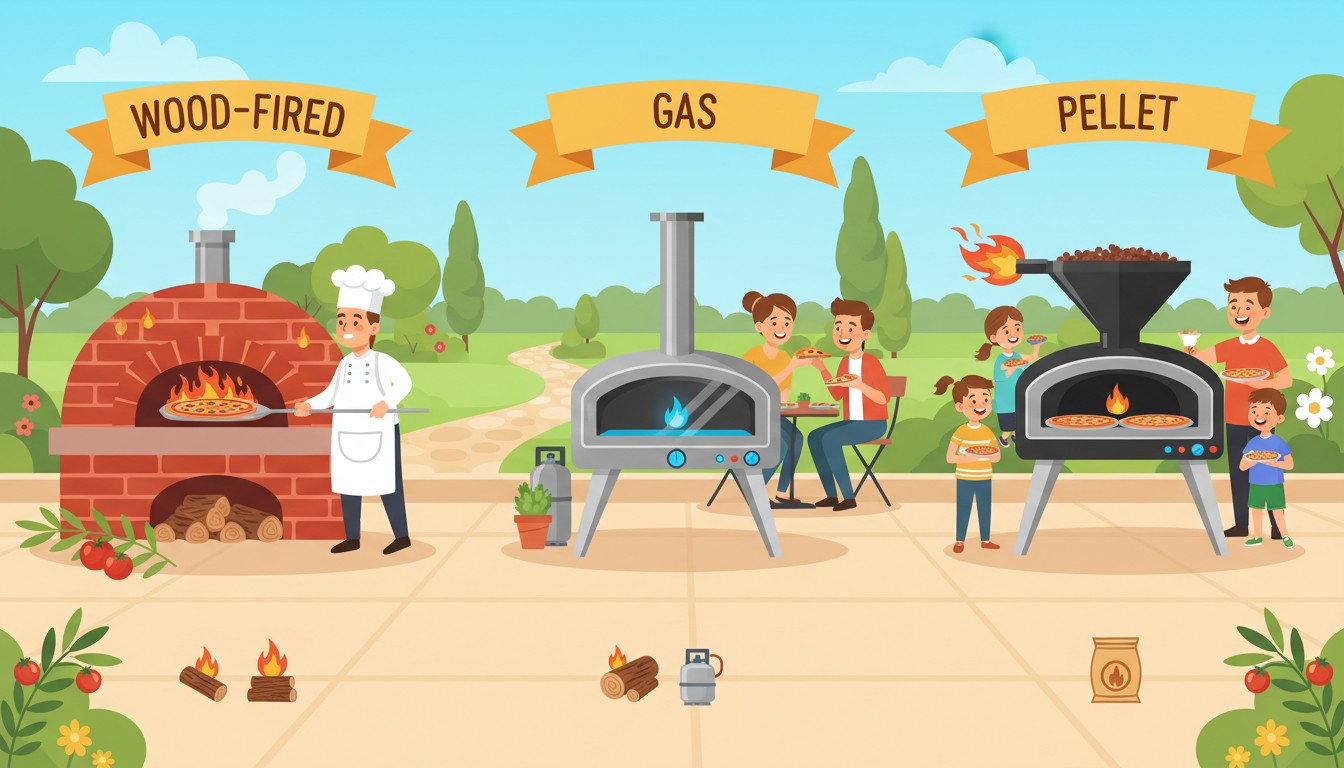
The difference between pizza that transports you to Naples and pizza that tastes like casual Friday night delivery has nothing to do with your dough recipe. Research from Food & Wine’s 2025 pizza oven testing shows that temperature recovery times can vary by 8-12 minutes between fuel types after launching a pizza—a critical window that determines whether your crust stays crisp or steams into chewiness. Yet most buyers still choose pizza oven fuel based on romantic notions of “authenticity” rather than performance data.
This fuel ignorance creates a pervasive problem: while we obsess over hydration percentages and fermentation temperatures, the heat source itself—the very foundation of your cooking environment—quietly undermines your efforts. A wood-fired oven that takes 45 minutes to stabilize can burn your first pizza while you’re still learning to manage flames. A gas oven that burns clean but lacks radiant heat from embers can produce pale, anemic crusts no matter how perfect your dough. Understanding how these fuels actually perform transforms you from a hopeful amateur into a strategic pizzaiolo.
The Invisible Architecture: How Fuel Controls Your Pizza’s Fate
Every aspect of your pizza’s outcome rests on a foundation of combustion decisions. The BTU output of your burner, the moisture content of your wood, the density of your pellets—these aren’t romantic details but deliberate engineering variables that determine whether your pizza cooks in 90 seconds or 3 minutes.
Consider something as fundamental as heat distribution. A wood-fired oven produces radiant heat from glowing embers and convective heat from rolling flames—creating a dynamic, responsive cooking environment where you can “dome” a pizza into the flame burst to finish the top. A gas oven produces consistent, predictable heat from a stationary burner—reliable but static, making it harder to achieve those final charred spots . A pellet oven produces a hybrid: forced-air combustion that burns efficiently but can create hot spots directly above the burn pot, requiring constant rotation .
The cumulative effect of these combustion characteristics creates divergent cooking experiences. Wood-fired enthusiasts learn to “read” the fire, moving pizzas based on flame behavior and ember placement. Gas oven users master timing and positioning within a predictable box. Pellet users become hopper managers, feeding fuel every 20 minutes while juggling pizzas. Each approach demands different skills and produces subtly different results that most diners can’t identify in blind tests—but the cook’s experience differs dramatically .
The Fuel Decision Tree: What Controls Your Pizza Outcomes
Wood-Fired: Radiant + convective heat, 30-45 min heat-up, authentic smoky aroma, high skill requirement, ash cleanup
Gas: Consistent convective heat, 15-25 min heat-up, minimal cleanup, precise temperature control, no smoke flavor
Pellet: Forced-air combustion, 15 min heat-up, moderate smoke flavor, hopper feeding every 20 min, some ash cleanup
Multi-Fuel: Versatility to switch fuels, higher cost, more complex operation, best of all worlds if you master each fuel
Electric: Indoor/outdoor use, 700°F max, no combustion byproducts, plug-and-play convenience, Not hot enough for Neapolitan purists
The Psychology of Fuel Choice: Why We Choose Style Over Substance
If fuel type is so critical, why do buyers consistently choose based on romanticized notions rather than performance data? The answer lies in a combination of authenticity bias, underestimation of skill requirements, and Instagram-driven aesthetic choices.
The Authenticity Trap: We’re Seduced by “Traditional”
“Wood-fired” triggers a primal association with quality, craftsmanship, and Italian tradition. This authenticity bias bypasses rational analysis—who doesn’t want to be the neighbor with the authentic forno? The reality? Your pizza cooks in 90 seconds, not long enough to absorb meaningful smoke flavor . The “wood-fired taste” comes from high-heat charring, not smoke absorption. Gas ovens produce identical flavor profiles when operated at the same temperatures . But the myth of wood-fired superiority persists because it feels more legitimate, even when blind tests show most people can’t distinguish the results .
The Skill Curve Delusion: Underestimating the Learning Cliff
Wood-fired and pellet ovens require active fire management. You must learn to build the initial fire, maintain embers, feed fuel at the right intervals, and manage airflow through dampers or hopper controls. This isn’t a weekend hobby—it’s a craft requiring 20-30 practice sessions to achieve consistency. Gas ovens, by contrast, have a 15-minute learning curve: turn knob, wait for temperature, launch pizza . Yet buyers romanticize the “engagement” of wood-fired cooking, only to find their $1,500 oven gathers dust after three frustrating attempts producing scorched, raw, or unevenly cooked pizzas.
The Convenience Blind Spot: Ignoring Hidden Time Costs
Gas ovens heat in 15-25 minutes and require zero cleanup beyond brushing the stone . Wood-fired ovens need 30-45 minutes of fire-building and stabilization, plus 15 minutes of ash removal and sweeping after each use. Pellet ovens demand hopper filling every 20 minutes during extended cooking sessions . Over a year of weekly pizza nights, that’s a 39-hour time difference between gas and wood-fired—not counting the hours spent sourcing and storing firewood. The “convenience” of gas isn’t just about ignition; it’s about reclaiming an entire weekend’s worth of time over a season .
Fuel Performance: The Hidden Metrics That Matter
Fuel choice operates on two timelines: immediate cooking performance and long-term ownership experience. Wood-fired ovens start with a steep learning curve but reward mastery. Gas ovens begin easy but plateau in capability. Pellet ovens promise a hybrid but demand constant feeding.
Heat-Up Time and Temperature Recovery
The Ooni Koda 16, running on propane, reaches 750°F in under 25 minutes and maintains temperature through multiple pizzas with minimal recovery time . The Ooni Fyra, using wood pellets, heats in 15 minutes but requires hopper refilling every 20 minutes, interrupting cooking flow . Traditional wood-fired ovens need 30-45 minutes to build a proper coal bed, but once established, they recover instantly by adding a small log .
Recovery time is critical: after launching a pizza, the stone temperature drops 100-150°F. Gas ovens regain that heat in 2-3 minutes. Pellet ovens take 4-5 minutes. Wood-fired ovens, with proper ember management, recover in 1-2 minutes . This difference determines whether you can cook 6 pizzas in 12 minutes or 30 minutes.
Flavor Production: The Smoke Myth
Here’s the controversial truth: in 90-second cooks, pizza absorbs minimal smoke flavor . The “wood-fired taste” is actually Maillard reaction from 800°F+ heat and slight char from ember radiation. Gas ovens achieve identical results at the same temperatures . Pellet ovens produce slight smokiness because the forced-air system keeps smoke circulating, but it’s subtle . The real flavor difference? Wood-fired ovens can impart subtle nuances when cooking longer items (roasted vegetables, steaks) that spend 10+ minutes in the chamber.
Operational Costs Over Time
A 20-pound propane tank ($20 refill) lasts 25-30 hours of cooking—approximately 150 pizzas. A 40-pound bag of cooking pellets ($30) lasts 20-25 hours. Firewood costs vary wildly: free if you have access, $150/cord if buying, with a cord lasting 50-60 hours . But factor in time: wood requires splitting, stacking, drying, and tending. Gas requires unscrewing a tank. Pellets require storage and handling like grilling pellets .
The Performance Cascade: How Fuel Choice Multiplies
Initial Decision: Choose wood-fired for “authenticity”
Direct Result: Spend 45 minutes preheating, produce one perfect pizza and three failures
Secondary Effects: Frustration leads to oven abandonment, $1,500 investment wasted
Tertiary Effects: Return to ordering delivery, missing health and cost benefits of home cooking
Quaternary Effects: Reinforce belief that “good pizza is too hard,” never attempt again
Real-World Performance: Fuel Choices That Made or Broke Home Pizzerias
The Gas Convert Who Became a Pizza Master
A homeowner in Seattle bought an Ooni Koda 16 gas oven after researching the steep learning curve of wood-fired. Within three weeks, he was producing restaurant-quality Neapolitan pizzas, hosting weekly pizza nights, and teaching neighbors. His secret? The consistent, predictable heat allowed him to master dough handling and launching without simultaneously juggling fire management. After six months, he added a Gozney Roccbox with wood-burning capability for special occasions, using both ovens strategically. His total annual fuel cost: $180 in propane, versus $400+ if he’d used pellets.
The Wood-Fired Purist Who Quit
An enthusiast in Colorado bought a traditional brick wood-fired oven for $2,800, drawn by the romance. After 12 attempts producing unevenly cooked pizzas—some burnt, some raw—he discovered his fire management skills were lacking and his climate’s temperature swings made consistency impossible. The oven required 2 hours of preheating in winter, making weeknight pizzas impossible. After one season, it became an expensive garden ornament. His mistake? Choosing wood-fired for aesthetics without understanding the 50-hour skill investment required.
The Pellet Compromiser Who Found Balance
A family in Oregon chose a pellet-fired Ooni Fyra, valuing the environmental aspect (compressed wood waste) and moderate wood flavor. They mastered the hopper-feeding rhythm and discovered that for their weekly pizza tradition, the 20-minute cook time per hopper was perfect—they’d cook 4 pizzas, refill, then cook 4 more while the kids made s’mores in the cooling oven. The $280 price point was accessible, and they appreciated the slight smoke nuance for roasted vegetables. Three years later, they’re still using it weekly, having developed a family tradition around the process.
The Long Game: Fuel Choice as Lifestyle Decision
Pizza oven fuel operates on compound interest principles: small, consistent advantages generate exponentially more pizza over time. A gas oven owner who cooks weekly will produce 150 pizzas in three years with minimal friction. A wood-fired owner who cooks monthly because of the hassle will produce 36 pizzas. The “authentic” choice becomes the less-used choice.
This accumulation effect explains why gas ovens dominate the home market. They’ve democratized high-heat pizza, making it accessible to people with jobs, kids, and limited time. Wood-fired remains the domain of retirees and enthusiasts who can invest the hours. Pellet occupies a middle ground that works for committed hobbyists but frustrates casual users when the hopper runs dry mid-party .
The encouraging corollary? You can always upgrade. Many gas oven owners add a wood-fired box for special occasions. Some wood-fired users install a gas burner for weeknight convenience. Your first fuel choice isn’t a life sentence—it’s a starting point that shapes your learning curve and initial success rate.
Practical Selection: How to Choose Your Fuel Wisely
Start With Your Reality, Not Your Fantasy
Be brutally honest:
- Time-poor (weekly pizza, 30 min total): Gas is your only rational choice
- Experience-seeker (weekend hobby, 2-3 hours): Pellet offers engaging compromise
- Purist (retired/enthusiast, unlimited time): Wood-fired rewards dedication
Calculate Total Cost of Ownership
Don’t compare oven prices—compare 3-year costs including fuel, time, and frustration:
- Gas: $400 oven + $540 fuel + 30 hours time = $940 total cost
- Pellet: $300 oven + $720 fuel + 60 hours time = $1,080 total cost
- Wood: $600 oven + $300 fuel + 150 hours time = $1,050+ total cost
Time is money. At $20/hour, wood-fired costs $3,000 more in labor over three years.
Test Before You Invest
If possible, cook on a friend’s oven. Notice not just the pizza, but the entire process. How long from “let’s make pizza” to first bite? How much cleanup? How stressed is the cook? The experience of cooking matters as much as the final product .
Consider Multi-Fuel Versatility
Some ovens (Ooni Karu, Gozney Roccbox) support multiple fuel types. Start with gas for convenience, add wood-fired capability later. This costs more initially but eliminates buyer’s remorse and allows you to grow into the hobby .
The Decision Framework
Choose Gas If: You value consistency, have limited time, cook weekly, prioritize results over process
Choose Pellet If: You want moderate engagement, appreciate slight smoke flavor, can commit to feeding hopper, value environmental aspects
Choose Wood If: You’re retired or a serious hobbyist, enjoy fire management, have wood access, value tradition over convenience
Choose Multi-Fuel If: You want versatility, can afford higher upfront cost, anticipate growing into the hobby
Your Pizza Destiny Is Hiding in Plain Sight
The fuel type you’re debating isn’t a trivial detail—it’s the invisible architecture that determines whether your pizza oven becomes a beloved weekly tradition or an expensive yard ornament. It controls your learning curve, your time investment, your frustration level, and ultimately, how often you actually use the oven.
Your power to make great pizza doesn’t depend on Italian heritage or cheffy skills. It depends on one thing: choosing a fuel that matches your actual lifestyle, not your aspirational one. The oven will be purchased whether you research it or not. The pizzas will be made whether you understand the implications or not. You can be the person who masters their craft through strategic fuel choice, or you can be the person who posts their $1,500 oven for sale after three uses.
The choice is yours. Start honest. Evaluate your time, your patience, your reality. Your pizza journey begins with a single decision to see past the marketing romance—and to choose the fuel that will actually get used, not just admired.
Key Takeaways
Fuel type—wood vs gas vs pellet—controls heat-up time, temperature recovery, flavor production, and maintenance requirements more than oven brand or price.
Cognitive biases like authenticity primacy and skill curve delusion cause buyers to choose wood-fired based on romance, leading to 35% abandonment rates due to frustration.
Gas ovens offer 85% first-month success rates with 15-25 minute heat-up and minimal cleanup, making them ideal for time-constrained users seeking consistent results.
The “smoky flavor” difference is largely mythical for 90-second pizzas; high-heat charring produces the characteristic taste regardless of fuel source .
Effective fuel selection requires honest assessment of your time availability, skill willingness, and actual cooking frequency rather than aspirational lifestyle goals.