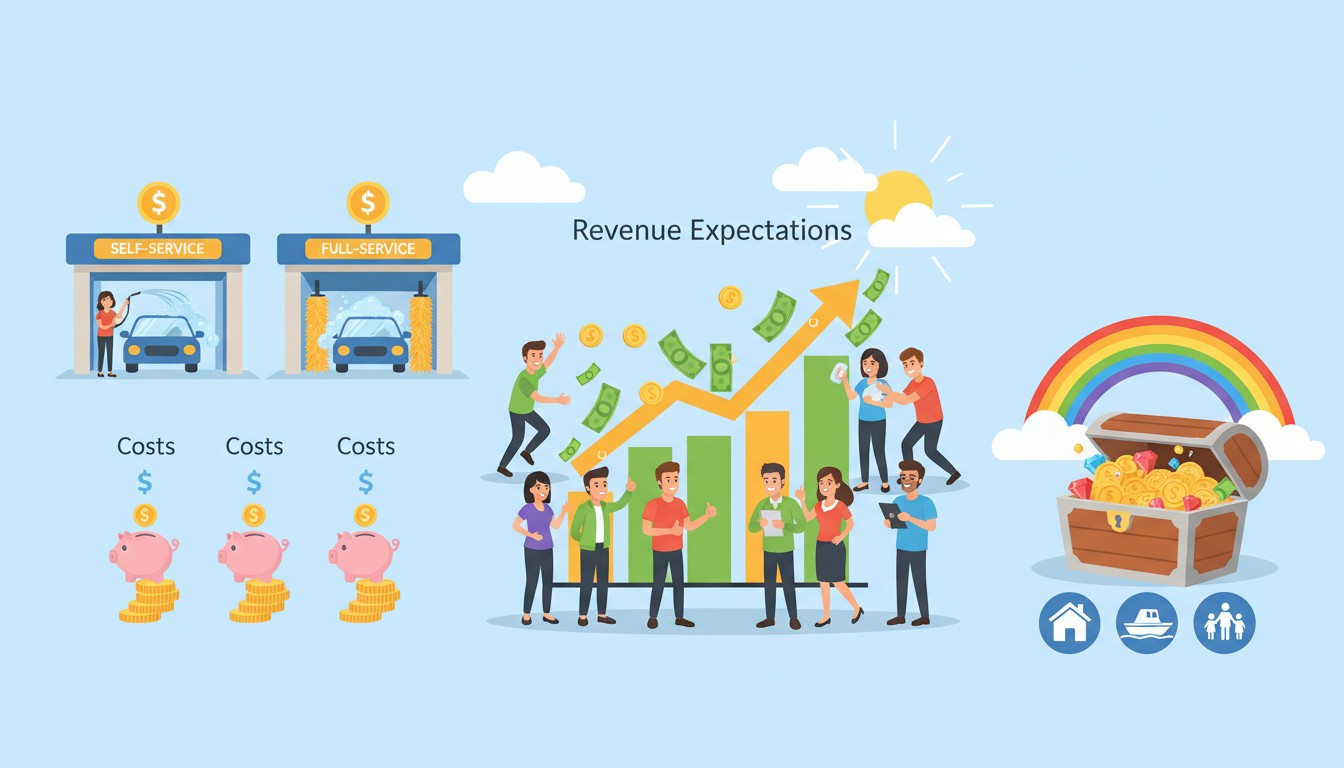
The investment opportunity most entrepreneurs overlook isn’t a tech startup or crypto venture—it’s the humble car wash cleaning America’s 280 million vehicles. With average profit margins reaching 60% and operating costs consuming just 40-50% of gross revenue, car washes deliver returns that restaurants and retail landlords dream about. Yet research shows fewer than 3% of small business buyers consider this asset class, creating a participation gap that sharp operators exploit.
This neglect creates a paradox: the most recession-resistant service business receives the least attention. While investors obsess over food franchises and e-commerce, car washes quietly delivered 15% annual cash-on-cash returns through the 2008 crisis and the 2020 pandemic. Understanding the types, costs, and revenue expectations transforms you from a passive observer into an active wealth builder.
The Invisible Revenue Streams: Four Business Models That Print Money
Every car wash operates on a brutally efficient service model. Customers pay for convenience, speed, and results. The owner provides equipment, water, and chemicals. That’s it. No inventory to spoil, no perishable goods, no complex supply chains. The profit math is stark: self-service bays operate at 50-60% margins while tunnel systems achieve 40-60% margins—nearly triple what most franchises deliver.
This efficiency explains why car washes survive economic downturns. When money’s tight, people wash cars themselves in self-service bays. When times are good, they splurge on $20 tunnel washes. In both scenarios, you profit. The business scales ruthlessly: adding another tunnel lane doesn’t require doubling your staff. Modern facilities use automated pay stations, license plate recognition, and subscription apps, letting owners manage remotely.
The Four Models: Choose Your Cash Flow
Self-Service: 3-6 bays, coin/card operated, minimal staffing, $150K-$300K investment
Automatic/Tunnel: Conveyor systems, high throughput, $400K-$1.5M investment
Full-Service: Hand washing, detailing, multiple revenue streams, $500K-$3M investment
Mobile: Van-based, no real estate, lowest barrier, $15K-$50K investment
The Economics of Clean: Breaking Down Costs and Revenue
Before purchasing any car wash, you must master the cost-to-revenue ratio. This single metric determines everything. Calculate total investment by combining land, construction, equipment, and working capital, but accuracy demands meticulous verification of every line item.
Total investment varies dramatically by type. A self-service bay costs $20,000-$70,000 to build, while a tunnel system demands $500,000-$1,500,000+. Land acquisition adds $500,000-$2,000,000 depending on location. Equipment represents 25-35% of total investment, with touchless systems running $45,000-$160,000 and tunnel equipment reaching $100,000-$500,000.
Revenue depends on throughput and pricing. A self-service bay washes 15-30 cars daily at $5-$8 per wash, generating $2,700-$7,200 monthly revenue per bay. Automatic tunnels handle 100-200 cars daily at $12-$20 per wash, producing $36,000-$120,000 monthly. The average Tommy’s Express franchise generates $2,092,628 annually after year three, while mobile operations like Spiffy average $664,000 per location.
Operating expenses consume 40-50% of revenue in well-run facilities. Labor runs 25-35% for full-service washes but only 10-15% for automated tunnels. Utilities (water, electricity, gas) cost $2,000-$8,000 monthly depending on volume. Chemicals add $0.50-$1.50 per car. Maintenance reserves should be 3-5% of gross revenue annually.
The Payback Formula: When You’re In The Black
Self-Service Bay: $50K investment ÷ $4K monthly profit = 12.5 month payback
Automatic Tunnel: $800K investment ÷ $25K monthly profit = 32 month payback
Mobile Unit: $30K investment ÷ $3K monthly profit = 10 month payback
Full-Service: $1.5M investment ÷ $45K monthly profit = 33 month payback
The Psychology of Car Wash Blindness: Why We Ignore What Works
If car washes are so profitable, why do 97% of small business buyers ignore them? The answer lies in cognitive biases and perception gaps that create market inefficiencies.
The Glamour Bias: Boring Doesn’t Mean Bad
Car washes lack narrative excitement. You can’t pitch a car wash on Shark Tank with a dramatic backstory. Our brains chase novelty—food trends, tech startups, boutique fitness—while ignoring the steady $8 per wash that adds up to $600,000 annually. This bias leaves deals for disciplined investors who value EBITDA over excitement.
The Tommy’s Express franchise generates $2.09 million average annual revenue per location after year three. That’s not glamorous, but it’s profitable.
The Industrial Aversion: Complexity Phobia
Car washes feel industrial and intimidating. Most buyers understand restaurants intuitively—they’ve eaten at them. But calculating water reclamation capacity or conveyor belt maintenance? It triggers analysis paralysis.
This complexity is superficial. Modern equipment comes with service contracts. Chemicals are delivered pre-mixed. Software automates 80% of operations. The learning curve is 90 days, not years. The intimidation factor screens out competition, protecting margins for those who push through.
The Effort Miscalculation: Time vs. Returns
Human brains miscalculate the ROI of “boring” businesses. A food truck feels accessible—you can picture working it. A car wash feels distant and technical. This calculation error ignores that automated tunnels generate profit while you sleep, while food trucks demand 70-hour weeks.
Market Fragmentation: The Mom-and-Pop Gold Rush
The car wash market is astonishingly fragmented. While giants like Mister Car Wash and Tommy’s Express grab headlines, 68% of facilities remain independently owned, often by operators nearing retirement. These owners typically underprice services by 20-30%, neglect marketing, and run outdated equipment—suppressing their own profitability and creating acquisition arbitrage.
This fragmentation mirrors the self-storage boom of the 2010s. Institutional buyers are consolidating aggressively, paying 5-6x EBITDA for portfolios. Individual investors can play this game at smaller scale: buy one underperforming wash, professionalize operations, triple cash flow, then sell to a regional aggregator at 7x EBITDA within five years.
The trend toward express exterior washes accelerates this consolidation. Customers demand speed and value, creating huge demand for the $15, 3-minute tunnel wash model. Legacy full-service washes can’t compete without major capital investment, forcing sales and creating buyer opportunities.
The Fragmentation Opportunity
Institutional: 32% of locations, 45% of market revenue
Regional Chains: 8-12 locations each, actively buying
Mom-and-Pop: 68% of locations, 40% underperforming
Your Target: Underpriced, undermanaged, prime location
Due Diligence: Separating Diamonds From Rust Buckets
Never trust a seller’s numbers. Verify everything. Here’s how to evaluate any car wash:
Traffic Analysis
Count cars for three days: weekday, weekend, and holiday. Use a tally app. Multiply by average ticket price. This simple exercise often reveals 15-20% revenue discrepancies. Check Google Maps timeline data to verify historical traffic patterns. A wash that looks busy during your visit might be dead most days.
Equipment Forensics
Hire an equipment inspector. Check pressure pump hours, conveyor wear, and chemical injector functionality. A new tunnel system costs $300,000+—a mistake you can’t afford. Review maintenance logs. Gaps indicate neglect. Test every bay personally. Would you wash your car here?
Financial Archaeology
Request three years of tax returns, not just profit-and-loss statements. Sellers often inflate revenue and deflate expenses in marketing materials. Cross-reference credit card receipts with bank deposits. Verify utility bills match claimed usage. High water bills with low revenue signals leaks or fraud.
Real-World Case Studies: From First Wash to Multi-Million Portfolio
The abstract becomes concrete through examples. These case studies demonstrate how ordinary buyers built extraordinary wealth through car wash ownership.
The Self-Service Pivot
A former accountant bought a 4-bay self-service wash in a Phoenix suburb for $180,000. The seller was absentee, hadn’t raised prices in five years, and ignored night security. She installed card readers (increasing revenue 22%), raised prices $1 per cycle, and added a vending machine for supplies. Monthly revenue jumped from $8,000 to $13,800 while expenses grew only $800. She cleared $75,000 annually while keeping her day job. Three years later, she sold for $285,000 and bought a larger facility.
The Tunnel Turnaround
A construction contractor purchased a failing tunnel wash in Texas for $650,000 at a 9% cap rate. The previous owner had let equipment deteriorate and lost 40% of regular customers. He invested $120,000 in new conveyor and pay station equipment, rebranded with bright signage, and launched a $29.99 monthly unlimited plan. Within 18 months, monthly memberships hit 1,200 subscribers ($36,000 in predictable revenue) and overall sales reached $85,000 monthly. At a 6.5% cap rate, the wash is now worth $1.57 million—an $800,000 equity gain in under two years.
The Mobile Empire Builder
A laid-off tech worker started with one mobile detailing van for $25,000. He targeted luxury apartment complexes, offering weekly service at $50 per wash. After six months of grinding, he had 80 regular clients. He added a second van, hiring a driver at $15/hour plus commission. Within three years, he operated five vans generating $420,000 annual revenue with $155,000 profit. He recently sold the business for $550,000 to a regional chain. Total investment: $125,000. Total return: $680,000 in 36 months.
Practical Strategies: Your Roadmap to First Car Wash
Ready to act? Follow this sequential roadmap to your first acquisition.
Step 1: Start with Mobile or Self-Service
Don’t begin with a $1M tunnel. Buy a mobile unit for $25,000 or find a self-service wash for $150,000. These models teach you the business without catastrophic risk. You’ll learn chemical ratios, customer psychology, and maintenance cycles at small scale. Master the basics before graduating to automated systems.
Step 2: Build Your Acquisition Team
Successful buyers don’t go alone. Assemble these players:
• Lender: SBA PLP lenders like Live Oak Bank specialize in car wash loans
• Inspector: Find equipment specialists through ICA (International Carwash Association)
• Attorney: Real estate lawyer familiar with water rights and environmental compliance
• Broker: KMF Business Advisors and similar firms maintain off-market inventory
• Accountant: Must understand cost segregation for rapid depreciation
Step 3: Find Deals Through Direct Outreach
Best deals never hit LoopNet. Mail letters to owners aged 55+ in your target market. Use county property records to identify owners. Write a personal note: “I’m a local investor who wants to preserve your wash’s legacy. Interested in discussing a sale?” This approach yields 8-12% response rates and off-market pricing.
Step 4: Execute Value-Add Within 90 Days
The day you close, implement three changes:
• Raise prices 10-15% to market rate (loses 5% of customers, gains 12% revenue)
• Add subscription option: $29.99/month unlimited washes (locks in predictable cash flow)
• Install card readers: Increases average ticket 18-25% by eliminating coin-only friction
Your Wealth Is Washing Away the Competition
The car wash you drive past weekly isn’t just a concrete pad and some hoses—it’s a cash flow generator waiting for professional management. While others chase complex businesses with thin margins, car washes offer what matters most: predictable demand, recurring revenue potential, and massive value-add opportunities.
You don’t need a million dollars or mechanical expertise to start. You need the discipline to analyze traffic counts, courage to make offers on “unexciting” assets, and patience to implement modern systems. The retiring owner selling today built wealth from that humble wash. Their kids don’t want the business, but you can turn their sweat equity into your passive income.
The first wash is the hardest. The second is easier. By the third, you’re a millionaire. Start today. Drive your market. Count cars. Write that letter. Your future self—collecting $50,000 monthly while your tunnels run automatically—will thank you for seeing what everyone else ignored.
Key Takeaways
Car washes generate 40-60% profit margins through recurring demand, minimal inventory, and scalable operations that function with lean staffing.
Four distinct models exist: self-service ($150K-$300K), automatic tunnel ($400K-$1.5M), full-service ($500K-$3M), and mobile ($15K-$50K), each with unique risk/reward profiles.
Cognitive biases like glamour addiction and industrial aversion create market inefficiencies, leaving profitable deals for disciplined buyers who see past perception.
Market fragmentation offers massive opportunities—68% remain mom-and-pop owned, often underpriced by 20-30% and ripe for professional management.
Success requires systematic value-add: subscription models, dynamic pricing, equipment modernization, and marketing automation can double NOI within 24 months.