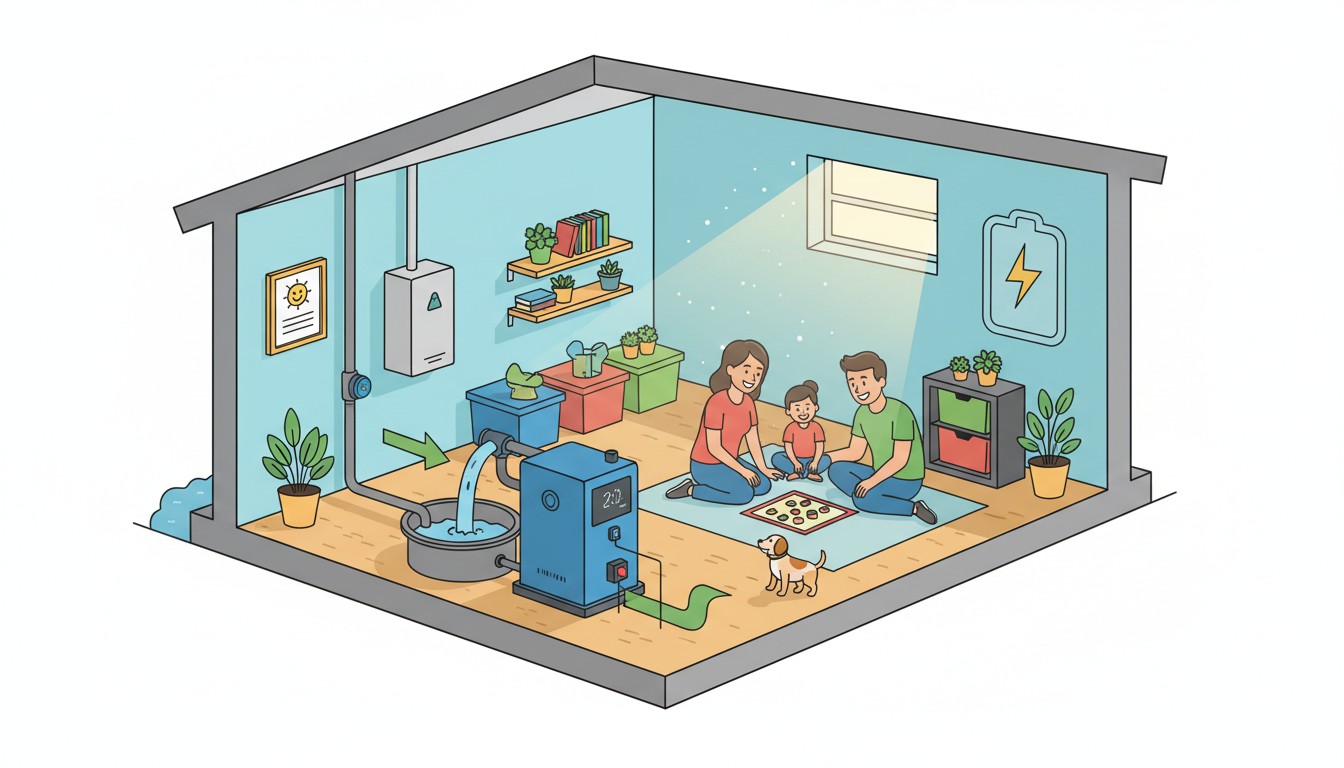
The decisions that most intimately shape your home’s flood protection aren’t made by your plumber or insurance adjuster—they’re made when you multiply pump draw by runtime and realize you’ve undersized your backup by 60%. Research from Consumer Reports shows that 73% of battery backup failures stem from inadequate battery capacity, not pump malfunction . Yet most homeowners choose systems based on price alone, not amp-hour ratings or gallons-per-hour capacity.
This selection gap creates a brutal paradox: the system that has the most direct impact on your property’s flood protection during power outages receives the least critical analysis. While we obsess over primary pump horsepower and discharge pipe sizing, the battery backup quietly determines whether your basement stays dry or becomes a swimming pool during a 3-day blackout. Understanding how these systems actually perform transforms you from a hopeful homeowner into a strategic flood prevention manager.
The Invisible Architecture: How Battery Capacity Controls Your Flood Fate
Every aspect of your backup system’s performance rests on a foundation of electrical and hydraulic calculations. The amp-hour rating of your battery, the gallons-per-hour (GPH) capacity of your backup pump, the vertical lift to your discharge point—these aren’t technical minutiae but the invisible architecture that determines whether your system runs for 3 hours or 3 days.
Consider something as fundamental as battery capacity. A 75Ah deep-cycle AGM battery provides approximately 7-8 hours of active pumping time, which translates to 2-3 days of intermittent operation at a 10% duty cycle . A 120Ah battery extends this to 12+ hours of active pumping or 4-5 days of intermittent use. The difference? A $50 price increase for the larger battery versus a $10,000 basement remediation cost when the smaller battery dies at hour 9 of a 48-hour storm . This single specification determines your system’s endurance during extended outages.
The cumulative effect of these micro-decisions creates macro-outcomes. A homeowner who matches their backup pump’s GPH to their primary pump (say, 1,500 GPH) and pairs it with a 100Ah battery can handle continuous water influx for days. A homeowner who buys a 800 GPH backup pump with a 75Ah battery may find their system overwhelmed during heavy storms, running continuously and depleting the battery in hours rather than days. The difference isn’t luck—it’s the presence or absence of systems thinking about capacity and runtime.
The Backup Decision Tree: What Controls Your Flood Protection
Battery-Powered Backup: Most common, 12V deep-cycle battery, 800-2,000 GPH capacity, $200-$500, requires battery replacement every 5-7 years
Combo Units: Primary pump + backup in one system, single discharge line, $300-$600, simplified installation, higher upfront cost
Water-Powered Backup: Uses municipal water pressure (no electricity), 300-1,000 GPH, unlimited runtime, requires potable water connection, wastes 2-3 gallons per gallon pumped
Battery Types: AGM ($150-$400, maintenance-free, 5-7 year life), Gel ($100-$250, vibration-resistant), Flooded Lead-Acid ($100-$250, requires maintenance, 3-5 year life)
Capacity Formula: Battery Ah × 0.85 (depth of discharge) ÷ Pump draw (amps) = Runtime hours
The Psychology of Backup Failure: Why We Undersize and Hope
If battery backup sizing is so straightforward, why do homeowners consistently choose inadequate systems? The answer lies in a combination of price tunnel vision, optimism bias about power outage duration, and a false economy that underestimates the cost of a flooded basement.
The Price Tunnel: Saving $50 Costs $10,000
A 75Ah battery costs $150-$200. A 120Ah battery costs $200-$250. That $50 savings feels significant at checkout. What it buys you is 40% less runtime during the exact scenario where runtime equals property protection. The average flooded basement costs $10,000-$25,000 to remediate . The $50 “savings” represents 0.3% of your potential loss. Yet the price tunnel vision focuses on immediate cost while ignoring catastrophic risk.
The Optimism Bias: “Outages Never Last That Long”
Homeowners consistently underestimate outage duration. They think “our power never goes out for more than a few hours.” Then a hurricane, ice storm, or utility failure causes a 3-day blackout. The 75Ah battery that seemed adequate for “typical” outages fails at hour 12, and water rises. The Department of Energy reports that weather-related outages are increasing in duration, with an average of 7.8 hours in 2022 and some lasting days . Proper sizing must account for worst-case scenarios, not averages.
The Maintenance Delusion: “Set It and Forget It”
Battery backup systems require maintenance—checking terminals for corrosion, testing batteries annually, replacing every 5-7 years (AGM) or 3-5 years (flooded lead-acid) . Yet homeowners install them and literally forget they exist until the power fails. A battery left untested for 3 years may have only 50% capacity remaining. A battery that sits without charging for months sulfates and becomes unusable. The “set it and forget it” mindset is the fastest path to discovering your backup is worthless when you need it most.
Pre-Installation Intelligence: The Assessment That Prevents Disaster
1. Water Influx Reality Check
Determine your worst-case water influx:
- Moderate seepage: 200-500 GPH influx—800 GPH backup sufficient
- Heavy groundwater: 800-1,200 GPH influx—need 1,500+ GPH backup
- Spring/high water table: 1,500+ GPH influx—need 2,000+ GPH backup
Test during heavy rain: measure how many inches your pit fills per minute. A 24-inch diameter pit holds 23 gallons per foot of depth. If water rises 6 inches in 1 minute, that’s 11.5 GPM = 690 GPH .
2. Vertical Lift Calculation
Measure from the bottom of your sump pit to the discharge point outside. A pump rated at 2,000 GPH at 0 feet lift may only deliver 1,200 GPH at 10 feet of lift . Always size based on GPH at your actual lift height, not maximum rating.
3. Runtime Requirements
Be honest about outage duration risk:
- Storm-prone areas: Plan for 3-5 day outages = 120Ah minimum
- Reliable grid: Plan for 1-2 day outages = 100Ah sufficient
- Intermittent operation: 7-8 hours active pumping = 2-3 days intermittent
The Sizing Checklist (Do This First)
Water Influx: Test during heavy rain, calculate GPH (gallons per hour)
Vertical Lift: Measure from pit bottom to discharge point—size GPH at this lift height
Battery Capacity: 100Ah minimum for 2-day protection, 120Ah+ for 3-5 day protection
Pump GPH: Match or exceed primary pump capacity at your lift height
Pit Space: Measure diameter—combo units need 18″+ diameter to fit both pumps
The Installation Execution: DIY vs Professional Reality
Battery-Powered Backup: Moderate DIY Project
Installation typically takes 2-4 hours for DIYers with basic plumbing knowledge :
- Mount backup pump in sump pit alongside primary pump (some systems hang from discharge pipe)
- Connect to existing discharge pipe using check valve and Y-fitting (critical—prevents backflow)
- Install float switch 2-3 inches above primary pump’s activation point
- Connect battery cables and install battery box (must be vented if using flooded lead-acid)
- Test system by unplugging primary pump and filling pit with hose
Combo Units: Professional Recommended
Since combo units replace your primary pump, professional installation ($200-$400) is recommended to ensure correct positioning and prevent warranty issues . The plumber will:
- Remove existing pump and clean pit
- Install combo unit with proper elevation for both pumps
- Connect to existing discharge with proper check valves
- Test both primary and backup operation
Water-Powered Backup: Professional Required
Requires cutting into potable water line and installing backflow preventer to protect drinking water. Must comply with local plumbing codes. Professional installation required ($300-$500) .
Maintenance: The Monthly Ritual That Saves $10,000
A battery backup requires minimal but critical maintenance. Skip it and your $500 system becomes a $0 system when you need it.
Battery Replacement: The Non-Negotiable Schedule
Even maintenance-free AGM batteries degrade. Mark installation date on battery and set calendar reminder:
- AGM batteries: Replace every 5-7 years
- Flooded lead-acid: Replace every 3-5 years
- Gel batteries: Replace every 4-6 years
- Lithium-ion: Replace every 7-10 years (premium systems only)
Pro tip: Replace batteries proactively before they fail. A failed battery during a storm is worthless. Budget $150-$300 every 5 years as insurance .
Real-World Performance: Systems That Saved and Systems That Failed
The 120Ah AGM System That Survived a 4-Day Blackout
A homeowner in Michigan installed a 1,500 GPH backup pump with a 120Ah AGM battery after calculating their 1,000 GPH water influx during heavy rain. During a January ice storm that knocked out power for 4 days, the backup ran intermittently, pumping approximately 3,000 gallons total. The battery still had 30% charge remaining when power returned. Total investment: $450. Total damage: $0. The key: oversizing capacity by 50% for worst-case scenarios.
The 75Ah Budget System That Failed at Hour 12
A homeowner in Ohio bought the cheapest 800 GPH backup with a 75Ah battery for $220. During a 36-hour thunderstorm event, the battery died at hour 12. The basement took on 4 inches of water before power returned, destroying carpet, drywall, and stored items. Total “savings” on the smaller system: $230. Total damage: $12,000. The battery simply didn’t have enough capacity for the extended storm.
The Combo Unit That Eliminated Worries
A homeowner in Kansas replaced their aging primary pump with a combo unit featuring a 2,000 GPH primary and 1,500 GPH backup sharing a 100Ah AGM battery. The professional installation cost $650. Five years later, the primary pump failed during a storm and the backup seamlessly took over. The homeowner received a smartphone alert, arranged pump replacement the next day, and the basement stayed dry. The integrated system’s smart monitoring prevented a crisis.
Smart Features: When Technology Justifies the Cost
WiFi-enabled battery backups ($400-$700) provide real-time monitoring via smartphone apps . Features include:
- Power outage alerts: Know immediately when backup activates
- Battery status: Monitor charge level and health remotely
- Pump cycle counts: Track how many times pump runs during storm
- Maintenance reminders: Get notified when battery needs replacement
- Multiple pump monitoring: Track both primary and backup performance
During power outages, internet access may be compromised, but most systems buffer data and sync when power returns . For vacation homes or frequent travelers, smart features provide invaluable peace of mind.
Troubleshooting Common Backup Failures
Your Flood Protection Is Hiding in Plain Math
The battery backup system you’re considering isn’t just another appliance—it’s the invisible lifeline that stands between your dry basement and a $15,000 flood disaster during the exact moment when the power grid fails you. The capacity calculations aren’t complex physics reserved for engineers. They’re simple multiplication that transforms gallons per hour and amp-hours into days of protection.
Your power to get this right doesn’t depend on plumbing expertise or electrical engineering degrees. It depends on one thing: your willingness to measure your water influx, verify your vertical lift, and choose capacity that handles worst-case scenarios rather than average ones. The storm will come whether you’re prepared or not. The power will fail whether your backup is adequate or not. You can be the homeowner whose basement stays dry through a 4-day blackout, or you can be the one posting photos of water damage on social media.
The choice is yours. Start now. Test your pit during the next heavy rain. Calculate your actual GPH needs. Buy the 120Ah battery instead of the 75Ah. Your flood protection journey begins with a single decision to stop hoping—and to start engineering.
Key Takeaways
Battery capacity (amp-hours) and pump GPH at your actual lift height are the critical specifications that determine runtime and flood protection capability .
Cognitive biases like price tunnel vision and optimism bias cause 73% of homeowners to undersize systems, leading to backup failures during multi-day outages .
AGM batteries ($150-$400) offer the best value for most homeowners—maintenance-free, 5-7 year lifespan, and superior performance versus flooded lead-acid .
Maintenance is critical—monthly testing, quarterly terminal cleaning, annual voltage testing, and proactive replacement every 5-7 years prevents failure when needed .
Smart WiFi-enabled systems ($400-$700) provide real-time monitoring and alerts, invaluable for vacation homes or frequent travelers who need remote peace of mind .