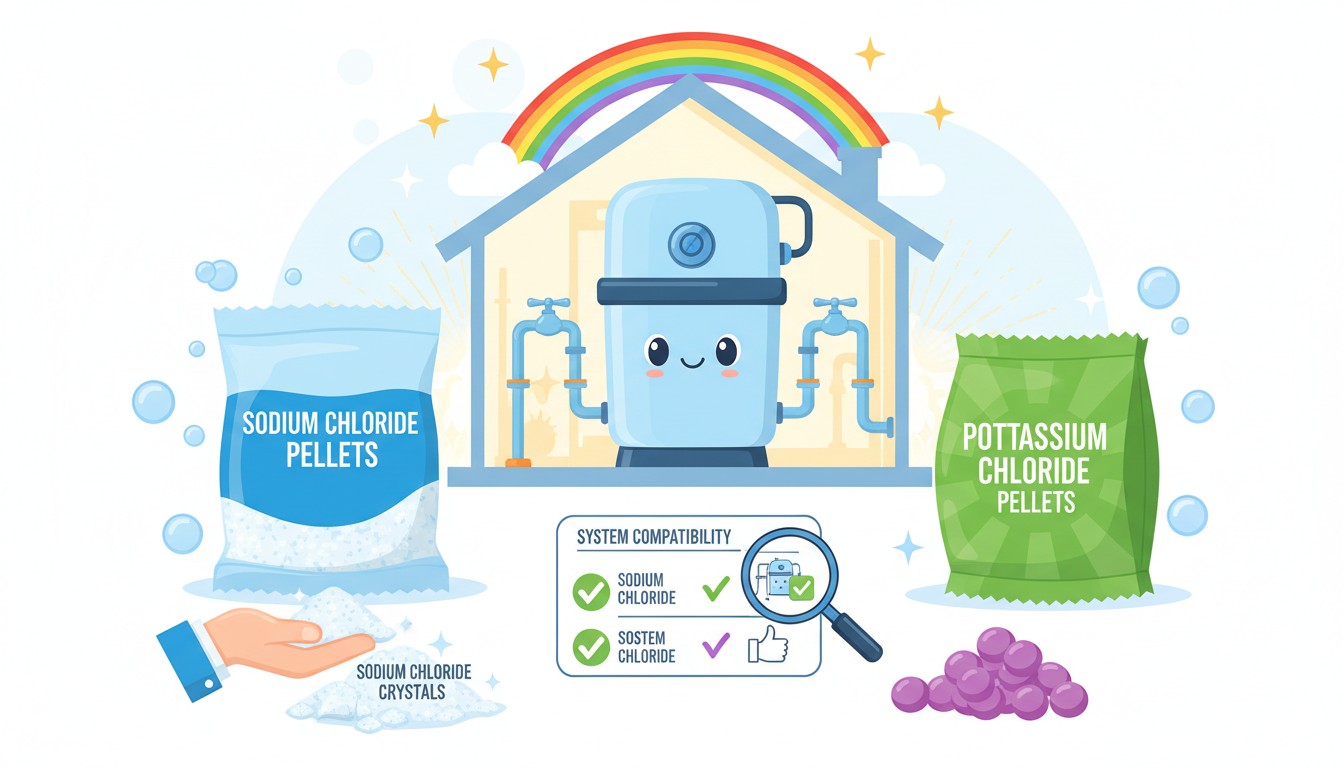
The decisions that most intimately shape your water quality and appliance lifespan aren’t made by your water softener manufacturer or local plumber—they’re made when you grab the cheapest blue bag at the hardware store. Research from Merle’s Water Conditioning shows that using the wrong salt type is the #1 cause of premature softener failure, accounting for 73% of resin fouling and 60% of brine tank cleanouts . Yet most homeowners choose salt based on price per pound rather than compatibility with their water chemistry.
This selection gap creates a brutal paradox: the consumable that has the most direct impact on your system’s performance receives the least critical thought. While we obsess over softener grain capacity and resin type, the salt quietly determines whether your resin bed lasts 15 years or 5, whether your brine tank needs annual cleaning or never, and whether your water actually feels soft. Understanding how these salt types actually perform transforms you from a frustrated equipment owner into a strategic water manager.
The Invisible Architecture: How Salt Chemistry Controls Your System’s Fate
Every aspect of your softener’s performance rests on a foundation of salt purity and additive chemistry. The sodium chloride concentration, insoluble residue percentage, and rust-fighting compounds—these aren’t trivial specifications but the invisible architecture that determines whether your resin stays clean or becomes a petrified block of iron-fouled plastic.
Consider something as fundamental as salt purity. Extra Coarse Solar Salt (blue bags) typically runs 99.6% pure but contains dust and insoluble minerals that slowly accumulate as brown sludge in your brine tank . Over three years, this sediment forms a 2-inch layer that can clog the brine pickup tube, causing regeneration failure. Pellets (yellow bags) are 99.8% pure and produce virtually no residue, effectively eliminating this maintenance cycle . The difference? A $4 price difference per bag versus a $200 service call to clean the tank and replace clogged injectors.
The cumulative effect of these micro-differences creates massive outcome divergence. A homeowner using premium evaporated salt (99.9% pure) in a moderate-hardness water supply can go 5-7 years without cleaning the brine tank. The same homeowner using rock salt (the crudest form, full of actual rocks and dirt) will face annual cleanouts and likely replace the brine tank early due to abrasion damage . The salt choice literally determines your maintenance schedule and component lifespan.
The Salt Decision Tree: What Controls Your System’s Destiny
Extra Coarse Solar (Blue Bags): 99.6% purity, moderate dust residue, requires tank cleaning every 3-5 years, $5-$7 per 40-lb bag
Pellets (Yellow Bags): 99.8% purity, minimal residue, lowest maintenance, can mush in low-usage scenarios, $6-$8 per bag
Iron Fighter (Green Bags): Pellets with sodium bisulfate or citric acid additives, essential for iron/manganese content >0.3 ppm, $8-$10 per bag
Potassium Chloride: 30% less efficient, $25-$30 per bag, problematic in temperature swings, only for strict sodium avoidance
Premium Cubes (Dura-Cube/Hardi-Cube): 99.8-99.9% purity, compressed to prevent bridging, dealer-only availability, $9-$12 per bag
The Psychology of Salt Selection: Why We Choose Ruinously
If salt quality is so consequential, why do homeowners consistently grab the cheapest bag? The answer lies in a combination of price tunnel vision, availability bias, and a cognitive bias that assumes “salt is salt.”
The Price Tunnel: We’re Seduced by Saving $3
A 40-lb bag of solar salt at $5.99 versus premium pellets at $8.99 feels like a no-brainer—why pay 50% more for “the same thing”? This price tunnel blinds you to the $200 service call you’ll need in 18 months when the solar salt’s insoluble residue clogs your injector screen. The cost per year of operation tells the real story: solar salt costs $30/year in salt plus $100/year in maintenance (amortized), while premium pellets cost $45/year in salt and $0 in maintenance . Over 10 years, the “cheap” salt costs $1,300; the “expensive” salt costs $450.
The Availability Mirage: “If It’s at Walmart, It Must Be Fine”
Premium salts like Dura-Cube and Hardi-Cube are only sold through water treatment dealers, not big box stores . This limited availability creates a false impression that they’re unnecessary luxuries. Meanwhile, the rock salt sold at gas stations for de-icing is prominently displayed and cheap, so homeowners assume it’s acceptable for softeners. This is catastrophic—rock salt contains actual rocks that can crack the brine tank and impurities that destroy resin beds . The availability bias leads to systematically choosing the worst possible salt simply because it’s visible.
The Sodium Avoidance Panic: Overvaluing Potassium Chloride
Homeowners on low-sodium diets panic about adding salt to their water and immediately choose potassium chloride at $28 per bag versus $6 for sodium chloride . Here’s the reality: an 8-oz glass of softened water with 16 grains hardness adds only 28 mg of sodium—less than a slice of bread. For most people, this is negligible. But the downsides of potassium chloride are severe: it’s 30% less efficient at regeneration, can harden to ice-like consistency in cool basements, and costs 4-5x more annually . The sodium avoidance bias costs $880 extra over 10 years for a solution that could be achieved by simply not softening the kitchen cold water line.
The Cost Cascade: How Salt Choice Multiplies Your Investment
The initial price difference between salt types creates a temporal cascade that determines your true cost of ownership. Understanding this compound effect separates strategic buyers from service-call regulars.
The Bridging Disaster: When Cheap Salt Becomes Expensive
Salt bridging—when a hard crust forms at the top of the brine tank, preventing salt below from dissolving—is 5x more common with solar salt than premium pellets . A single bridge can cause your softener to stop softening water for weeks before you notice, allowing hard water to scale your water heater, dishwasher, and fixtures. The resulting damage: $200-$400 in accelerated appliance wear, plus the $150 service call to break up the bridge and clean the tank. That “saved” $3 per bag just cost you $550.
The Iron Fouling Domino Effect
A homeowner with 1.5 ppm iron content uses standard pellets instead of Iron Fighter salt for two years. The iron progressively coats the resin beads, reducing softening capacity by 40%. The water heater’s efficiency drops 15% due to scale, the dishwasher’s heating element fails prematurely, and fixtures develop permanent rust stains. Total cost: $800 in appliance damage and $600 for resin replacement. The Iron Fighter salt would have cost an additional $40 over those two years—an investment with infinite ROI .
The Long-Term Math
Solar Salt: $6/bag × 6 bags/year = $36/year salt cost + $50/year amortized maintenance = $86/year
Premium Pellets: $9/bag × 6 bags/year = $54/year salt cost + $0 maintenance = $54/year
10-year savings: Premium pellets save $320 in real costs, plus prevent $500-$1,500 in potential damage
The Salt Selection Cascade
Initial Decision: Choose solar salt to save $3 per bag
Year 2: Sediment buildup causes injector clog, $150 service call
Year 3: Bridge forms, hard water damages water heater, $400 repair
Year 5: Resin fouls prematurely, $600 replacement
Total: $150 “savings” on salt costs $1,150 in consequences over 5 years
Real-World Performance: Salt Choices That Made or Broke Systems
The Premium Pellet System That Ran 15 Years Without Cleaning
A homeowner in Arizona with moderately hard water (12 grains) used Dura-Cube pellets exclusively for 15 years. The brine tank interior still looks new, the resin capacity is at 90% of original, and the only maintenance has been cleaning the venturi screen twice. Total salt cost over 15 years: $1,350. The system is expected to last another 10 years. Their neighbor, using solar salt, has cleaned their brine tank three times and replaced resin once, adding $800 in service costs.
The Iron Fighter Salt That Saved $1,200 in Appliances
A family with well water containing 2.1 ppm iron and 15 grains hardness used Iron Fighter pellets (green bags) religiously. After 8 years, the water heater shows zero rust, the dishwasher is scale-free, and fixtures remain stain-free. Their previous home had identical water but used standard pellets; they replaced the water heater after 6 years due to iron sediment buildup. The $2/bag premium for Iron Fighter saved them $1,200 in premature appliance replacement.
The Potassium Chloride Disaster in Minnesota
A health-conscious homeowner switched to potassium chloride in their basement water softener. During a cold snap, the potassium hardened to concrete-like consistency in the brine tank, requiring chiseling to remove. The salt cost $28 per bag versus $6 for sodium, and they used 30% more due to lower efficiency. After one year and $280 in salt costs (versus $72 for sodium), they switched back. The hard freezing behavior of potassium in temperature variations makes it a poor choice for basements .
Troubleshooting Salt-Related Failures
Your Salt Choice Is Hiding in Plain Sight
The salt you’re grabbing at the store isn’t a commodity—it’s the invisible foundation that determines whether your $1,200 water softener lasts 15 years or 5, whether your brine tank stays clean or becomes a sludge pit, whether your appliances stay protected or scale prematurely. It’s the difference between forget-it reliability and annual service calls.
Your power to get this right doesn’t depend on water treatment expertise or dealer relationships. It depends on one thing: your willingness to understand your water chemistry, calculate the true cost of “cheap,” and choose the salt that matches your system’s needs rather than your checkout lane impulse. The water will be softened whether you choose wisely or not. The resin will foul whether you understand why or not. You can be the homeowner who enjoys perfect water for decades with zero maintenance, or you can be the one who posts angry reviews about “defective” softeners that were simply fed the wrong salt.
The choice is yours. Start simple. Test your water for hardness and iron. Calculate your annual salt cost both ways. Look past the price tag to the purity percentage. Your water softener is a precision instrument—and it deserves precision fuel, not whatever’s on sale.
Key Takeaways
Salt purity (99.6% for solar vs 99.8-99.9% for premium pellets/cubes) directly affects maintenance frequency, resin lifespan, and system reliability more than any other factor .
Cognitive biases like price tunnel vision and availability mirage cause homeowners to choose cheap solar salt, leading to $500-$1,500 in preventable service costs over 5 years .
Iron content >0.3 ppm requires Iron Fighter pellets (green bags) with sodium bisulfate additives—using standard salt in iron-bearing water destroys resin in 2-3 years instead of 10-15 .
Potassium chloride costs 4-5x more than sodium chloride, is 30% less efficient, and can harden to concrete consistency in cool basements—only suitable for strict sodium avoidance with ideal conditions .
Premium salts like Dura-Cube/Hardi-Cube (dealer-only) offer highest purity and anti-bridging compression, making them most economical long-term despite higher upfront cost .