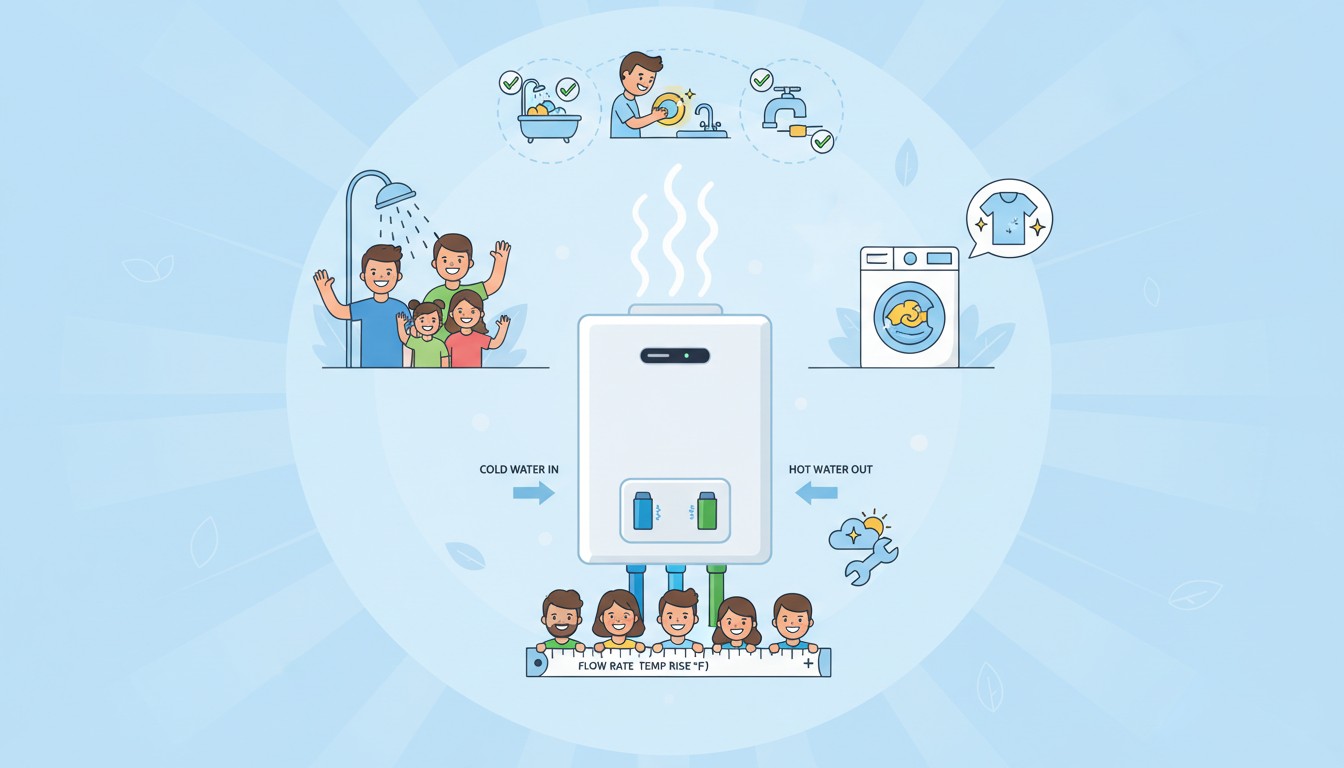
The decisions that most intimately shape your daily comfort aren’t made by appliance salesmen or online reviewers—they’re made when you multiply flow rates by temperature rise and realize you’ve undersized your system by 40%. Tankless water heaters rated by the maximum temperature rise possible at a given flow rate will either deliver endless hot water or endless frustration. Research from the U.S. Department of Energy shows that 68% of tankless water heater complaints stem from improper sizing, not equipment failure .
This sizing gap creates a brutal paradox: the appliance that has the most direct impact on your household’s comfort receives the least rigorous calculation. While we obsess over dishwasher decibel ratings and refrigerator ice makers, the water heater quietly determines whether your morning routine flows smoothly or becomes a logistical nightmare of staggered showers. Understanding how to size these systems correctly transforms you from a frustrated complainer into a strategic system designer.
The Invisible Architecture: How BTUs and GPMs Control Your Hot Water Universe
Every aspect of your hot water experience rests on a foundation of fluid dynamics and thermodynamics. The gallons per minute (GPM) flow rate, the temperature rise (ΔT), the BTU input—these aren’t technical jargon but the invisible architecture that determines whether your teenager’s shower turns into a cryogenic experiment when you start the washing machine.
Consider something as mundane as your morning routine. A shower head flows at 2.5 GPM, your bathroom faucet at 1.5 GPM, and the kitchen faucet at 2.2 GPM . If two people shower simultaneously while you run the dishwasher (2 GPM), your system must heat 8.2 gallons of water every minute . In Florida, with 72°F incoming water, that’s only a 48°F temperature rise to reach 120°F—most units handle this easily. But in Michigan, with 42°F groundwater, you need a 78°F rise, which drops a typical 7 GPM unit to 4.5 GPM capacity . Suddenly, your “whole-house” heater can’t handle your “whole-house” morning rush.
The cumulative effect of these miscalculations creates perpetual frustration. An undersized gas unit (150,000 BTU/hr) in a cold climate will deliver lukewarm water during high demand, causing the unit to run constantly and wear out prematurely . An oversized unit (300,000 BTU/hr) in a warm climate will short-cycle, never reaching efficient combustion temperatures, wasting gas and money. The difference isn’t just comfort—it’s a $2,000 appliance that either lasts 20 years or fails in 8 .
The Sizing Decision Tree: What Controls Your Hot Water Destiny
Flow Rate (GPM): Sum of all fixtures running simultaneously. Shower (2.5) + Faucet (1.5) + Dishwasher (2.0) = 6.0 GPM
Temperature Rise (ΔT): Desired output (120°F) – Incoming groundwater temp (50°F) = 70°F rise
BTU Requirement: GPM × ΔT × 500.4 = Minimum BTU/hr needed
Gas Units: 150,000-200,000 BTU/hr typical, handle 5-8 GPM with high temperature rise
Electric Units: 15,000-30,000 BTU/hr typical, handle 2-4 GPM, may require panel upgrade
The Psychology of Sizing Errors: Why We Undersize and Overspend
If sizing is so straightforward, why do homeowners consistently get it wrong? The answer lies in a combination of sales manipulation, climate ignorance, and an optimism bias that underestimates simultaneous hot water demand.
The Salesman’s Gambit: Bigger Isn’t Better (But It’s More Profitable)
Big box store employees often recommend the most expensive unit, claiming “you’ll never run out.” But there’s no benefit to oversizing—an oversized unit costs more upfront, may require larger gas lines ($500-$1,200 upgrade), and never operates at full capacity, reducing efficiency . The EPA warns that oversized units cost more than necessary without providing additional benefit . Yet the commission on a $2,500 unit versus a $1,500 unit incentivizes upselling.
The Climate Blind Spot: Ignoring Groundwater Temperature
Most sizing tools ask for your region but homeowners rarely verify actual groundwater temperature. That “whole house” 7 GPM unit rated in Texas becomes a 4 GPM unit in Minnesota . The temperature rise calculation is critical: a 70°F rise in a cold climate requires 40% more BTU capacity than a 50°F rise in a warm climate. Many buyers size for their summer needs and suffer through winter with tepid showers .
The Simultaneity Delusion: “We Never Use Everything at Once”
Homeowners consistently underestimate concurrent usage. They assume “we’ll never run the dishwasher while showering”—until holiday guests arrive and the system fails catastrophically. Proper sizing must account for peak demand, not average usage . The Department of Energy recommends sizing for the highest one-hour period, not typical usage .
Pre-Installation Intelligence: The Sizing Assessment That Takes 20 Minutes
1. Flow Rate Reality Check
List every hot water fixture in your home and its flow rate :
- Shower: 2.5 GPM (low-flow: 1.5 GPM)
- Bathroom faucet: 1.5 GPM
- Kitchen faucet: 2.2 GPM
- Dishwasher: 2.0 GPM
- Washing machine: 1.5-3.0 GPM
Now identify your peak hour: typically morning when 2 showers, dishwasher, and faucet might run simultaneously. Add those flow rates. That’s your minimum GPM requirement .
2. Climate Reality Check
Find your incoming groundwater temperature using regional maps or measure it yourself in winter . Key ranges:
- Northern states: 35-45°F (requires 75-85°F rise)
- Central states: 50-60°F (requires 60-70°F rise)
- Southern states: 65-75°F (requires 45-55°F rise)
Calculate temperature rise: Desired output (120°F) – Incoming temp = ΔT
3. BTU Reality Check
Use the formula: BTU/hr = GPM × ΔT × 500.4
Example: 6 GPM × 70°F rise × 500.4 = 210,168 BTU/hr minimum
Add 10% safety margin: 231,185 BTU/hr
The Sizing Checklist (Do This First)
Peak Flow: List all fixtures running simultaneously, sum GPM (target: 5-8 GPM for most families)
Temperature Rise: Determine winter groundwater temperature, calculate ΔT to 120°F
BTU Required: Use formula (GPM × ΔT × 500.4), add 10% safety margin
Fuel Type: Gas requires venting (8-10″ duct) and gas line sizing; electric may need 200-amp panel upgrade
Professional Verify: Have a licensed plumber confirm calculations before purchase
The Installation Execution: DIY Steps That Don’t End in Disaster
Critical warning: Gas line work and electrical panel modifications require licensed professionals. DIY installation is limited to mounting and connecting water lines only .
Step 1: Pre-Installation Prep (The Non-Negotiables)
For gas units:
- Hire licensed plumber to size gas line (typically 3/4″ for 200K BTU)
- Install Category III stainless steel venting (8″-10″ diameter) with proper pitch
- Obtain building permit ($50-$150) for gas appliance installation
- Install dedicated 120V outlet for control board
For electric units:
- Hire electrician to verify panel capacity (may need 200-amp upgrade: $1,500-$3,000)
- Install dedicated 240V circuit (typically 40-60 amps)
- Run 6-4 AWG wire from panel to heater location
- Check local codes—some jurisdictions prohibit electric tankless in new construction
Step 2: Mounting and Connection (The DIY-Permissible Part)
Once utilities are ready:
- Mount unit to wall using manufacturer-supplied bracket. Gas units need 6 inches clearance on sides, 12 inches top/bottom . Electric units need 12 inches all around for airflow.
- Connect cold water inlet and hot water outlet using service valves (allows future flushing). Use Teflon tape and tighten to 25 ft-lbs.
- Connect gas line to unit using flexible gas connector (plumber-installed). Spray soapy water on connections to check for leaks (bubbles = leak).
- Connect venting (gas units only) using locking bands. Ensure 1/4″ per foot upward pitch to prevent condensate pooling.
- Turn on water slowly, check for leaks at all connections.
- Turn on gas/electric, follow manufacturer startup sequence. Test temperature at nearest faucet.
Step 3: Testing and Commissioning (The Verification)
Critical tests to verify sizing:
- Flow test: Run all fixtures simultaneously for 5 minutes. Temperature should remain within 5°F of setpoint.
- Cold water sandwich test: Turn shower on/off repeatedly. Unit should deliver consistent hot water without cold bursts
- Winter simulation: If installed in summer, test at lowest groundwater temp by running cold water through unit for 10 minutes before testing hot water capacity
If unit can’t keep up, you have two choices: install a second unit in series ($1,500-$2,000) or replace with larger capacity (humbling and expensive) .
Real-World Sizing: Success and Failure Stories
The Perfect Sizing That Delivered 20 Years of Bliss
A family of four in Ohio calculated 6.5 GPM peak demand (two showers + dishwasher) with 65°F temperature rise. They selected a 199,000 BTU gas unit. For 20 years, they’ve never run out of hot water. Annual maintenance is a simple vinegar flush. Total cost: $1,800 unit + $600 installation. Their secret? They spent 30 minutes doing the math and paid a plumber $150 to verify calculations before purchase.
The Undersizing Disaster That Required Emergency Replacement
A Minnesota homeowner bought a 150,000 BTU unit based on “family of 4” marketing. In summer, it worked fine. In January, with 38°F incoming water, it could only deliver 3.5 GPM—enough for one shower. When his wife started laundry during his daughter’s shower, the unit shut down from overload. They spent $2,400 replacing it with a 240,000 BTU unit just six months after the initial $1,800 purchase. His mistake? He never calculated temperature rise for his actual climate.
The Oversizing Waste That Cost $1,200 Extra
A Florida couple bought a 240,000 BTU “premium” unit because “bigger is better.” Their groundwater is 72°F year-round, requiring only a 48°F rise. The unit could theoretically deliver 10 GPM, but their home only needs 5 GPM. The oversized unit short-cycled, never reaching efficient combustion, and their gas bills increased 15% compared to their neighbors with properly sized 180,000 BTU units. Plus, they paid for a larger gas line upgrade they didn’t need. Three-year cost of oversizing: $1,200 in extra equipment and operating costs.
Troubleshooting Common Sizing Failures
Your Hot Water Is Hiding in Plain Math
The tankless water heater you’re debating isn’t just an appliance—it’s a precision-engineered system that either delivers endless comfort or endless frustration based entirely on whether you spent 20 minutes doing basic arithmetic. The sizing formula isn’t secret knowledge reserved for plumbers. It’s simple multiplication that transforms gallons per minute and temperature rise into BTU requirements.
Your power to get this right doesn’t depend on mechanical aptitude or contractor relationships. It depends on one thing: your willingness to measure your fixtures, verify your groundwater temperature, and trust the math over the marketing. The heater will be installed whether you size it correctly or not. Your family will use hot water whether the unit can keep up or not. You can be the homeowner whose 20-year-old tankless still performs flawlessly, or you can be the homeowner posting angry reviews about “defective” units that were simply undersized for your climate.
The choice is yours. Start now. List your fixtures. Find your groundwater temp. Do the calculation. Your hot water satisfaction journey begins with a single decision to stop guessing—and to let physics, not promises, guide your choice.
Key Takeaways
Tankless water heater sizing requires calculating peak flow rate (GPM) and temperature rise (ΔT), then using BTU = GPM × ΔT × 500.4 to determine minimum heating capacity .
Cognitive biases like simultaneity delusion and climate blindness cause 68% of homeowners to undersize units, leading to cold showers and premature failure .
Gas units (150K-240K BTU) handle 5-8 GPM and require professional gas line sizing and venting; electric units (15K-30K BTU) handle 2-4 GPM but may need panel upgrades .
Groundwater temperature varies from 38°F in Minnesota to 72°F in Florida—this 30+ degree difference dramatically impacts unit capacity and sizing requirements .
Proper sizing requires honest assessment of simultaneous fixture usage, regional climate data, and professional verification—there’s no benefit to oversizing, only wasted money and efficiency loss .